Opinion - (2025) Volume 21, Issue 5
Received: 01-Sep-2025, Manuscript No. jos-26-185175;
Editor assigned: 03-Sep-2025, Pre QC No. P-185175;
Reviewed: 17-Sep-2025, QC No. Q-185175;
Revised: 22-Sep-2025, Manuscript No. R-185175;
Published:
29-Sep-2025
, DOI: 10.37421/1584-9341.2024.20.224
Citation: Osei, Kevin. ”Imaging’s Role in Achieving Clear Oncologic
Resection Margins.” J Surg 21 (2025):224.
Copyright: © 2025 Osei K. This is an open-access article distributed under the terms of the Creative Commons Attribution License, which permits unrestricted use, distribution
and reproduction in any medium, provided the original author and source are credited.
The precision of preoperative imaging plays a pivotal role in the successful execution of oncologic resections, directly influencing the attainment of clear surgical margins and ultimately impacting patient prognoses. Enhanced imaging capabilities facilitate a more accurate definition of tumor extent, thereby enabling surgeons to develop optimal resection strategies and potentially decrease the incidence of positive margins. This improvement in surgical outcomes can contribute to better patient results and a reduction in oncologic recurrences. The Department of General Surgery at the University of Cape Coast acknowledges the vital connection between diagnostic accuracy and surgical effectiveness in cancer management [1].
Advanced imaging modalities, including MRI and PET-CT, provide superior visualization of tumor boundaries and their critical relationships with adjacent vital structures. This detailed preoperative mapping is indispensable for guiding surgical dissection, particularly in intricate cases, and is crucial for achieving the negative margins necessary for oncologic control. A deliberate focus on these technologies is paramount for surgical departments striving to optimize cancer treatment protocols [2].
Significant discrepancies can arise between preoperative imaging assessments and intraoperative findings, presenting substantial challenges in achieving complete tumor eradication. Bridging this informational gap through enhanced interpretation of imaging data and its seamless integration into surgical decision-making processes is a primary objective for improving oncologic outcomes. The incorporation of such advanced interpretation strategies is a stated priority within contemporary surgical practice [3].
The continuous development and deployment of novel imaging techniques, such as diffusion-weighted MRI and contrast-enhanced ultrasound, hold considerable promise for more effectively characterizing tumor margins and refining preoperative surgical planning. These technological innovations are directly aligned with the overarching goal of achieving more precise and accurate oncologic resections in clinical practice [4].
Radiomics, a field focused on extracting quantitative features from medical images, is emerging as a valuable tool for predicting tumor invasiveness and informing surgical resection strategies. The meticulous analysis of radiomic data has the potential to significantly refine preoperative assessments, thereby increasing the probability of achieving clear surgical margins and improving the overall success of cancer surgery [5].
Multidisciplinary tumor boards serve a critical function in the comprehensive integration of preoperative imaging findings with detailed pathological and clinical data to formulate the most effective surgical plans. This collaborative approach is absolutely essential for maximizing the likelihood of achieving negative margins and enhancing patient outcomes, especially in the context of complex oncologic cases requiring nuanced treatment strategies [6].
The ongoing evolution of imaging technology, encompassing significant advancements in AI-powered image analysis, presents promising opportunities for elevating the accuracy of tumor detection and characterization. Such technological progress is indispensable for refining preoperative strategies and achieving superior results in oncologic resections, underscoring the dynamic nature of modern cancer care [7].
It is imperative to thoroughly understand the inherent limitations of preoperative imaging within specific tumor types and anatomical locations. Surgeons must remain cognizant of potential ambiguities and proactively integrate this knowledge with intraoperative assessments to ensure the complete removal of tumor tissue and minimize the risk of positive surgical margins, thereby safeguarding patient well-being [8].
The integration of intraoperative imaging techniques, such as real-time ultrasound or augmented reality systems, can effectively complement traditional preoperative imaging by offering dynamic guidance during surgical procedures. This real-time feedback loop assists surgeons in precisely confirming tumor resection margins, leading to a notable improvement in the overall accuracy and efficacy of the operative intervention [9].
A critical step towards ensuring consistency and accuracy in oncologic imaging involves the standardization of protocols for both the interpretation and reporting of preoperative imaging studies across various healthcare institutions. Such standardization fosters improved communication channels between radiologists and surgeons, which is fundamental to enhancing the quality and reliability of oncologic resections [10].
The accuracy of preoperative imaging is a cornerstone in the successful execution of oncologic resections, directly impacting the achievement of clear surgical margins. Improved imaging allows for a more precise delineation of tumor extent, aiding surgeons in planning optimal resection strategies and potentially reducing positive margin rates. This, in turn, can lead to better patient outcomes and fewer oncologic recurrences. The Department of General Surgery at the University of Cape Coast recognizes the critical link between diagnostic precision and surgical efficacy in cancer care [1].
Advanced imaging modalities, such as MRI and PET-CT, offer enhanced visualization of tumor boundaries, including critical relationships with adjacent vital structures. This detailed preoperative mapping is instrumental in guiding surgical dissection, particularly in complex cases, and contributes to achieving the negative margins essential for oncologic control. A focus on these technologies is crucial for surgical departments aiming to optimize cancer treatment [2].
Discrepancies between preoperative imaging findings and intraoperative realities can lead to challenges in achieving complete tumor removal. Bridging this gap through improved imaging interpretation and integration into surgical decision-making is a key area of focus for enhancing oncologic outcomes. Such integration is a priority in surgical practice [3].
The development and implementation of novel imaging techniques, such as diffusion-weighted MRI and contrast-enhanced ultrasound, hold promise for better characterizing tumor margins and improving preoperative planning. These innovations directly support the goal of achieving more accurate oncologic resections [4].
The impact of radiomics, which extracts quantitative features from medical images, on predicting tumor invasiveness and guiding surgical resection strategies is an emerging area. Accurate radiomic analysis can potentially refine preoperative assessments and improve the likelihood of achieving clear margins [5].
Multidisciplinary tumor boards play a vital role in integrating preoperative imaging findings with pathological and clinical data to formulate optimal surgical plans. This collaborative approach is essential for maximizing the chances of achieving negative margins and improving patient outcomes in complex oncologic cases [6].
The ongoing evolution of imaging technology, including advancements in AI-powered image analysis, offers exciting possibilities for enhancing the accuracy of tumor detection and characterization. Such advancements are critical for refining preoperative strategies and achieving superior oncologic resection results [7].
Understanding the limitations of preoperative imaging in specific tumor types and locations is crucial. Surgeons must be aware of potential ambiguities and integrate this knowledge with intraoperative assessment to ensure complete tumor removal and minimize the risk of positive margins [8].
The integration of intraoperative imaging techniques, such as ultrasound or augmented reality, can complement preoperative imaging by providing real-time guidance during surgery. This can help surgeons confirm tumor resection margins and improve the accuracy of the procedure [9].
Standardizing protocols for preoperative imaging interpretation and reporting across different institutions is essential for ensuring consistency and accuracy. This standardization facilitates better communication between radiologists and surgeons, ultimately improving the quality of oncologic resections [10].
The accuracy of preoperative imaging significantly influences the success of oncologic resections, directly impacting the achievement of clear surgical margins. Advanced imaging modalities like MRI and PET-CT enhance tumor boundary visualization, aiding surgical planning and improving oncologic control. Discrepancies between preoperative imaging and intraoperative findings pose challenges, necessitating improved interpretation and integration into surgical decisions. Novel techniques such as diffusion-weighted MRI and contrast-enhanced ultrasound promise better tumor margin characterization. Radiomics offers quantitative image analysis for predicting invasiveness and guiding resection. Multidisciplinary tumor boards are crucial for integrating imaging with other data to optimize surgical plans. AI-powered image analysis is advancing tumor detection and characterization. Understanding imaging limitations and integrating this with intraoperative assessment is vital. Intraoperative imaging techniques complement preoperative planning by providing real-time guidance. Standardizing imaging interpretation and reporting ensures consistency and accuracy, fostering better communication and improved oncologic resections.
None
None
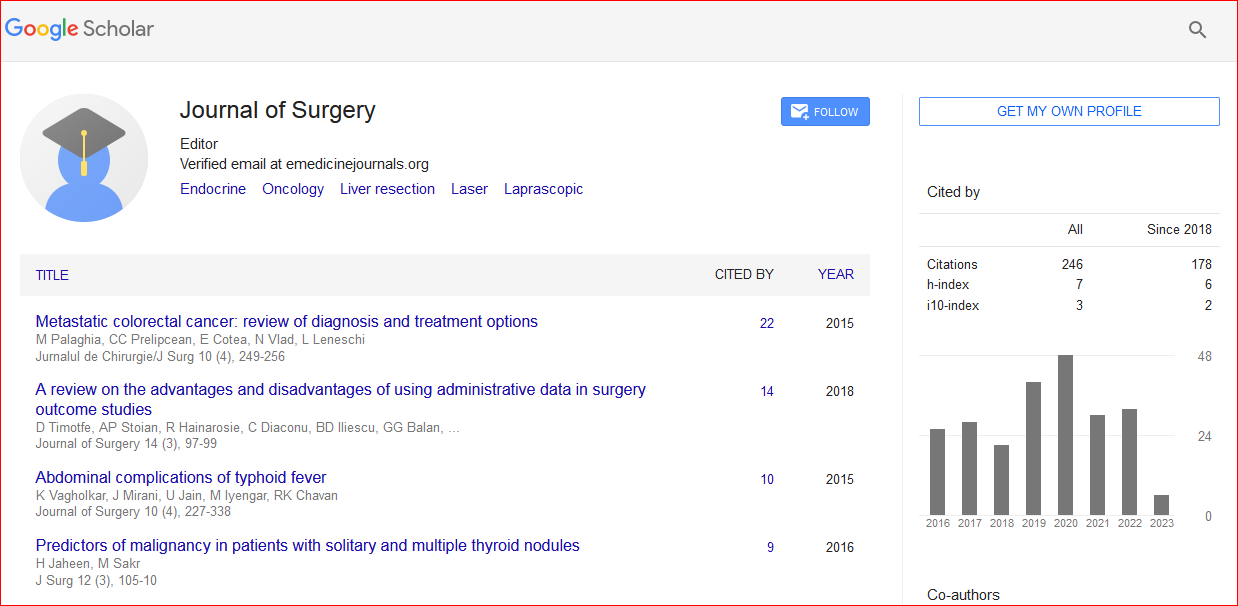
Journal of Surgery received 288 citations as per Google Scholar report