Brief Report - (2025) Volume 11, Issue 6
Received: 01-Dec-2025, Manuscript No. icoa-25-178179;
Editor assigned: 03-Dec-2025, Pre QC No. P-178179;
Reviewed: 17-Dec-2025, QC No. Q-178179;
Revised: 22-Dec-2025, Manuscript No. R-178179;
Published:
29-Dec-2025
, DOI: 10.37421/2469-9756.2025.11.330
Citation: Deshmukh, Priyanka. ”IHC: Diagnosis, Prognosis and Targeted Therapy Advances.” Immunochem Immunopathol 11 (2025):330.
Copyright: © 2025 Deshmukh P. This is an open-access article distributed under the terms of the Creative Commons Attribution License, which permits unrestricted use, distribution and reproduction in any medium, provided the original author and source are credited.
Immunohistochemistry (IHC) stands as a cornerstone technique in modern pathology, offering unparalleled precision in the detection and localization of specific antigens within tissue samples. This methodology, by leveraging the specificity of antibodies, allows for the direct visualization of proteins, which is indispensable for accurate disease diagnosis, prognostication, and the informed selection of therapeutic strategies, particularly in the fields of oncology and neuropathology. The continuous evolution of IHC is marked by significant advancements that enhance its sensitivity, specificity, and multiplexing capabilities, thereby facilitating a deeper comprehension of cellular and molecular pathology. As research progresses, IHC promises even greater insights into the intricate biological processes underlying various diseases. Recent innovations have extended the power of IHC into the realm of multiplexing, enabling the simultaneous detection of multiple biomarkers within a single tissue section. This sophisticated approach significantly deepens our understanding of complex biological interactions and the nuanced tumor microenvironment. By providing a more comprehensive diagnostic picture, multiplex IHC aids in the identification of novel therapeutic targets and the elucidation of intricate disease mechanisms. This holistic view is crucial for developing personalized treatment plans and advancing our knowledge of disease progression. The integration of artificial intelligence (AI) and machine learning algorithms into IHC image analysis represents a paradigm shift in the quantitative assessment of staining patterns. These advanced technologies are capable of automating laborious tasks such as cell counting, intensity scoring, and spatial distribution analysis. The application of AI in this domain leads to remarkable improvements in objectivity, reproducibility, and overall efficiency within diagnostic workflows, addressing long-standing challenges in quantitative pathology. Standardization across both the pre-analytical and analytical phases of IHC is paramount for achieving reliable and reproducible results. Meticulous attention to optimizing tissue fixation, processing techniques, antibody selection, and staining protocols is essential. These efforts are directed towards minimizing inter-laboratory and intra-laboratory variability, thereby ensuring consistent diagnostic accuracy and promoting confidence in IHC-based diagnoses. Complementary molecular techniques, such as chromogenic in situ hybridization (CISH), when synergistically employed with IHC, offer invaluable additional information. This combined approach is particularly effective for detecting gene amplification events alongside protein expression, providing a more complete picture for the assessment of solid tumors and guiding therapeutic decisions. The landscape of pathology is being reshaped by the increasing integration of digital pathology workflows. These digital platforms are facilitating remote consultation, enabling second opinions from experts worldwide, and supporting advanced computational analysis of stained slides. The digitization of IHC slides opens new avenues for collaboration and sophisticated data interpretation. Ongoing research and development efforts are focused on creating novel antibody clones and sophisticated detection systems. These advancements are crucial for enhancing the sensitivity and specificity of IHC, particularly for detecting antigens present at low abundance or subtle pathological changes that might otherwise be missed. Such improvements are vital for early and accurate diagnosis. The interpretation of IHC results demands a high level of expertise and continuous professional development. Robust ongoing training programs and stringent quality assurance measures are fundamental to maintaining diagnostic consistency and accuracy. These programs are vital for ensuring that pathologists can reliably interpret complex IHC findings across diverse clinical scenarios. IHC continues to play a pivotal role in the precise classification and subtyping of a wide array of cancers. This detailed characterization is essential for guiding the selection of targeted therapies and for accurately predicting patient outcomes. The ability of IHC to define specific molecular profiles within tumors makes it an indispensable tool in the oncological armamentarium. The pursuit of next-generation detection methodologies in IHC is driven by the goal of further pushing the boundaries of sensitivity and speed. Innovations such as nanoparticle-based IHC and advanced signal amplification techniques are at the forefront of this research, promising to revolutionize IHC analysis and its clinical applications.
Immunohistochemistry (IHC) is a pivotal technique in diagnostic pathology, employing antibodies to precisely detect specific antigens within tissue samples. This method facilitates the exact localization of proteins, which is crucial for disease diagnosis, prognosis, and the selection of appropriate treatments, especially in oncology and neuropathology. Ongoing advancements in IHC continue to enhance its sensitivity, specificity, and multiplexing capabilities, offering deeper insights into cellular and molecular pathology. This continuous improvement ensures that IHC remains a leading tool in the diagnostic arsenal. Recent breakthroughs in multiplex IHC have enabled the simultaneous detection of multiple biomarkers on a single tissue section. This approach significantly improves the understanding of complex biological interactions and the tumor microenvironment, leading to a more comprehensive diagnostic assessment and the identification of potential therapeutic targets. The ability to visualize multiple markers at once provides a richer context for disease evaluation. The application of artificial intelligence (AI) and machine learning in IHC image analysis is revolutionizing the quantitative assessment of staining. These technologies automate tasks such as cell counting, intensity scoring, and spatial distribution analysis, thereby increasing objectivity, reproducibility, and efficiency in diagnostic workflows. This computational approach promises to streamline and enhance the accuracy of IHC analysis. Standardization of the pre-analytical and analytical phases in IHC is critical for ensuring reliable and reproducible results. This involves optimizing critical steps like tissue fixation, processing, antibody selection, and staining protocols. By minimizing variability, these standardization efforts are key to maintaining diagnostic accuracy and inter-laboratory consistency. The synergistic combination of chromogenic in situ hybridization (CISH) with IHC provides complementary data for evaluating gene amplification and protein expression. This integrated approach is particularly valuable in the diagnostic assessment of solid tumors, offering a more comprehensive molecular and protein-based profile. Digital pathology workflows are increasingly incorporating IHC, facilitating remote consultations, second opinions, and advanced computational analyses of stained slides. This digital transformation enhances accessibility, collaboration, and the application of sophisticated analytical tools to IHC data. The development of novel antibody clones and detection systems is continuously improving the sensitivity and specificity of IHC. These innovations are essential for detecting antigens present at low levels or subtle pathological alterations, thereby improving the diagnostic yield of the technique. Expert interpretation of IHC results is essential, and ongoing training and quality assurance programs are vital for maintaining diagnostic consistency and accuracy. These programs ensure that pathologists are equipped with the latest knowledge and skills to interpret complex IHC findings reliably. IHC plays a crucial role in the classification and subtyping of various cancers, which directly guides the selection of targeted therapies and helps predict patient outcomes. The specific molecular information provided by IHC is indispensable for personalized cancer treatment. Research into novel detection methodologies, including nanoparticle-based IHC and advanced signal amplification techniques, aims to further enhance the sensitivity and speed of IHC analysis. These next-generation systems hold the promise of pushing the diagnostic capabilities of IHC to new levels.
Immunohistochemistry (IHC) is a vital technique for detecting specific antigens in tissue samples, aiding in disease diagnosis, prognosis, and treatment selection. Advances in multiplex IHC allow for simultaneous detection of multiple biomarkers, improving the understanding of biological interactions and tumor microenvironments. Artificial intelligence and machine learning are revolutionizing quantitative IHC image analysis by automating complex tasks, leading to increased objectivity and efficiency. Standardization of IHC protocols is crucial for reliable and reproducible results. Complementary techniques like CISH combined with IHC offer enhanced diagnostic insights. Digital pathology is integrating IHC for remote consultation and advanced analysis. Ongoing development of novel antibody clones and detection systems further improves sensitivity and specificity. Expert interpretation and quality assurance are essential for consistent diagnostic accuracy. IHC is critical for cancer classification, guiding targeted therapies, and predicting outcomes. Research into next-generation detection methods aims to further enhance IHC's sensitivity and speed.
None
None
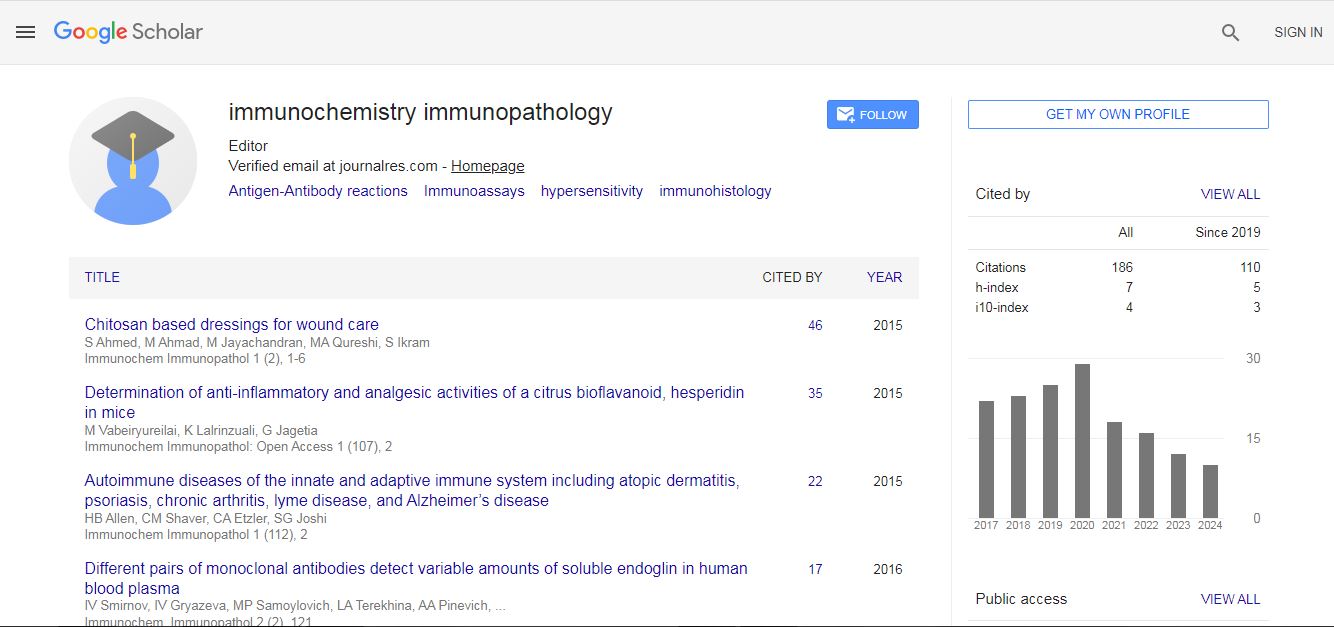
Immunochemistry & Immunopathology received 174 citations as per Google Scholar report