Perspective - (2025) Volume 17, Issue 5
Received: 01-Sep-2025, Manuscript No. jcst-25-176303;
Editor assigned: 03-Sep-2025, Pre QC No. P-176303;
Reviewed: 17-Sep-2025, QC No. Q-176303;
Revised: 22-Sep-2025, Manuscript No. R-176303;
Published:
29-Sep-2025
, DOI: 10.37421/1948-5956.2025.17.728
Citation: Eva Horvath. ”ICB: Revolutionizing Cancer, Battling
Resistance, New Avenues.” J Cancer Sci Ther 17 (2025):728.
Copyright: © 2025 H. Eva This is an open-access article distributed under the terms of the Creative Commons Attribution License, which permits unrestricted use, distribution
and reproduction in any medium, provided the original author and source are credited.
Immune checkpoint blockade (ICB) stands as a pivotal advancement in cancer therapy, offering comprehensive insights into the mechanisms of action for key agents such as anti-PD-1/PD-L1 and anti-CTLA-4. These treatments have demonstrated remarkable clinical successes across various malignancies, pushing forward the evolving landscape of immunotherapy [1].
Despite these successes, cancers often develop multifaceted resistance mechanisms to ICB, categorized into primary and acquired forms. These resistances stem from intrinsic tumor characteristics, the tumor microenvironment, and host-related factors. Overcoming these challenges is crucial, and emerging strategies include combination therapies and targeting novel pathways to improve patient outcomes [2].
The field is actively expanding beyond established targets like PD-1/PD-L1 and CTLA-4. Researchers are exploring novel immune checkpoint targets such as LAG-3, TIM-3, TIGIT, and VISTA. Understanding their roles in immune regulation and therapeutic potential is key to developing more effective, personalized treatments for patients who do not respond to current options [3].
Identifying patients most likely to benefit from ICB relies on predictive biomarkers. Established markers include PD-L1 expression, tumor mutational burden (TMB), and microsatellite instability (MSI). There are also promising new candidates under investigation, all essential for personalizing cancer immunotherapy and optimizing treatment decisions [4].
Combination therapies are gaining traction as a strategy to enhance anti-tumor responses and overcome resistance. This involves integrating ICB with other modalities like chemotherapy, radiotherapy, targeted therapies, and other immunotherapies. The aim is to leverage synergistic mechanisms while carefully managing potential toxicities [5].
However, ICB therapies are associated with immune-related adverse events (irAEs). These manifest across various organ systems, driven by distinct immunologic mechanisms. Effective management relies on early recognition and appropriate intervention, which is vital for patient safety and maximizing therapeutic benefits [6].
Emerging research highlights the profound influence of the gut microbiota on ICB efficacy. A clear correlation exists between specific microbial compositions and patient response, suggesting that modulating the gut microbiome could serve as a therapeutic strategy to improve outcomes and overcome resistance [7].
Epigenetic mechanisms also play an intricate role in ICB effectiveness. Modifications like DNA methylation and histone acetylation can influence tumor immunogenicity and the immune microenvironment, directly affecting responses to ICB. Epigenetic drugs may sensitize tumors to immunotherapy, opening avenues for novel combination strategies [8].
The development of next-generation ICB strategies continues to evolve past the established PD-1/PD-L1 and CTLA-4 pathways. This includes exploring novel targets, innovative combination approaches, and advanced therapeutic modalities designed to enhance anti-tumor immunity and overcome resistance, expanding treatment options for a broader range of cancer patients [9].
Immunometabolism is another burgeoning field, with a crucial role in modulating ICB efficacy. Metabolic pathways within immune and tumor cells influence immune responses and resistance. Targeting specific metabolic vulnerabilities represents a promising strategy to enhance anti-tumor immunity and improve ICB outcomes [10].
Immune checkpoint blockade (ICB) represents a significant paradigm shift in cancer treatment, leveraging the body's own immune system to fight malignant cells. Key agents like anti-PD-1/PD-L1 and anti-CTLA-4 function by disrupting immune checkpoints that tumors exploit to evade detection and destruction. This therapeutic approach has achieved notable clinical successes across a spectrum of cancers, marking an exciting evolution in oncology [1].
Despite the efficacy of ICB, a significant challenge is the development of resistance. This resistance can be broadly classified into primary (pre-existing) and acquired (developing during treatment) forms. Factors contributing to resistance are diverse, encompassing intrinsic tumor characteristics, the immune-suppressive tumor microenvironment, and host-related elements. Addressing these resistance mechanisms is paramount for improving patient outcomes, and current efforts focus on combination therapies and targeting novel pathways to circumvent these challenges [2]. Expanding on this, the search for novel immune checkpoint targets beyond PD-1/PD-L1 and CTLA-4 is actively underway. Emerging targets like LAG-3, TIM-3, TIGIT, and VISTA are being investigated for their roles in immune regulation and their potential as therapeutic interventions. A deeper understanding of these pathways is essential for creating more effective and personalized treatment strategies for patients who do not respond to existing immunotherapies [3].
Personalizing ICB therapy requires accurate predictive biomarkers. Established markers like PD-L1 expression, tumor mutational burden (TMB), and microsatellite instability (MSI) help identify patients likely to benefit. Alongside these, promising new candidates are being explored to further refine treatment selection. These biomarkers are critical for optimizing therapeutic decisions and improving patient prognosis in the era of cancer immunotherapy [4]. A key strategy to enhance anti-tumor responses and overcome resistance involves combining ICB with other therapeutic modalities. These include conventional treatments like chemotherapy and radiotherapy, alongside targeted therapies and other forms of immunotherapy. The goal is to achieve synergistic effects, maximizing anti-tumor efficacy while carefully managing the complexities of toxicity associated with these multi-agent regimens [5].
However, the immune activation induced by ICB can lead to a range of immune-related adverse events (irAEs), affecting various organ systems. Understanding the underlying immunologic mechanisms of these events is crucial for their effective management. Early recognition and timely intervention are emphasized to ensure patient safety and sustain the long-term benefits of ICB therapy [6]. Interestingly, extrinsic factors like the gut microbiota have been shown to profoundly influence ICB efficacy. Meta-analyses reveal a clear correlation between specific microbial compositions within the gut and a patient's response to ICB. This insight suggests that modulating the gut microbiome could emerge as a promising therapeutic strategy to improve ICB outcomes and overcome resistance [7].
Furthermore, epigenetic mechanisms play an intricate role in governing ICB effectiveness. Epigenetic modifications, such as DNA methylation and histone acetylation, can critically impact tumor immunogenicity and reshape the immune microenvironment, thereby influencing how tumors respond to ICB. Research indicates that epigenetic drugs could sensitize tumors to immunotherapy, paving the way for innovative combination strategies [8]. The evolution of ICB continues with the exploration of next-generation strategies, moving beyond the well-established PD-1/PD-L1 and CTLA-4 pathways. This includes investigating entirely novel targets, developing more innovative combination approaches, and utilizing advanced therapeutic modalities to further enhance anti-tumor immunity and overcome existing resistance mechanisms, thereby broadening treatment options for a wider array of cancer patients [9]. The burgeoning field of immunometabolism also holds crucial implications for modulating ICB efficacy. Metabolic pathways within both immune cells and tumor cells are understood to influence immune responses and contribute to resistance. Targeting specific metabolic vulnerabilities presents a compelling strategy to enhance anti-tumor immunity and ultimately improve ICB outcomes [10].
Immune checkpoint blockade (ICB) has revolutionized cancer therapy by targeting agents like anti-PD-1/PD-L1 and anti-CTLA-4, achieving significant clinical success across various malignancies. Despite this, resistance remains a major hurdle, driven by tumor characteristics, the microenvironment, and host factors. To combat this, researchers are exploring novel checkpoint targets beyond established pathways, such as LAG-3 and TIGIT, alongside developing advanced combination therapies that integrate ICB with modalities like chemotherapy or radiotherapy. The field also emphasizes the importance of predictive biomarkers, including PD-L1 expression and tumor mutational burden, to personalize treatment and optimize patient outcomes. Managing immune-related adverse events is another critical aspect, requiring early recognition and intervention for patient safety. Emerging research highlights the influence of extrinsic factors like the gut microbiota and intrinsic epigenetic mechanisms on ICB efficacy, suggesting modulation of these factors could sensitize tumors to immunotherapy. Looking ahead, next-generation ICB strategies continue to evolve, incorporating new targets, innovative combinations, and insights from immunometabolism to enhance anti-tumor immunity and broaden therapeutic options for more cancer patients.
Indexed at, Google Scholar, Crossref
Indexed at, Google Scholar, Crossref
Indexed at, Google Scholar, Crossref
Indexed at, Google Scholar, Crossref
Indexed at, Google Scholar, Crossref
Indexed at, Google Scholar, Crossref
Indexed at, Google Scholar, Crossref
Indexed at, Google Scholar, Crossref
Indexed at, Google Scholar, Crossref
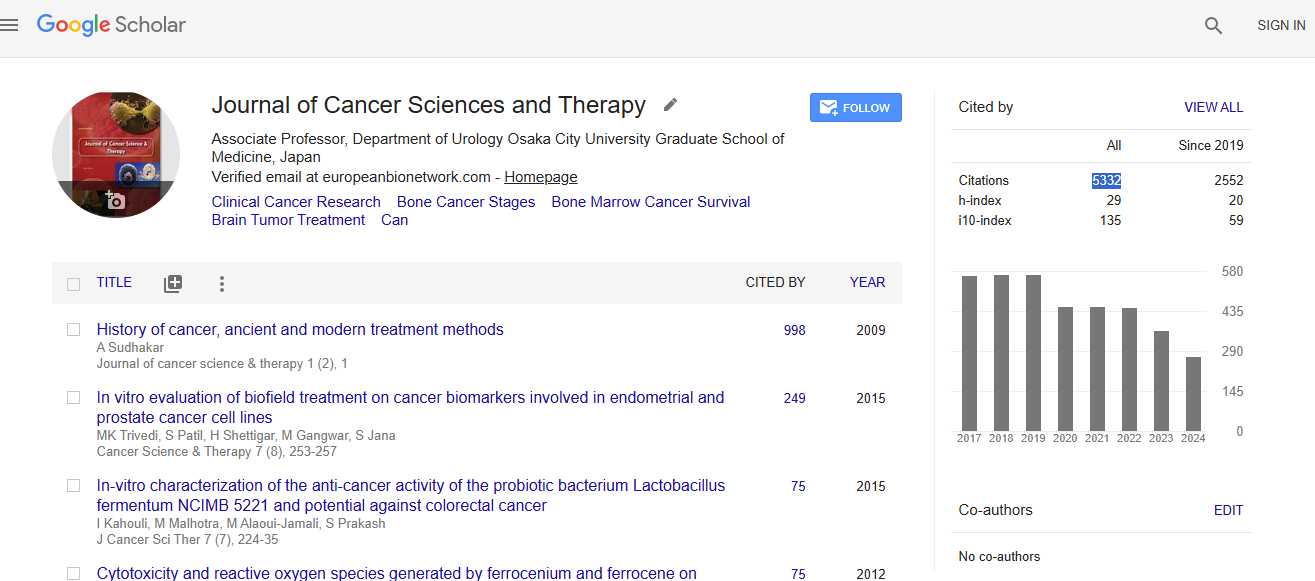
Cancer Science & Therapy received 5332 citations as per Google Scholar report