Commentary - (2025) Volume 11, Issue 3
Received: 02-Jun-2025, Manuscript No. jpnp-25-175491;
Editor assigned: 04-Jun-2025, Pre QC No. P-175491;
Reviewed: 18-Jun-2025, QC No. Q-175491;
Revised: 23-Jun-2025, Manuscript No. R-175491;
Published:
30-Jun-2025
, DOI: 10.37421/2472-0992.2025.11.363
Citation: Chatterjee, Priya N. ”Hydrology: Global Challenges, Impacts, and Advancements.” J Pharmacogn Nat Prod 11 (2025):363.
Copyright: © 2025 Chatterjee N. Priya This is an open-access article distributed under the terms of the Creative Commons Attribution License, which permits unrestricted use, distribution and reproduction in any medium, provided the original author and source are credited.
Recent advancements in hydrological research illuminate critical aspects of global water dynamics and resource management. Studies show global terrestrial evapotranspiration (ET) has significantly increased between 1982 and 2019 [1].
These changes are largely attributed to climatic factors like temperature and precipitation, with vegetation greening playing a secondary but notable role in regional ET dynamics [1].
The findings provide essential insights into the global water cycle and its responses to ongoing environmental shifts [1].
In urban hydrology, an enhanced distributed hydrological model has been developed for improved flood simulations [2].
This model incorporates high-resolution urban data, which greatly improves the accuracy of predicting inundation extents and depths [2].
It serves as a vital tool for urban flood risk management and early warning systems, particularly demonstrated through a case study in Shenzhen, China [2].
For groundwater management, the synergistic application of remote sensing and machine learning techniques has been explored to improve groundwater potential mapping in water-stressed semi-arid areas [3].
By integrating diverse geospatial data and advanced algorithms, more accurate and reliable predictions of groundwater resources are achieved [3].
This approach significantly aids sustainable water management and exploration efforts in vulnerable regions [3].
Arid and semi-arid regions face complex eco-hydrological responses driven by both climate change and intensified human activities [4].
Understanding the critical interplay between water availability, vegetation dynamics, and ecosystem health in these environments is paramount [4].
There is a clear emphasis on developing integrated management strategies to mitigate degradation and enhance resilience [4].
Attribution science in hydrology has seen comprehensive reviews examining methods used to link changes in hydrological extremes, such as floods and droughts, to specific drivers like climate change and human activities [5].
These reviews discuss the strengths and limitations of different attribution approaches, offering crucial insights for managing the increasing frequency and intensity of extreme hydrological events globally [5].
Land use and land cover changes profoundly impact water quality in river basins [6].
Research synthesizes current understanding, highlighting critical links between urbanization, agricultural practices, deforestation, and the resulting degradation of water resources [6].
This underscores the urgent need for sustainable land management practices to protect aquatic ecosystems and human health [6].
Global groundwater resources are also under scrutiny, with a comprehensive overview of groundwater storage changes across major global aquifers utilizing data from GRACE and GRACE-FO satellite missions [7].
This reveals widespread groundwater depletion in many regions, primarily due to unsustainable extraction and climate variability [7].
Satellite remote sensing plays a critical role in monitoring these vital freshwater resources [7].
Climate change presents significant challenges to snow hydrology and water resources in mountainous regions worldwide [8].
Rising temperatures alter snowpack accumulation, melt timing, and runoff regimes, which have major implications for water supply, hydropower, and ecosystem stability in downstream areas [8].
The evolving field of socio-hydrology focuses on the intricate and dynamic two-way coupling between human systems and hydrological processes [9].
This involves discussing conceptual frameworks, modeling approaches, and case studies that illustrate how human decisions influence water systems, and conversely, how water availability shapes societal development and resilience [9].
Finally, a thorough examination of various satellite precipitation products highlights their suitability for diverse hydrological applications [10].
The review assesses the strengths and limitations of these products in terms of spatial and temporal resolution, accuracy, and error characteristics [10].
It provides essential guidance for users and outlines future research directions to enhance precipitation estimation for water resource management [10].
Research consistently highlights the profound impact of climate change and human activities on global hydrological systems. A significant increase in global terrestrial evapotranspiration (ET) from 1982 to 2019 has been observed, primarily driven by powerful climatic factors such as rising temperature and shifting precipitation patterns, with vegetation greening also playing a secondary yet modulating role in regional ET dynamics [1]. These findings are crucial not just for academic understanding but for informing policies related to the global water cycle's response to ongoing environmental shifts. Similarly, arid and semi-arid regions, already vulnerable, exhibit complex eco-hydrological responses to both a changing climate and intensified human interventions [4]. Here, the critical interplay between dwindling water availability, dynamic vegetation changes, and overall ecosystem health demands the urgent development and implementation of integrated management strategies to effectively mitigate environmental degradation and enhance resilience in these sensitive environments [4]. Further complicating the global water picture, changes in hydrological extremes, such as more frequent and intense floods and droughts, necessitate careful attribution to their specific drivers, including both climate change and direct human activities [5]. Various reviewed methods for this attribution offer crucial insights into both understanding and proactively managing these increasingly severe and frequent global hydrological events [5]. Beyond climatic influences, land use and land cover changes are major, direct contributors to water quality degradation in river basins worldwide [6]. Urbanization, intensive agricultural practices, and widespread deforestation are critically linked to the declining health of water resources, emphasizing the paramount urgency for sustainable land management practices to protect both aquatic ecosystems and human health [6]. Even in seemingly stable mountainous regions, climate change profoundly impacts snow hydrology and subsequent water resources, leading to altered snowpack accumulation, changes in melt timing, and shifting runoff regimes with severe implications for downstream water supply, hydropower generation, and broader ecosystem stability [8].
Technological advancements are proving central to addressing these multifaceted hydrological challenges, particularly through enhanced modeling techniques and sophisticated remote sensing capabilities. An improved distributed hydrological model, for instance, has been specifically engineered for more accurate urban flood simulations [2]. By effectively integrating high-resolution urban data, this model significantly improves the accuracy of predicting inundation extents and depths, thereby offering a vital and actionable tool for urban flood risk management and the development of early warning systems, as powerfully demonstrated in a Shenzhen case study [2]. Furthermore, the synergistic application of remote sensing and advanced machine learning techniques is enhancing groundwater potential mapping, especially crucial in water-stressed semi-arid areas [3]. The successful integration of diverse geospatial data with advanced algorithms yields more accurate and reliable predictions of precious groundwater resources, thereby aiding sustainable water management planning and exploration efforts [3]. Satellite technology further expands our observational capabilities on a global scale; a comprehensive review of various satellite precipitation products highlights their specific suitability for diverse hydrological applications [10]. This review thoroughly assesses their inherent strengths and limitations concerning spatial and temporal resolution, accuracy, and error characteristics, providing essential guidance for users and outlining vital future research directions to significantly enhance precipitation estimation for more effective water resource management [10].
Groundwater resources, a critical component of global freshwater supply, face substantial and increasing pressures worldwide. A comprehensive overview, drawing extensively from data provided by the GRACE and GRACE-FO satellite missions, distinctly highlights widespread groundwater depletion observed across many major global aquifers [7]. This concerning depletion is primarily attributed to unsustainable extraction practices coupled with the variability of a changing climate [7]. The critical and ever-growing role of satellite remote sensing in effectively monitoring these vital, yet often hidden, freshwater resources cannot be overstated [7]. Such advanced monitoring is absolutely essential for informing and shaping effective policies aimed at mitigating the adverse impacts of both overuse and changing climatic patterns on these crucial, irreplaceable reserves.
Moreover, the intricate and fundamentally dynamic relationship between human systems and hydrological processes forms the very core of the evolving scientific field of socio-hydrology [9]. This discipline focuses intently on the complex, two-way coupling where human decisions and societal actions directly influence water systems, and in turn, the availability and characteristics of water profoundly shape societal development, resilience, and even cultural practices [9]. Discussions within this innovative domain cover essential conceptual frameworks, cutting-edge modeling approaches, and real-world case studies that vividly illuminate this complex human-water interaction, strongly advocating for a more holistic and integrated understanding of water management that purposefully incorporates crucial social, economic, and cultural dimensions alongside traditional hydrological science.
Research across hydrology and water resources reveals critical global challenges and advancements. Global terrestrial evapotranspiration has significantly increased, primarily due to climatic factors, with vegetation greening also playing a role. Urban areas benefit from enhanced distributed hydrological models that improve flood simulations and risk management. In semi-arid regions, the integration of remote sensing and machine learning proves vital for accurate groundwater potential mapping, supporting sustainable water resource management. These vulnerable environments also show complex eco-hydrological responses to climate change and human activities, underscoring the need for integrated strategies. Scientists are also reviewing methods to attribute changes in hydrological extremes like floods and droughts to specific drivers. Furthermore, land use and land cover changes are explicitly linked to water quality degradation in river basins, requiring urgent sustainable land management practices. Satellite missions like GRACE and GRACE-FO provide crucial data, showing widespread groundwater depletion in major global aquifers due to unsustainable extraction and climate variability. Climate change also profoundly impacts snow hydrology and water resources in mountainous regions, altering snowpack and runoff regimes with significant implications for downstream areas. The evolving field of socio-hydrology is explored, highlighting the dynamic two-way interaction between human systems and hydrological processes, where human decisions shape water systems and vice-versa. Lastly, a comprehensive review of satellite precipitation products offers insights into their suitability for various hydrological applications, guiding better water resource management through improved precipitation estimation.
None
None
Indexed at, Google Scholar, Crossref
Indexed at, Google Scholar, Crossref
Indexed at, Google Scholar, Crossref
Indexed at, Google Scholar, Crossref
Indexed at, Google Scholar, Crossref
Indexed at, Google Scholar, Crossref
Indexed at, Google Scholar, Crossref
Indexed at, Google Scholar, Crossref
Indexed at, Google Scholar, Crossref
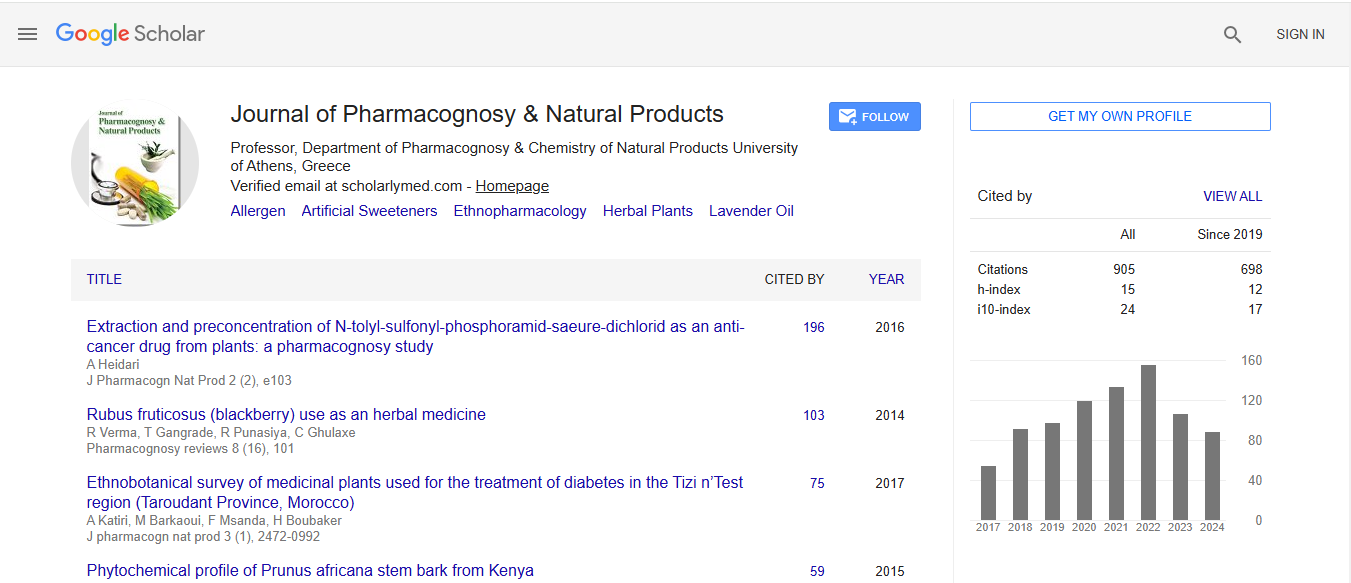
Journal of Pharmacognosy & Natural Products received 606 citations as per Google Scholar report