Opinion - (2025) Volume 16, Issue 3
Received: 01-Apr-2025, Manuscript No. hycr-25-172524;
Editor assigned: 03-Apr-2025, Pre QC No. P-172524;
Reviewed: 17-Apr-2025, QC No. Q-172524;
Revised: 22-Apr-2025, Manuscript No. R-172524;
Published:
29-May-2025
, DOI: 10.37421/2157-7587.2025.16.581
Citation: Nakamura, Kaori . ”Hydrology: AI, Climate Change, Water Management.” Hydrol Current Res 16 (2025):581.
Copyright: © 2025 Nakamura K. This is an open-access article distributed under the terms of the Creative Commons Attribution License, which permits
unrestricted distribution and reproduction in any medium,provided the original author and source are credited
This review explores the growing integration of machine learning techniques in hydrological modeling, highlighting their potential for improving predictions of water resources, floods, and droughts. It covers various ML algorithms and their applications, discussing both the successes and the persistent challenges like data requirements and model interpretability for future research directions [1].
This comprehensive review examines the significant progress in utilizing remote sensing technologies for drought monitoring across various scales. It discusses different drought indices derived from satellite data, their strengths and limitations, and identifies key challenges such as data continuity, algorithm accuracy, and the integration of multi-sensor data for improved drought assessment [2].
This review synthesizes current research on how climate change exacerbates flood risks, particularly in urban environments. It delves into the increased frequency and intensity of extreme rainfall, the vulnerability of existing urban drainage infrastructure, and explores adaptation strategies needed to enhance resilience against future hydrological challenges [3].
This review article provides a critical assessment of various methods used to estimate groundwater recharge across diverse climatic zones. It evaluates techniques ranging from water balance approaches to tracer methods, discussing their applicability, strengths, and weaknesses under different hydrogeological conditions, emphasizing the need for robust methods for sustainable groundwater management [4].
This paper investigates the intricate ecohydrological feedbacks within forest ecosystems and their critical role in shaping water resources, especially in the context of a changing climate. It highlights how forest characteristics, such as vegetation type and density, influence evapotranspiration, infiltration, and streamflow, providing insights for sustainable forest and water management strategies [5].
This systematic review comprehensively evaluates the application of artificial intelligence techniques in modeling water quality parameters. It explores various AI methods, from neural networks to fuzzy logic, demonstrating their effectiveness in prediction, classification, and optimization of water quality management, while also identifying research gaps and future directions [6].
This paper critically reviews sources of uncertainty in hydrological modeling, particularly when projecting impacts of climate change. It discusses uncertainties arising from climate model projections, downscaling methods, hydrological model structures, and parameterizations, emphasizing the need for robust uncertainty quantification and communication in water resource management decisions [7].
This review provides an extensive overview of smart technologies applied in urban water management, including smart sensors, Internet of Things (IoT), big data analytics, and artificial intelligence. It highlights how these technologies enhance monitoring, control, and optimization of urban water systems, addressing challenges like water scarcity, pollution, and flood risk, paving the way for more resilient and efficient urban water infrastructure [8].
This review provides an updated synthesis of water footprint assessment methodologies, highlighting their application in evaluating sustainable water use across different sectors. It discusses advancements in calculating blue, green, and gray water footprints, addressing existing challenges in data availability and standardization, and offering insights for policy-making and corporate water stewardship [9].
This study offers a global synthesis of observed and projected changes in hydrological extremes, specifically focusing on floods and droughts, driven by climate change. It utilizes a vast dataset and modeling approaches to identify regional patterns of increasing intensity and frequency of these events, providing crucial insights for global and regional climate adaptation strategies [10].
The integration of Machine Learning (ML) techniques is significantly advancing hydrological modeling, promising improved predictions for water resources, floods, and droughts [1]. Various ML algorithms find applications in this field, despite facing challenges such as data requirements and model interpretability [1]. Similarly, Artificial Intelligence (AI) methods, encompassing neural networks and fuzzy logic, are proving highly effective in modeling water quality parameters, aiding in prediction, classification, and optimization for water quality management [6]. Beyond AI, a broader adoption of smart technologies like sensors, Internet of Things (IoT), big data analytics, and AI is revolutionizing urban water management. These innovations enhance monitoring, control, and optimization of urban water systems, crucial for tackling issues such as scarcity, pollution, and flood risks, thereby fostering more resilient and efficient infrastructure [8].
Climate change presents a fundamental challenge to water systems worldwide. Research clearly shows how it exacerbates flood risks, particularly in vulnerable urban environments. This includes increased frequency and intensity of extreme rainfall events and significant stress on existing urban drainage infrastructure, necessitating proactive adaptation strategies [3]. From a global perspective, observed and projected changes in hydrological extremes, notably floods and droughts, are directly linked to climate change. Comprehensive studies using extensive datasets and modeling approaches reveal distinct regional patterns of intensifying and more frequent extreme events, offering vital insights for developing global and regional climate adaptation strategies [10].
Accurate monitoring and assessment are cornerstones of effective water resource management. Remote sensing technologies have made substantial progress in drought monitoring across various scales. This involves the development and application of diverse drought indices derived from satellite data, though challenges persist regarding data continuity, algorithm accuracy, and the integration of multi-sensor data for enhanced assessment [2]. Concurrently, the sustainable management of groundwater critically depends on reliable estimation of groundwater recharge. A thorough review assesses various estimation methods, from water balance to tracer techniques, evaluating their applicability and limitations across different climatic and hydrogeological conditions, underscoring the demand for robust methodologies [4]. Furthermore, understanding the intricate ecohydrological feedbacks within forest ecosystems is crucial. Forest characteristics, like vegetation type and density, significantly influence evapotranspiration, infiltration, and streamflow. These insights are vital for formulating sustainable forest and water management strategies, especially as climate patterns shift [5].
The efficacy of water quality management is significantly bolstered by intelligent systems. As noted, Artificial Intelligence (AI) techniques offer predictive power and optimization capabilities for various water quality parameters [6]. These advanced tools contribute to more proactive and responsive management strategies, ensuring water resources remain safe and usable. In the urban context, smart technologies broadly enhance the ability to manage water resources efficiently. By improving monitoring and control, these systems help mitigate pollution incidents and reduce the impact of water scarcity, leading to a more streamlined and responsive urban water infrastructure [8].
Addressing future hydrological challenges requires grappling with inherent uncertainties and holistic assessment frameworks. A critical review of hydrological modeling, especially concerning climate change impacts, highlights significant uncertainties. These uncertainties stem from climate model projections, downscaling techniques, hydrological model structures, and parameterizations, underscoring the necessity for transparent uncertainty quantification and communication in water resource decisions [7]. In parallel, water footprint assessment methodologies continue to evolve, offering a comprehensive framework for evaluating sustainable water use across various sectors. Advancements in calculating blue, green, and gray water footprints, despite ongoing challenges in data availability and standardization, provide crucial insights for policy-making and corporate water stewardship [9].
This collection of reviews and studies provides a broad perspective on contemporary hydrological research, emphasizing technological advancements and environmental challenges. Machine Learning (ML) and Artificial Intelligence (AI) are central, offering significant improvements in hydrological modeling, predicting water resources, and understanding floods and droughts [1]. These AI techniques also prove effective in modeling water quality parameters, aiding in prediction, classification, and optimization for better management [6]. Beyond AI, smart technologies, including sensors, Internet of Things (IoT), and big data analytics, are transforming urban water management by enhancing monitoring and optimizing systems to combat scarcity, pollution, and flood risks [8]. Climate change emerges as a pervasive theme, profoundly impacting water systems. Research synthesizes how climate change intensifies flood risks, particularly in urban areas, stressing the vulnerability of existing infrastructure and the need for adaptation strategies [3]. It also addresses a global perspective on observed and projected changes in hydrological extremes, identifying regional patterns of increasing flood and drought intensity and frequency [10]. Moreover, the intricate ecohydrological feedbacks within forest ecosystems are crucial, as forest characteristics influence vital processes like evapotranspiration and streamflow, particularly under a changing climate, guiding sustainable forest and water management [5]. A critical aspect of hydrological science involves monitoring and assessment. Remote sensing technologies show significant progress in drought monitoring across various scales, employing diverse indices derived from satellite data [2]. Alongside this, robust methods for estimating groundwater recharge across different climatic zones are essential for sustainable management, with a critical assessment of various techniques from water balance to tracer methods [4]. Finally, effectively managing water resources under future climate scenarios requires understanding and quantifying uncertainties in hydrological modeling, stemming from climate projections and model structures [7]. Water footprint assessment methodologies are also evolving to evaluate sustainable water use across sectors, considering blue, green, and gray water footprints for policy and corporate stewardship [9].
None
None
Indexed at, Google Scholar, Crossref
Indexed at, Google Scholar, Crossref
Indexed at, Google Scholar, Crossref
Indexed at, Google Scholar, Crossref
Indexed at, Google Scholar, Crossref
Indexed at, Google Scholar, Crossref
Indexed at, Google Scholar, Crossref
Indexed at, Google Scholar, Crossref
Indexed at, Google Scholar, Crossref
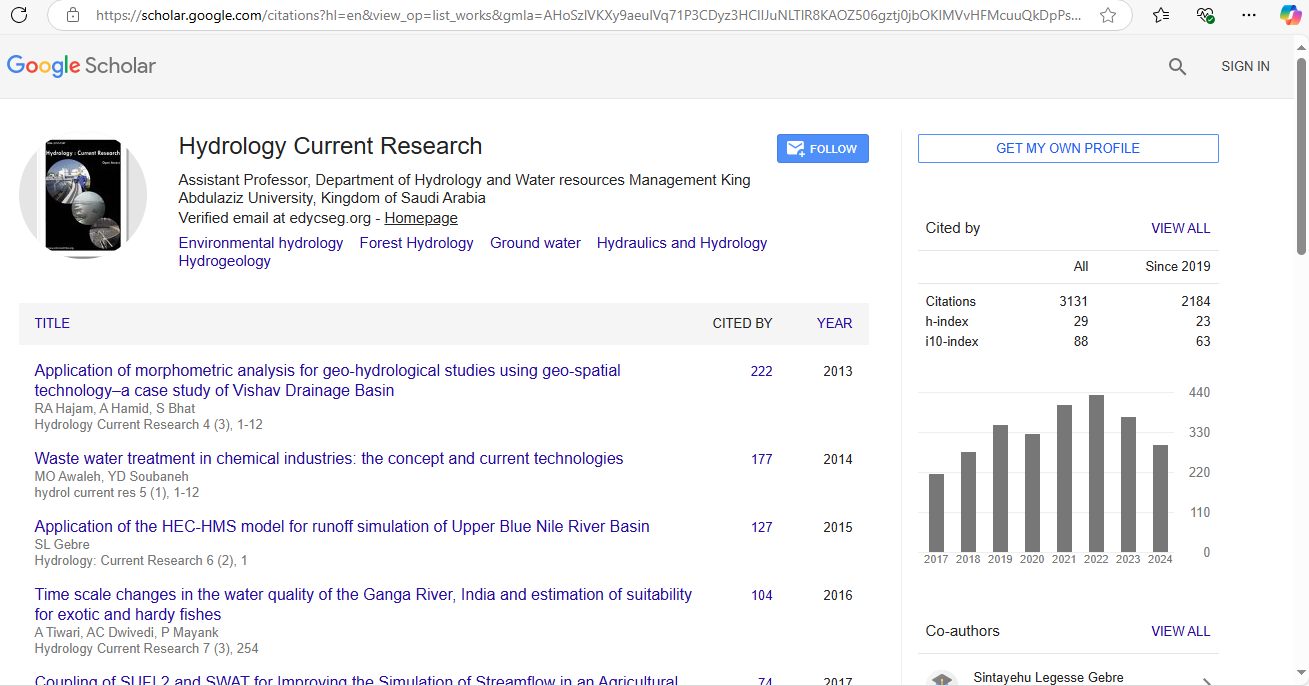
Hydrology: Current Research received 2843 citations as per Google Scholar report