Opinion - (2025) Volume 14, Issue 4
Received: 03-Aug-2025, Manuscript No. jnc-25-173951;
Editor assigned: 05-Aug-2025, Pre QC No. P-173951;
Reviewed: 19-Aug-2025, QC No. Q-173951;
Revised: 25-Aug-2025, Manuscript No. R-173951;
Published:
30-Aug-2025
, DOI: 10.37421/2167-1168.2025.14.718
Citation: Rahman, Alisha. ”Holistic Perioperative Care: Enhancing Patient Outcomes.” J Nurs Care 14 (2025):718.
Copyright: © 2025 Rahman A. This is an open-access article distributed under the terms of the Creative Commons Attribution License, which permits unrestricted use, distribution and reproduction in any medium, provided the original author and source are credited.
This article highlights that prehabilitation, an intervention involving exercise, nutrition, and psychological support before surgery, significantly improves patient outcomes, especially in abdominal surgery. It reduces postoperative complications and shortens hospital stays, demonstrating its value in optimizing patient readiness for major procedures [1].
This consensus statement provides comprehensive guidelines for implementing Enhanced Recovery After Surgery (ERAS) protocols specifically tailored for cardiac surgery. It emphasizes multidisciplinary team involvement, standardized pathways, and evidence-based interventions to reduce complications, accelerate recovery, and improve patient experience after complex heart procedures [2].
This review explores advanced concepts in multimodal analgesia, stressing the importance of combining various analgesic agents and techniques with different mechanisms of action to achieve superior pain control, reduce opioid consumption, and minimize side effects in the postoperative period. It highlights personalized approaches and regional anesthesia's role [3].
This article updates the evidence for goal-directed fluid therapy (GDFT) in major abdominal surgery, advocating for individualized fluid administration based on physiological parameters. It demonstrates that GDFT optimizes hemodynamic stability, reduces complications, and improves patient outcomes by avoiding both under- and over-hydration [4].
This review provides a current understanding of postoperative cognitive dysfunction (POCD), covering its complex etiology, identifiable risk factors, and strategies for prevention. It underscores the importance of preoperative cognitive assessment, careful anesthetic management, and comprehensive postoperative support to mitigate this significant complication, particularly in older adults [5].
This article presents consensus recommendations for perioperative nutrition specifically for cancer surgery patients. It emphasizes tailored nutritional interventions, including pre-operative oral nutritional supplements and early postoperative feeding, to optimize immune function, reduce surgical stress, and improve recovery, recognizing the unique metabolic challenges faced by cancer patients [6].
This systematic review and meta-analysis of randomized controlled trials demonstrate the efficacy of patient blood management (PBM) strategies in elective surgery. PBM, encompassing anemia optimization, blood conservation, and judicious transfusion, is shown to reduce transfusion rates, improve patient outcomes, and lower healthcare costs, promoting a patient-centered approach to blood use [7].
This joint statement offers crucial guidance on optimizing perioperative care for older adults, recognizing their unique vulnerabilities and complex health needs. It advocates for comprehensive geriatric assessment, shared decision-making, and targeted interventions to prevent common postoperative complications like delirium, functional decline, and medication-related issues in this patient population [8].
This systematic review explores the emerging role of digital health technologies, including remote monitoring and telemedicine, in perioperative care. It discusses how these tools can enhance patient engagement, facilitate continuity of care, improve postoperative surveillance, and potentially optimize resource utilization, though it notes the need for further evidence on their widespread implementation and impact [9].
This article discusses the evolving role of anesthesiologists beyond the operating room, positioning them as perioperative physicians who manage patient care from preoperative assessment through postoperative recovery. It highlights their critical function in optimizing patient health, coordinating multidisciplinary teams, and ensuring seamless transitions across the entire surgical journey [10].
Modern perioperative care embraces a comprehensive, patient-centered approach that begins well before surgery and extends through recovery. Prehabilitation, which integrates exercise, nutrition, and psychological support, significantly improves patient outcomes, especially for abdominal surgery. This intervention reduces postoperative complications and shortens hospital stays, clearly demonstrating its value in preparing patients for major procedures [1]. For complex interventions like cardiac surgery, Enhanced Recovery After Surgery (ERAS) protocols offer comprehensive guidelines. These protocols emphasize multidisciplinary team involvement, standardized pathways, and evidence-based interventions to reduce complications, accelerate recovery, and improve the patient experience [2].
Effective postoperative pain management is critical for patient comfort and recovery. Advanced concepts in multimodal analgesia advocate combining various analgesic agents and techniques with different mechanisms of action. This strategy aims to achieve superior pain control, significantly reduce opioid consumption, and minimize side effects. Personalized approaches and the strategic use of regional anesthesia are key components here [3]. Maintaining stable physiological parameters during major surgery is equally vital. Goal-Directed Fluid Therapy (GDFT) in major abdominal surgery provides an update on evidence for individualized fluid administration. This approach, based on physiological parameters, optimizes hemodynamic stability, reduces complications, and improves patient outcomes by meticulously avoiding both under- and over-hydration [4].
Postoperative Cognitive Dysfunction (POCD) represents a significant complication, particularly for older adults. A current understanding highlights its complex etiology, identifiable risk factors, and critical strategies for prevention. This involves emphasizing preoperative cognitive assessment, careful anesthetic management, and comprehensive postoperative support to mitigate this condition [5].
Tailored nutritional support is essential for optimizing recovery, especially for cancer surgery patients who face unique metabolic challenges. Consensus recommendations outline specific perioperative nutrition guidelines, including pre-operative oral nutritional supplements and early postoperative feeding, aimed at optimizing immune function, reducing surgical stress, and enhancing overall recovery [6]. Furthermore, Patient Blood Management (PBM) strategies have proven highly effective in elective surgery. This systematic review and meta-analysis of randomized controlled trials demonstrate that PBM, encompassing anemia optimization, blood conservation, and judicious transfusion, reduces transfusion rates, improves patient outcomes, and lowers healthcare costs, fostering a patient-centered approach to blood use [7].
Optimizing perioperative care for older adults requires specific consideration due to their unique vulnerabilities and complex health needs. A joint statement provides crucial guidance, advocating for comprehensive geriatric assessment, shared decision-making, and targeted interventions to prevent common postoperative complications such as delirium, functional decline, and medication-related issues [8]. The future of perioperative care is increasingly shaped by digital health technologies. This includes remote monitoring and telemedicine, which can enhance patient engagement, facilitate continuity of care, improve postoperative surveillance, and potentially optimize resource utilization. While promising, further evidence on their widespread implementation and impact is still needed [9]. Integral to these advancements is the evolving role of the anesthesiologist. They are transitioning beyond the operating room to become perioperative physicians who manage patient care from preoperative assessment through postoperative recovery. Their critical function involves optimizing patient health, coordinating multidisciplinary teams, and ensuring seamless transitions throughout the entire surgical journey [10].
Perioperative care is transforming into a holistic, multidisciplinary endeavor focused on enhancing patient outcomes across the entire surgical timeline. Key strategies include prehabilitation, which prepares patients for surgery with exercise and nutritional support, significantly reducing complications in procedures like abdominal surgery [1]. Enhanced Recovery After Surgery (ERAS) protocols, particularly in cardiac surgery, standardize care pathways to accelerate recovery and improve patient experience [2]. Effective pain management leverages multimodal analgesia to minimize opioid use and side effects [3], while Goal-Directed Fluid Therapy (GDFT) ensures optimal hemodynamic stability during major abdominal surgery [4]. Addressing specific patient vulnerabilities is also paramount, with efforts focused on preventing postoperative cognitive dysfunction (POCD) through careful assessment and management [5], and providing tailored perioperative nutrition for cancer patients to boost recovery and immune function [6]. Patient Blood Management (PBM) strategies reduce the need for transfusions and healthcare costs in elective surgeries [7]. Specialized care for older adults includes comprehensive geriatric assessments to prevent common postoperative complications like delirium [8]. Looking forward, digital health technologies, such as remote monitoring and telemedicine, are emerging to enhance patient engagement and postoperative surveillance [9]. These advancements highlight the anesthesiologist's evolving role as a perioperative physician, coordinating care from assessment to full recovery [10].
None
None
1. Joseph AM, Rakesh A, Sarah L. "Prehabilitation in abdominal surgery: a systematic review and meta-analysis.".BMJ Open 9 (2019):e030255.
Indexed at, Google Scholar, Crossref
2. Olle L, Monty GS, Kenneth CF. "Enhanced Recovery After Surgery (ERAS) for Cardiac Surgery: A Consensus Statement From the ERAS® Society.".World J Surg 43 (2019):1629-1641.
Indexed at, Google Scholar, Crossref
3. Tong JG, Ã?milie PB, Matthew KC. "New insights into multimodal analgesia for acute postoperative pain management.".Curr Opin Anaesthesiol 34 (2021):541-547.
Indexed at, Google Scholar, Crossref
4. Alberto Z, Giuseppe B, Gianpaolo DM. "Goal-Directed Fluid Therapy in Major Abdominal Surgery: An Update.".J Clin Med 8 (2019):1222.
Indexed at, Google Scholar, Crossref
5. Nan L, Yi Y, Changdong M. "Postoperative Cognitive Dysfunction: An Update on the Etiology, Risk Factors, and Prevention.".J Alzheimers Dis 82 (2021):1-13.
Indexed at, Google Scholar, Crossref
6. Kjetil L, Olle L, Franco C. "Perioperative Nutrition in Cancer Surgery: Consensus Recommendations from the International Society of Gastrointestinal Oncology.".J Gastrointest Oncol 12 (2021):S1-S14.
Indexed at, Google Scholar, Crossref
7. Jing H, Shuhui H, Ke X. "Patient blood management in elective surgery: A systematic review and meta-analysis of randomized controlled trials.".Front Surg 9 (2022):852787.
Indexed at, Google Scholar, Crossref
8. Mark DN, Rui F, Daniel DD. "Perioperative care for older adults: An American Geriatrics Society and American College of Surgeons joint statement.".J Am Geriatr Soc 69 (2021):1111-1116.
Indexed at, Google Scholar, Crossref
9. Nayan HS, Aamir RK, Michael GM. "Digital health in perioperative care: a systematic review of the literature.".Br J Anaesth 131 (2023):e102-e104.
Indexed at, Google Scholar, Crossref
10. Kevin AE, Eric CG, Michael AM. "The evolving role of the anesthesiologist in perioperative medicine.".Curr Opin Anaesthesiol 33 (2020):785-790.
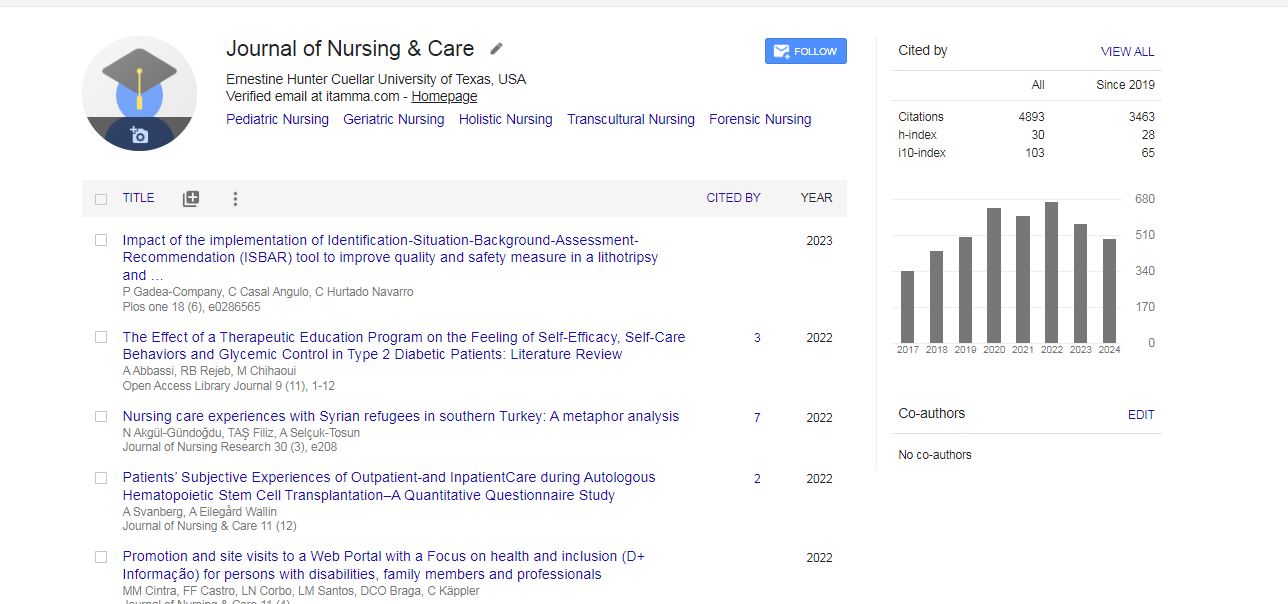
Journal of Nursing & Care received 4230 citations as per Google Scholar report