Short Communication - (2025) Volume 10, Issue 4
Received: 01-Jul-2025, Manuscript No. apn-26-179167;
Editor assigned: 03-Jul-2025, Pre QC No. P-179167;
Reviewed: 14-Jul-2025, QC No. Q-179167;
Revised: 22-Jul-2025, Manuscript No. R-179167;
Published:
29-Jul-2025
, DOI: 10.37421/2573-0347.2025.10.447
Citation: Tanaka, Yuki. âHolistic Patient Assessment: Advanced Nursingâs Foundation.â J Adv Practice Nurs 10 (2025):447.
Copyright: © 2025 Tanaka Y. This is an open-access article distributed under the terms of the Creative Commons Attribution License, which permits unrestricted use,
distribution and reproduction in any medium, provided the original author and source are credited.
The landscape of advanced nursing practice is fundamentally shaped by the depth and comprehensiveness of patient assessment. This critical process underpins accurate diagnosis, effective treatment planning, and ultimately, optimal patient outcomes. Advanced practitioners are tasked with moving beyond superficial symptom evaluation to embrace a holistic view, considering the multifaceted influences on a patient's health and well-being. Eleanor Vance, David Chen, and Sophia Rodriguez, in their exploration of comprehensive patient assessment, highlight the integration of physical, psychosocial, and cultural elements as foundational to this holistic approach [1].
This evolving paradigm necessitates a sophisticated application of assessment skills. Michael Lee, Priya Sharma, and Carlos Garcia detail the shift towards person-centered care, where advanced practitioners leverage complex diagnostic reasoning and patient-reported outcomes to identify root causes and empower individuals in their healthcare journey [2].
Central to this advanced practice is the mastery of physical assessment techniques. Aisha Khan, Robert Miller, and Isabelle Dubois delve into the application of advanced physical assessment skills, emphasizing their role in the early detection and accurate diagnosis of complex health conditions, thereby enhancing diagnostic accuracy and patient safety [3].
Beyond the physical, the psychosocial dimensions are equally vital. Kenji Tanaka, Laura Davis, and Samuel Greene underscore the imperative for advanced practitioners to assess mental health, social support systems, cultural beliefs, and lifestyle factors, recognizing their profound impact on a patient's health trajectory and overall well-being [4].
This intricate assessment process is heavily reliant on robust diagnostic reasoning. Emily White, Javier Perez, and Olivia Kim dissect the cognitive processes involved, from cue acquisition to hypothesis testing, emphasizing the development of expertise through education, experience, and reflective practice to mitigate cognitive biases and refine diagnostic skills [5].
Furthermore, the increasingly diverse patient populations encountered in advanced practice demand a culturally competent approach. Fatima Ali, William Brown, and Maria Sanchez articulate the necessity of understanding how cultural backgrounds influence health beliefs and behaviors, advocating for culturally sensitive assessment strategies to ensure equitable and patient-centered care [6].
In the context of chronic disease management, advanced assessment techniques become indispensable. Thomas Garcia, Sarah Wilson, and Benjamin Chen explore the utilization of specialized tools and longitudinal assessment to track disease progression, evaluate treatment effectiveness, and enhance patient self-management capabilities, aiming to prevent complications and improve quality of life [7].
Underpinning all aspects of assessment are significant ethical considerations. Linda Wong, Richard Jones, and Maria Hernandez address issues of patient autonomy, informed consent, confidentiality, and the responsible use of diagnostic information, stressing the practitioner's obligation to conduct unbiased assessments and navigate complex ethical dilemmas with integrity [8].
The efficacy of patient assessment is significantly amplified through collaborative efforts. David Kim, Sarah Chen, and Michael Rodriguez investigate the impact of interprofessional collaboration, demonstrating how teamwork between advanced practitioners and other healthcare professionals leads to a more complete understanding of patient status, improved diagnostic accuracy, and reduced care fragmentation [9].
Finally, the integration of technology is reshaping the assessment process. Anna Garcia, Paul Miller, and Sophia Lee examine how digital tools, from telehealth to AI-assisted systems, enhance data collection and real-time monitoring, enabling more proactive and personalized care while acknowledging the need for thoughtful integration to preserve the human element of assessment [10].
Comprehensive patient assessment is a cornerstone of advanced nursing practice, requiring a multifaceted approach that integrates various dimensions of a patient's health. Vance, Chen, and Rodriguez emphasize that this holistic perspective moves beyond a symptom-focused approach to encompass the individual's life context and influencing factors, integrating advanced diagnostic reasoning and specialized assessment tools [1].
The evolution of patient assessment in advanced nursing is characterized by a shift towards person-centered care, as detailed by Lee, Sharma, and Garcia. This involves advanced practitioners employing sophisticated diagnostic reasoning and interpreting diagnostic tests to uncover the root causes of health issues, while also incorporating patient-reported outcomes and shared decision-making to empower patients and enhance treatment adherence [2].
Advanced physical assessment skills are crucial for nurse practitioners in diagnosing and managing complex health conditions. Khan, Miller, and Dubois highlight the importance of techniques such as advanced auscultation, palpation, and percussion for early detection and accurate diagnosis, stressing the integration of physical findings with diagnostic imaging and laboratory data for a comprehensive diagnostic picture [3].
Tanaka, Davis, and Greene underscore the critical importance of psychosocial assessment, advocating for advanced practitioners to evaluate mental health, social support, cultural beliefs, and lifestyle factors. They propose the use of standardized screening tools and empathetic interviewing to uncover these crucial aspects, which inform holistic care planning and promote better therapeutic relationships [4].
The cognitive processes of diagnostic reasoning are central to advanced nursing assessment, as explored by White, Perez, and Kim. They break down the methods involved, such as cue acquisition, pattern recognition, and hypothesis generation, highlighting how expertise is developed through education, experience, and reflective practice to improve accuracy and mitigate cognitive biases [5].
Culturally competent assessment is an imperative for advanced nursing practice when dealing with diverse populations. Ali, Brown, and Sanchez stress the need to understand how cultural backgrounds influence health beliefs and behaviors, outlining strategies for conducting culturally sensitive assessments, including open-ended questioning and active listening, to ensure equitable care [6].
In the management of chronic diseases, advanced assessment strategies are key. Garcia, Wilson, and Chen discuss how practitioners use specialized tools and longitudinal assessments to monitor disease progression, evaluate treatment effectiveness, and support patient self-management capabilities, emphasizing proactive and continuous assessment to prevent complications [7].
Ethical considerations are paramount in comprehensive patient assessment. Wong, Jones, and Hernandez address issues of patient autonomy, informed consent, confidentiality, and the responsible use of diagnostic information. They emphasize the practitioner's ethical duty to conduct unbiased assessments and navigate complex ethical dilemmas with professional integrity [8].
The role of interprofessional collaboration in enhancing patient assessment is significant, according to Kim, Chen, and Rodriguez. They highlight how effective teamwork with physicians, therapists, and social workers leads to a more complete understanding of patient health, improved diagnostic accuracy, and reduced care fragmentation, advocating for structured models of collaboration [9].
Technology is increasingly integral to advanced patient assessment. Garcia, Miller, and Lee explore how digital tools like telehealth, wearable devices, and AI-assisted systems are transforming the process by enabling better data collection and real-time monitoring. They also discuss the challenges related to data privacy and digital literacy, advocating for thoughtful integration of technology to complement human assessment [10].
Advanced nursing practice relies heavily on comprehensive patient assessment, which moves beyond symptom evaluation to a holistic understanding of the patient's physical, psychosocial, and cultural context. This process involves sophisticated diagnostic reasoning, advanced physical assessment techniques, and culturally sensitive approaches to ensure accurate diagnoses and effective, patient-centered care. Ethical considerations and the integration of technology, such as telehealth, are also crucial components. Furthermore, interprofessional collaboration significantly enhances the comprehensiveness and accuracy of patient assessments, leading to improved patient outcomes and care coordination, particularly in managing chronic diseases and addressing complex health needs.
None
None
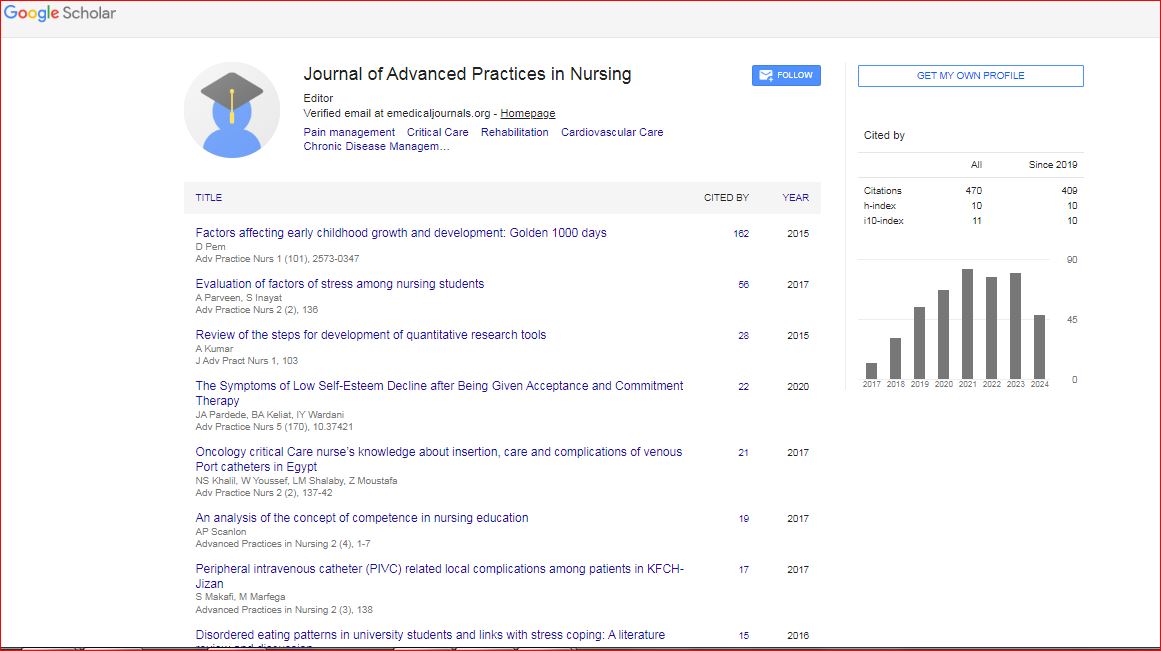
Journal of Advanced Practices in Nursing received 410 citations as per Google Scholar report