Brief Report - (2025) Volume 14, Issue 2
Received: 01-Apr-2025, Manuscript No. jhoa-26-187781;
Editor assigned: 03-Apr-2025, Pre QC No. P-187781;
Reviewed: 17-Apr-2025, QC No. Q-187781;
Revised: 22-Apr-2025, Manuscript No. R-187781;
Published:
29-Apr-2025
, DOI: 10.37421/2167-1095.2025.14.515
Citation: Dubois, Sophie. ”Holistic Hypertension Management: Family Medicine Approach.” J Hypertens 14 (2025):515.
Copyright: © 2025 Dubois S. This is an open-access article distributed under the terms of the Creative Commons Attribution License, which permits unrestricted use, distribution and reproduction in any medium, provided the original author and source are credited
Effective hypertension management in family medicine necessitates a comprehensive, multi-faceted strategy that integrates accurate diagnosis, tailored treatment plans, and robust patient education. This approach is paramount for achieving optimal blood pressure control and mitigating cardiovascular risks. Key strategies encompass significant lifestyle modifications, including dietary adjustments, consistent engagement in physical activity, and effective weight management. These foundational elements are frequently augmented by pharmacotherapy precisely calibrated to each patient's unique profile and co-existing medical conditions. Regular monitoring and diligent follow-up are indispensable components of this management framework. These practices are crucial for rigorously assessing treatment efficacy, proactively addressing any adherence challenges, and adeptly managing potential adverse effects that may arise. The family physician's role also extends significantly to the identification and management of resistant hypertension. This specific challenge demands a systematic methodology aimed at definitively ruling out secondary etiologies and strategically optimizing diuretic therapy. Careful review of existing medication regimens and thorough assessment of patient adherence are of utmost importance. Concurrently, consideration of referral to specialized care becomes essential when clinical indicators suggest such a need. Integrating advanced technological tools, such as telemedicine platforms and remote blood pressure monitoring devices, holds the potential to substantially enhance the delivery of hypertension care within family medicine settings. These innovative solutions facilitate increased patient interaction and provide real-time data for precise treatment adjustments. Empowering patients through comprehensive education on self-monitoring techniques and a clear understanding of their treatment objectives represents another fundamental pillar of successful long-term hypertension management. The diagnosis of hypertension in primary care settings relies heavily on accurate blood pressure measurement, incorporating out-of-office monitoring when clinical suspicion warrants it to confirm sustained elevation. Physicians must be skilled in distinguishing between essential and secondary hypertension. Lifestyle interventions continue to serve as the bedrock of initial hypertension management and remain an indispensable adjunct to pharmacological treatments. Family physicians are instrumental in counseling patients on the myriad benefits associated with the DASH diet, judicious sodium restriction, regular aerobic exercise, and moderate alcohol consumption. Adherence to antihypertensive therapy presents a persistent and significant hurdle in the management of this chronic condition. Family physicians can implement various strategies to bolster adherence, including simplifying medication schedules, actively addressing patient concerns and potential side effects, and employing motivational interviewing techniques to enhance patient engagement and commitment to consistent treatment.
Effective hypertension management in family medicine is built upon a foundation of accurate diagnosis, individualized treatment plans, and continuous patient education. This multifaceted approach ensures that patients receive care that is both effective and responsive to their specific needs and circumstances [1].
Central to this strategy are lifestyle modifications, which include dietary changes such as adopting a heart-healthy eating pattern, regular engagement in physical activity, and achieving and maintaining a healthy weight. These non-pharmacological interventions are often complemented by pharmacotherapy, which is carefully selected and adjusted based on the patient's unique clinical profile and any co-existing health issues [1].
Regular patient monitoring and consistent follow-up appointments are critical for evaluating the effectiveness of the prescribed treatment, identifying and addressing any barriers to medication adherence, and promptly managing any side effects that may emerge [1].
The scope of practice for family physicians includes the identification and management of resistant hypertension, a complex condition that requires a systematic approach. This involves a thorough investigation to rule out underlying secondary causes of hypertension and the optimization of diuretic therapy as a cornerstone of treatment [2].
Careful and systematic medication reviews are essential, alongside a diligent assessment of patient adherence to their prescribed regimens. In cases where hypertension remains uncontrolled despite optimal medical management, referral to specialist care may be indicated [2].
The integration of modern technology, such as telemedicine and remote blood pressure monitoring, offers significant potential to improve the quality and efficiency of hypertension care within primary care settings. These tools enable more frequent patient contact and provide valuable real-time data for timely therapeutic adjustments [3].
Empowering patients through education is a vital aspect of successful long-term hypertension management. This includes educating them on self-monitoring their blood pressure and fostering a clear understanding of their treatment goals, thereby promoting active participation in their care [3].
Diagnosing hypertension accurately in a family medicine context involves precise blood pressure measurement, including the judicious use of out-of-office monitoring when necessary to confirm sustained elevated readings. Clinicians must be adept at differentiating essential hypertension from secondary causes and initiating appropriate diagnostic workups [8].
Lifestyle interventions are universally recognized as the cornerstone of initial hypertension management and serve as an essential adjunct to pharmacological therapy. Family physicians play a pivotal role in counseling patients on the benefits of a DASH diet, reducing sodium intake, engaging in regular aerobic exercise, and moderating alcohol consumption [5].
Enhancing adherence to antihypertensive therapy is a significant challenge that requires proactive strategies. Family physicians can improve adherence by simplifying medication regimens, actively addressing patient concerns and potential side effects, and employing motivational interviewing techniques to foster commitment to consistent treatment [9].
Hypertension management in family medicine emphasizes a holistic approach involving accurate diagnosis, personalized treatment, and patient education. Key strategies include lifestyle modifications like diet and exercise, often supplemented by tailored pharmacotherapy. Regular monitoring and follow-up are crucial for assessing efficacy and managing adherence. The role of family physicians extends to managing resistant hypertension and utilizing technology like telemedicine for improved care. Patient education and self-management support are vital for long-term control. Accurate diagnosis through proper measurement techniques is essential, as is understanding evidence-based pharmacotherapy and improving adherence. Prevention through early risk factor identification and lifestyle counseling is also a key responsibility.
None
None
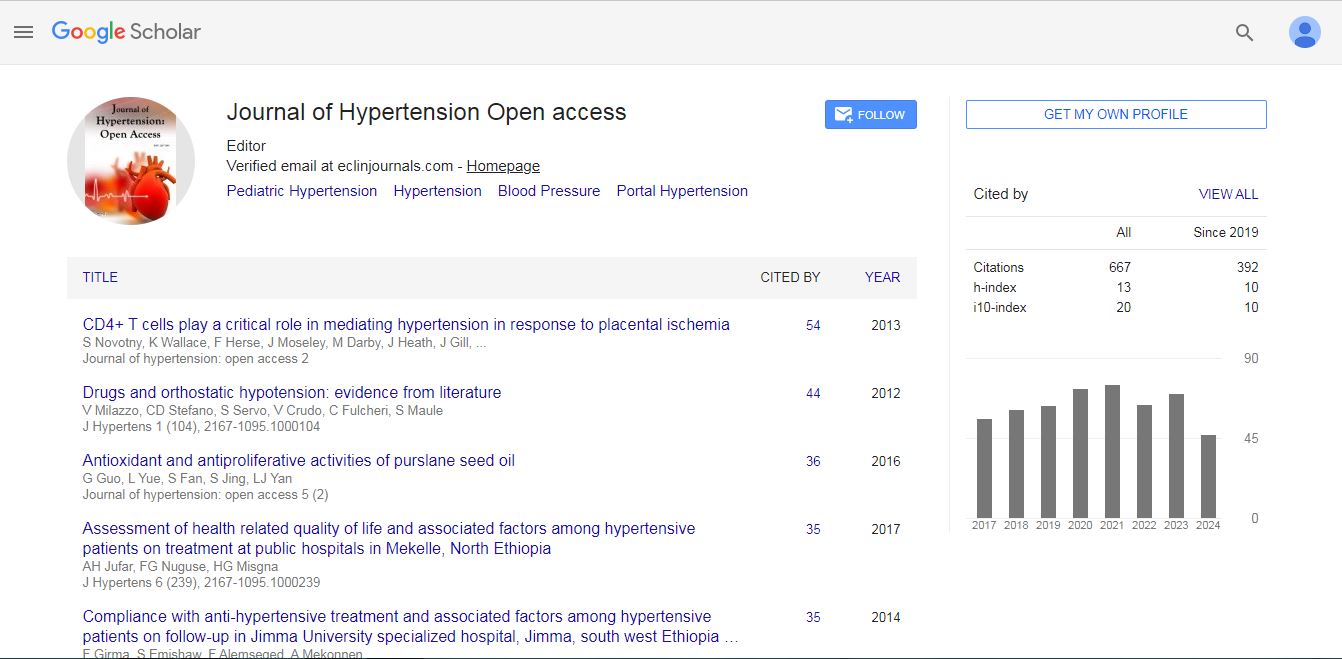
Journal of Hypertension: Open Access received 614 citations as per Google Scholar report