Short Communication - (2025) Volume 12, Issue 5
Received: 01-Oct-2025, Manuscript No. jreac-26-185836;
Editor assigned: 03-Oct-2025, Pre QC No. P-185836;
Reviewed: 17-Oct-2025, QC No. Q-185836;
Revised: 22-Oct-2025, Manuscript No. R-185836;
Published:
29-Oct-2025
, DOI: 10.37421/2380-2391.2025.12.447
Citation: Benali, Fatima Zahra. ”High-Resolution Mass Spectrometry: Revolutionizing Environmental Science.” J Environ Anal Chem 12 (2025):447.
Copyright: © 2025 Benali Z. Fatima This is an open-access article distributed under the terms of the Creative Commons Attribution License, which permits unrestricted use,
distribution and reproduction in any medium, provided the original author and source are credited.
High-resolution mass spectrometry (HRMS) has emerged as a transformative technology in environmental analysis, offering unprecedented sensitivity and selectivity for the detection of trace-level contaminants. Its capability to accurately identify and quantify a diverse array of pollutants, including persistent organic pollutants (POPs), pharmaceuticals, and pesticides, even at extremely low concentrations, is crucial for understanding and mitigating environmental risks [1].
The advancement of HRMS techniques, such as Orbitrap and time-of-flight (TOF) MS, has significantly enhanced mass accuracy and resolving power, enabling the differentiation of target analytes from complex environmental matrices and underpinning its indispensability in environmental monitoring, risk assessment, and regulatory compliance [1].
The development of novel analytical strategies employing HRMS for emerging contaminants in water resources is actively being explored. These efforts address the challenges posed by the low abundance and structural diversity of such pollutants. HRMS, particularly when coupled with advanced ionization techniques like electrospray ionization (ESI) and atmospheric pressure chemical ionization (APCI), effectively overcomes these hurdles, facilitating the identification and quantification of micropollutants in municipal wastewater and supporting water quality management [2].
Furthermore, the application of HRMS for non-targeted screening of volatile organic compounds (VOCs) in ambient air is providing powerful insights into atmospheric chemistry. This approach allows for the detection and identification of a broad spectrum of VOCs without prior knowledge of their identity, which is critical for discovering unknown pollutants or their transformation products and for air quality monitoring [3].
In the realm of environmental forensics, HRMS is proving invaluable for source apportionment of complex pollutant mixtures. Its ability to provide detailed chemical fingerprints of pollutants allows for the identification of their origins and pathways, particularly for compounds like polycyclic aromatic hydrocarbons (PAHs) and their derivatives in soil and sediment samples. This differentiation between petrogenic and pyrogenic sources is vital for effective environmental remediation and legal investigations [4].
The critical issue of per- and polyfluoroalkyl substances (PFAS) monitoring in various environmental compartments is being addressed through HRMS. The ubiquitous nature and diverse chemical structures of PFAS present significant analytical challenges, which HRMS, especially with tandem MS (MS/MS) capabilities, adeptly overcomes by offering superior selectivity and sensitivity for their detection and characterization, aiding in meeting stringent regulatory limits [5].
The integration of HRMS with advanced chemometric techniques is revolutionizing the comprehensive analysis of complex environmental samples. This synergistic application allows for the revelation of intricate patterns and relationships among pollutants that might be missed by traditional methods, offering a more holistic approach to environmental assessment by identifying sources of contamination and understanding pollutant behavior in ecosystems [6].
Tracking the spread of antibiotic resistance genes (ARGs) and their associated mobile genetic elements (MGEs) in environmental settings is a growing concern, and HRMS is emerging as a key tool. The need for sensitive techniques to monitor ARGs in water and soil is paramount for public health, and HRMS can contribute significantly to understanding their environmental fate and transport, aiding in strategies to combat antimicrobial resistance [7].
The characterization of microplastic leachates and their associated contaminants in marine environments is another area where HRMS demonstrates significant utility. As microplastic pollution escalates, its potential to release harmful chemicals necessitates detailed analysis. HRMS can identify and quantify a diverse array of organic compounds leaching from microplastics, providing crucial information for assessing the ecological risks posed by these pollutants [8].
Ensuring food safety through the rapid and reliable detection of pesticide residues is paramount, and HRMS plays a vital role in this domain. Its efficacy in identifying and quantifying a broad range of pesticides, including those with low maximum residue limits (MRLs), contributes to robust food quality control systems and meets stringent regulatory standards [9].
Finally, the identification of pharmaceutical pollutants in wastewater treatment plant effluents is being significantly advanced by HRMS. Addressing the challenges of detecting pharmaceuticals at trace levels and understanding their impact on aquatic ecosystems, HRMS provides accurate mass measurements for the unambiguous identification of active pharmaceutical ingredients (APIs) and their metabolites, supporting efforts to improve wastewater treatment efficacy and protect vital water resources [10].
High-resolution mass spectrometry (HRMS) has become an indispensable tool for the sensitive and selective detection of trace-level environmental pollutants. Its capacity to accurately identify and quantify a wide spectrum of contaminants, including persistent organic pollutants (POPs), pharmaceuticals, and pesticides, even at ultra-low concentrations, is fundamental to understanding environmental contamination and its impacts. The continuous evolution of HRMS technologies, such as Orbitrap and time-of-flight (TOF) mass analyzers, has led to remarkable improvements in mass accuracy and resolving power. These enhancements are critical for distinguishing target pollutants from the complex chemical backgrounds present in environmental samples, thereby bolstering its role in environmental monitoring, risk assessment, and ensuring regulatory compliance for the protection of public health and ecosystem integrity [1].
The exploration of novel analytical methodologies leveraging HRMS for the analysis of emerging contaminants in water bodies represents a critical area of research. The inherent challenges posed by the low concentrations and structural diversity of these pollutants are effectively addressed by HRMS, especially when combined with advanced ionization techniques like electrospray ionization (ESI) and atmospheric pressure chemical ionization (APCI). This approach has demonstrated success in identifying and quantifying various micropollutants present in municipal wastewater, significantly contributing to improved water quality management strategies and the development of effective remediation technologies [2].
The application of HRMS in the non-targeted screening of volatile organic compounds (VOCs) in ambient air is significantly advancing atmospheric chemistry research and air quality monitoring. This technique's ability to detect and identify a broad array of VOCs without prior knowledge of their identities is crucial for the discovery of previously unknown pollutants or their degradation products, providing a comprehensive profile of airborne contaminants [3].
Within the field of environmental forensics, HRMS is proving to be a powerful instrument for source apportionment studies of complex pollutant mixtures. By providing detailed chemical fingerprints of pollutants, HRMS enables the accurate identification of their origins and transport pathways. This capability is particularly valuable for analyzing polycyclic aromatic hydrocarbons (PAHs) and their derivatives in environmental matrices like soil and sediment, allowing for the differentiation of sources such as petroleum activities versus combustion processes, which is vital for targeted environmental remediation efforts and legal proceedings [4].
The pervasive issue of per- and polyfluoroalkyl substances (PFAS) contamination necessitates sophisticated analytical approaches, and HRMS plays a central role in their monitoring across diverse environmental compartments. The analytical hurdles presented by the widespread presence and varied chemical structures of PFAS are effectively managed by HRMS, particularly when equipped with tandem mass spectrometry (MS/MS) functionalities. This configuration provides the enhanced selectivity and sensitivity required to meet stringent regulatory limits and inform effective strategies for PFAS management and mitigation [5].
The synergistic integration of HRMS with advanced chemometric techniques is transforming the comprehensive analysis of complex environmental samples. This combined approach allows for the identification of subtle patterns and interrelationships among pollutants that might elude conventional analytical methods. The ability to discern sources of contamination and understand the complex behavior of pollutants within ecosystems offers a more holistic and effective framework for environmental assessment [6].
The detection and monitoring of antibiotic resistance genes (ARGs) and associated mobile genetic elements (MGEs) in environmental settings are critical for public health. HRMS offers the necessary sensitivity to track the dissemination of ARGs in water and soil, contributing to a deeper understanding of their environmental fate and transport. This knowledge is instrumental in developing strategies to combat the growing threat of antimicrobial resistance [7].
Investigating the chemical composition of microplastic leachates and their associated contaminants in marine environments is a growing area of concern, and HRMS is crucial for this research. The potential for microplastics to release harmful chemicals necessitates detailed characterization. HRMS excels at identifying and quantifying a wide range of organic compounds leaching from these particles, providing essential data for assessing the ecological risks associated with microplastic pollution [8].
Ensuring the safety of food products requires the rapid and reliable detection of pesticide residues, a task greatly facilitated by HRMS. Its effectiveness in identifying and quantifying a broad spectrum of pesticides, including those present at very low concentrations and subject to strict maximum residue limits (MRLs), is vital for maintaining robust food quality control systems and complying with international food safety regulations [9].
The identification of pharmaceutical pollutants in wastewater treatment plant effluents is a critical step in protecting water resources. HRMS addresses the challenge of detecting pharmaceuticals at trace levels and their potential ecological impacts. Its precise mass measurement capabilities enable the unambiguous identification of a wide array of active pharmaceutical ingredients (APIs) and their metabolites, thereby supporting efforts to enhance the efficiency of wastewater treatment processes and safeguard aquatic ecosystems [10].
High-resolution mass spectrometry (HRMS) is a powerful analytical technique revolutionizing environmental science. It enables sensitive and selective detection of trace pollutants like POPs, pharmaceuticals, and pesticides. Advanced HRMS techniques like Orbitrap and TOF MS provide high mass accuracy, crucial for complex sample analysis. HRMS is vital for identifying emerging contaminants in water, screening VOCs in air, and forensic investigations for pollutant source apportionment. It is also essential for monitoring challenging substances like PFAS, characterizing microplastic leachates, and detecting pesticide residues in food. The integration of HRMS with chemometrics offers holistic environmental assessment. Furthermore, HRMS aids in tracking antibiotic resistance genes and identifying pharmaceutical pollutants in wastewater, ultimately contributing to public health and ecological integrity.
None
None
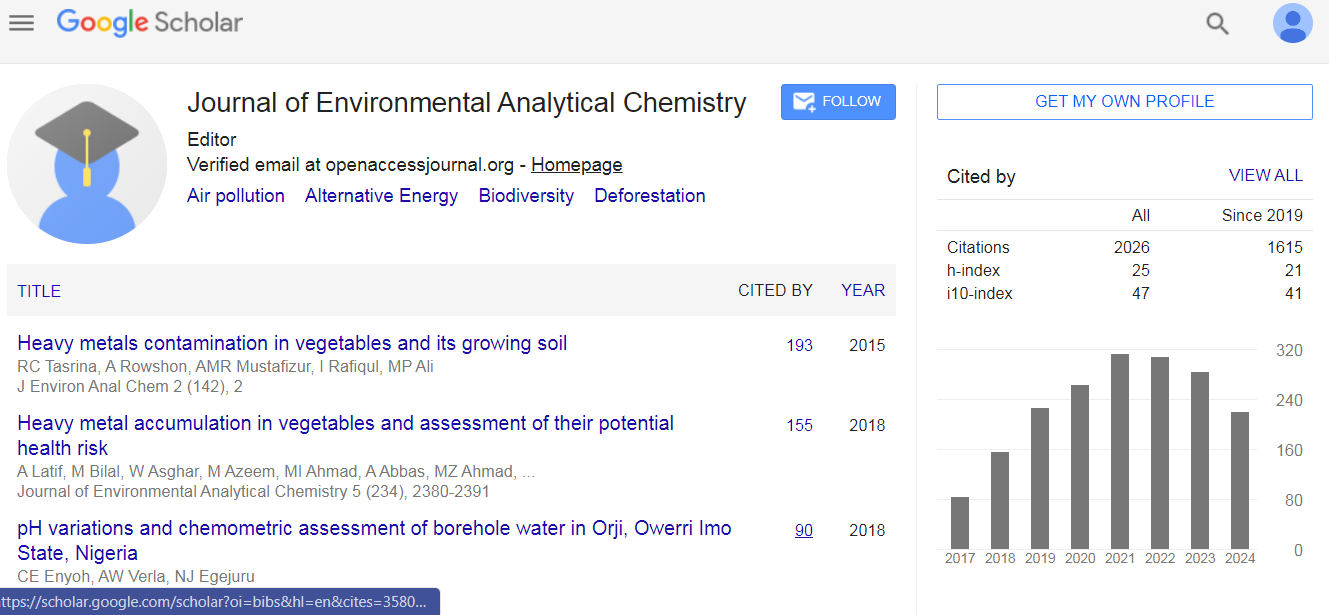
Journal of Environmental Analytical Chemistry received 1781 citations as per Google Scholar report