Perspective - (2025) Volume 14, Issue 3
Received: 02-May-2025, Manuscript No. aim-25-177354;
Editor assigned: 05-May-2025, Pre QC No. P-177354;
Reviewed: 19-May-2025, QC No. Q-177354;
Revised: 23-May-2025, Manuscript No. R-177354;
Published:
30-May-2025
, DOI: 10.37421/2427-5162.2025.14.575
Citation: Brooks, Helen. ”Herbal Medicine: Safety, Quality and Regulation Challenges.” Alt Integr Med 14 (2025):575.
Copyright: © 2025 Brooks H. This is an open-access article distributed under the terms of the Creative Commons Attribution License, which permits unrestricted use, distribution and reproduction in any medium, provided the original author and source are credited.
Assessing herbal medicine safety and efficacy faces challenges from chemical variability, lack of standardization, and inadequate clinical trials. These issues emphasize the need for robust regulatory frameworks to govern product development and marketing [1].
Quality control and standardization of herbal medicines are hindered by botanical misidentification, adulteration, and contaminants like pesticides and heavy metals. Advanced analytical techniques and stringent regulatory oversight are crucial for addressing these concerns [2].
Herbal medicines carry risks, including reported adverse drug reactions like liver and kidney toxicity, gastrointestinal issues, and significant drug-herb interactions. Increased awareness and comprehensive reporting systems are vital for mitigation [3].
Consumer perception often equates herbal products with natural safety, despite limited scientific evidence for efficacy or safety. This necessitates improved public education and stricter regulatory oversight to ensure informed choices and public health protection [4].
Integrating traditional herbal medicine into modern healthcare presents both opportunities and challenges. Scientific validation, stringent quality control, and standardized clinical practices are essential to ensure patient safety and therapeutic efficacy [5].
Good Manufacturing Practices (GMP) are critical for ensuring the quality and safety of herbal supplements. Adherence addresses concerns such as contamination, adulteration, and inconsistent potency, directly safeguarding consumer health throughout production [6].
Global regulatory approaches for herbal medicinal products vary significantly in classification, approval processes, and post-market surveillance. These disparities contribute to inconsistent product quality and safety worldwide, highlighting harmonization challenges [7].
Clinical evidence for many herbal supplements often lacks rigorous, large-scale randomized controlled trials, which are the gold standard. This highlights a pressing need for more robust scientific investigation to substantiate their health claims [8].
Advanced analytical techniques, including HPLC-MS, GC-MS, and NMR, are indispensable for quality control and standardization of herbal extracts. These methods identify active compounds, detect adulterants, and ensure product consistency [9].
A pharmacovigilance perspective is crucial for herbal medicine risk assessment. Robust post-market surveillance, adverse event reporting, and data analysis are advocated to understand and mitigate potential harms to consumers effectively [10].
This review addresses challenges in assessing herbal medicine safety and efficacy, citing chemical variability, lack of standardization, and inadequate clinical trials. It stresses the urgent need for robust regulatory frameworks [1]. The article examines hurdles in herbal medicine quality control and standardization, including botanical identification, adulteration, and contaminants. It advocates for advanced analytical techniques and stringent regulatory oversight [2]. This paper reviews adverse drug reactions associated with herbal medicines, focusing on liver and kidney toxicity, gastrointestinal issues, and drug-herb interactions. It urges greater awareness and comprehensive reporting systems [3]. Consumer perceptions of herbal products often assume natural safety despite limited scientific evidence. This systematic review highlights the need for improved public education and stricter regulatory oversight [4]. Integrating traditional herbal medicine into modern healthcare faces challenges. This article emphasizes scientific validation, quality control, and standardized clinical practices to ensure patient safety and therapeutic efficacy [5]. The article underscores Good Manufacturing Practices (GMP) as crucial for herbal supplement quality and safety. GMP addresses contamination, adulteration, and inconsistent potency, directly impacting consumer health [6]. A review of global regulatory approaches for herbal medicinal products reveals disparities in classification, approval, and surveillance. These inconsistencies contribute to varying product quality and safety worldwide [7]. This paper critically appraises clinical evidence for herbal supplements, noting a common lack of rigorous randomized controlled trials. It calls for more robust scientific investigation to substantiate health claims [8]. Advanced analytical techniques like HPLC-MS, GC-MS, and NMR are detailed for quality control and standardization of herbal extracts. They are essential for identifying compounds, detecting adulterants, and ensuring consistency [9]. This article offers a pharmacovigilance perspective on herbal medicine risk assessment, advocating for robust post-market surveillance, adverse event reporting, and data analysis to mitigate potential harms [10].
The current landscape of herbal medicine is characterized by significant challenges in ensuring product safety, quality, and efficacy. Key issues include the inherent variability in chemical composition, a pervasive lack of standardization across manufacturing processes, and insufficient rigorous clinical trials to substantiate therapeutic claims. These factors contribute to inconsistent product quality, potential adulteration, and the presence of harmful contaminants such like pesticides and heavy metals. Consumers often perceive herbal products as inherently safe due to their natural origin, a belief not always supported by scientific evidence. This gap highlights the need for better public education and stricter regulatory oversight. The risk profile of herbal medicines also includes a spectrum of adverse drug reactions, ranging from gastrointestinal disturbances to liver and kidney toxicity, and significant drug-herb interactions, necessitating robust pharmacovigilance and reporting systems. Integrating traditional herbal medicine into modern healthcare requires scientific validation, stringent quality control through Good Manufacturing Practices, and standardized clinical approaches. Globally, regulatory frameworks for herbal products vary widely, leading to inconsistencies in classification, approval, and post-market surveillance. Advanced analytical techniques are crucial for authenticating and standardizing herbal extracts, ensuring product consistency and safety. Overall, a harmonized, scientifically rigorous approach is essential for realizing the potential benefits of herbal medicine while mitigating its inherent risks.
None
None
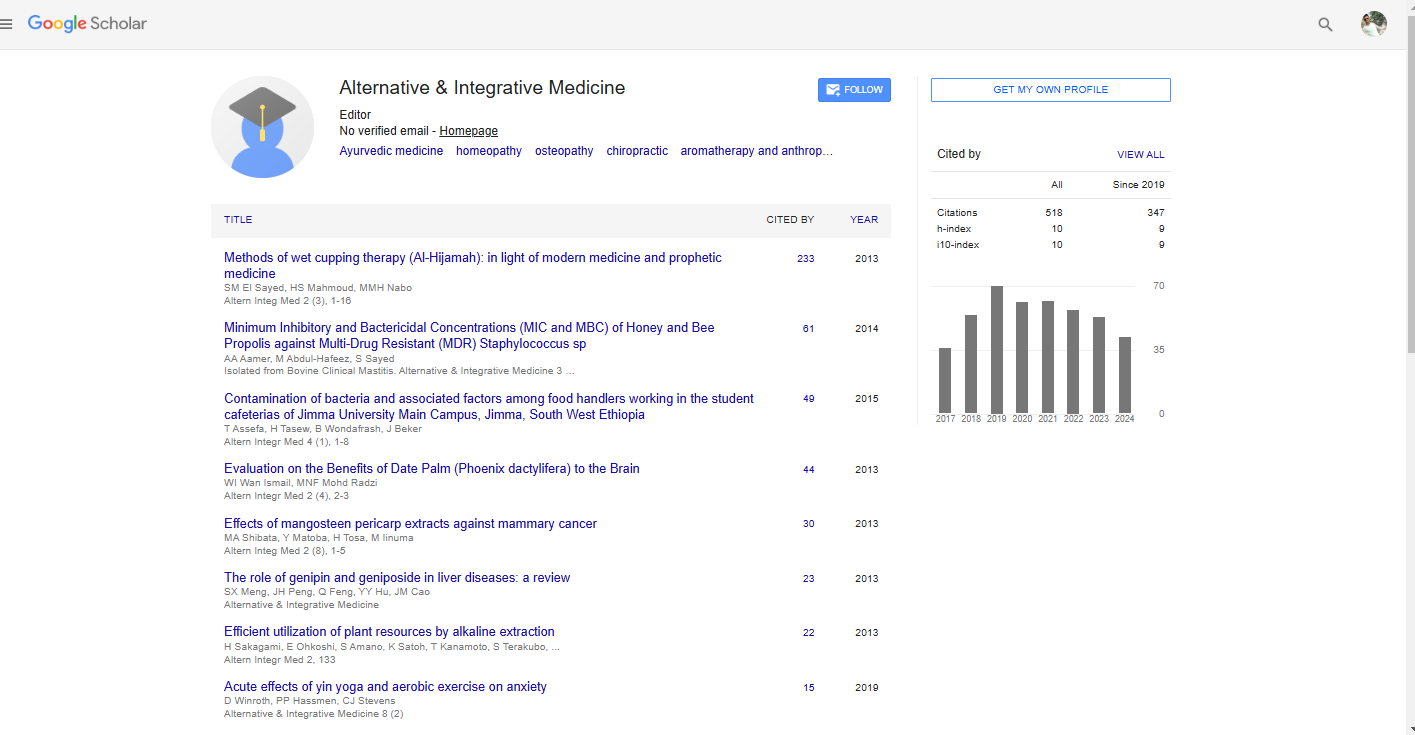
Alternative & Integrative Medicine received 476 citations as per Google Scholar report