Short Communication - (2025) Volume 14, Issue 4
Received: 03-Aug-2025, Manuscript No. jnc-25-173967;
Editor assigned: 05-Aug-2025, Pre QC No. P-173967;
Reviewed: 19-Aug-2025, QC No. Q-173967;
Revised: 25-Aug-2025, Manuscript No. R-173967;
Published:
30-Aug-2025
, DOI: 10.37421/2167-1168.2025.14.723
Citation: Gallagher, Patrick. ”Healthcare Workforce: Adapting, Supporting, Thriving.” J Nurs Care 14 (2025):723.
Copyright: © 2025 Gallagher P. This is an open-access article distributed under the terms of the Creative Commons Attribution License, which permits unrestricted use, distribution and reproduction in any medium, provided the original author and source are credited.
Healthcare professionals faced significant burnout during the COVID-19 pandemic. Factors like heavy workloads, the constant fear of infection, and immense emotional strain contributed to this widespread issue. Research emphasizes that psychological interventions and supportive leadership are essential for managing this burnout and maintaining mental well-being in these highly demanding settings[1].
Strong and effective leadership is a cornerstone for retaining healthcare workers. Leaders who cultivate positive work environments, provide comprehensive support, and acknowledge staff contributions significantly boost job satisfaction and reduce staff turnover. This really means that supportive leadership styles are more vital than ever for ensuring workforce stability and continuity[2].
Given the immense pressure on healthcare workers, implementing robust mental health interventions is absolutely crucial. Various effective strategies have been identified, ranging from tailored psychological support programs to practical stress management training. These initiatives demonstrably improve mental well-being and build resilience among staff, which ultimately benefits the quality of patient care[3].
The healthcare sector is navigating dynamic workforce challenges, including persistent shortages and an uneven distribution of professionals. Addressing these issues demands innovative solutions. Looking ahead, considerable investment in training, seamless technology integration, and adaptable policy adjustments will be necessary to cultivate an adequate and well-prepared workforce capable of meeting both escalating patient needs and rapid technological advancements[4].
Artificial Intelligence (AI) is fundamentally reshaping the roles within healthcare. While AI excels at automating routine tasks and significantly enhancing diagnostic capabilities, it also requires healthcare professionals to evolve. They must adapt by sharpening their complex problem-solving abilities, developing emotional intelligence, and focusing on human-centric care, thereby complementing AIâ??s strengths rather than being replaced by them[5].
Ensuring the occupational safety of healthcare workers is paramount, especially during public health crises such as pandemics. This highlights the critical need for adequate Personal Protective Equipment (PPE), stringent infection control protocols, and comprehensive training programs. These measures protect staff from both physical and psychological hazards, which maintains overall workforce readiness[6].
Diversity, equity, and inclusion (DEI) are not merely ethical imperatives but also strategic advantages for the healthcare workforce. Implementing effective DEI initiatives leads to improved patient outcomes, enhances cultural competence across the board, and consistently boosts staff morale and retention. This is achieved by creating a work environment that is more representative and inherently equitable for everyone[7].
Medical education is rapidly adapting to meet the evolving demands of a changing healthcare landscape. Innovations in curriculum design, advanced simulation-based training, and effective interprofessional learning are crucial. These approaches equip the next generation of healthcare professionals with the essential skills, adaptability, and resilience required for delivering complex and patient-centered care[8].
Interprofessional collaboration is a foundational element in modern healthcare, enabling truly integrated care, significantly improved patient safety, and ultimately better patient outcomes. Effective teamwork effectively breaks down traditional silos between different disciplines, promoting shared decision-making and efficient resource utilization. This approach is essential for expertly managing complex patient needs in todayâ??s environment[9].
Healthcare professionals navigated unprecedented ethical dilemmas during the COVID-19 pandemic. These challenges included difficult decisions about resource allocation, establishing fair patient visitation policies, and addressing vaccine hesitancy. This era underscored a profound need for clear ethical frameworks, enhanced communication skills, and robust moral support systems to guide professionals through complex decisions under immense pressure[10].
The healthcare sector routinely navigates substantial challenges impacting its dedicated workforce, with burnout being a particularly pervasive issue. During the unprecedented COVID-19 pandemic, healthcare professionals experienced an alarming surge in burnout, largely fueled by overwhelming workloads, the pervasive fear of infection, and immense emotional and psychological strain. This highlights the critical importance of psychological interventions and supportive leadership in mitigating burnout and preserving mental well-being within these demanding environments [1]. Furthermore, the pandemic presented healthcare professionals with complex ethical dilemmas, requiring difficult decisions regarding resource allocation, patient visitation policies, and addressing vaccine hesitancy. This period powerfully underscored the need for clear ethical frameworks, refined communication skills, and robust moral support systems to guide professionals through such high-stakes decisions [10]. Maintaining occupational safety and health for healthcare workers is paramount, especially during crises. This necessitates adequate Personal Protective Equipment (PPE), strict infection control protocols, and comprehensive training to safeguard staff from both physical and psychological hazards, thereby ensuring workforce readiness and capability [6].
Strong and visionary leadership is undeniably crucial for retaining healthcare workers and cultivating a resilient, engaged workforce. Effective leaders are those who actively foster positive work environments, provide consistent and adequate support, and genuinely recognize staff contributions. These actions have a direct and significant impact on improving job satisfaction and reducing staff turnover rates. What this really means is that supportive leadership styles are more critical now than ever before for achieving long-term workforce stability and continuity [2]. Alongside leadership, the implementation of diversity, equity, and inclusion (DEI) initiatives serves as both an ethical imperative and a strategic advantage for the healthcare workforce. DEI efforts are proven to improve patient outcomes, enhance cultural competence across the organization, and significantly boost staff morale and retention by creating a more representative and equitable work environment for everyone [7].
Addressing the profound pressures faced by healthcare workers, the implementation of targeted mental health interventions is absolutely vital. This includes identifying and employing various effective strategies, from psychological support programs tailored to specific needs to practical stress management training. These initiatives are instrumental in contributing to improved mental well-being and building greater resilience among staff, which in turn profoundly benefits patient care quality and overall healthcare delivery [3]. Concurrently, medical education is undergoing rapid and necessary evolution to adequately meet the dynamic demands of a changing healthcare landscape. Innovations in curriculum design, advanced simulation-based training, and integrated interprofessional learning are crucial elements. These educational advancements aim to equip the next generation of healthcare professionals with the essential skills, adaptability, and resilience required for delivering complex and patient-centered care in a continually evolving field [8].
Looking ahead, the healthcare sector confronts evolving workforce challenges, including persistent shortages and an uneven distribution of professionals across various regions. Addressing these intricate issues necessitates innovative and forward-thinking solutions. The future truly demands significant investment in continuous training programs, seamless technology integration, and adaptable policy adjustments. This proactive approach is essential to ensure an adequate and well-prepared workforce, capable of effectively meeting the growing and diversifying patient needs while also embracing rapid technological advancements [4]. Artificial Intelligence (AI) is already fundamentally reshaping traditional healthcare roles. While AI offers immense potential to automate routine tasks and enhance diagnostic capabilities with greater precision, it simultaneously requires healthcare professionals to adapt. They must focus on developing advanced complex problem-solving skills, cultivating emotional intelligence, and prioritizing human-centric care, thus complementing AI's strengths rather than being superseded by them [5].
Ultimately, interprofessional collaboration stands as a foundational pillar of modern healthcare delivery. This approach enables truly integrated care, leading to significantly improved patient safety outcomes and better overall health results for patients. Effective teamwork actively breaks down traditional silos that often exist between different healthcare disciplines, fostering shared decision-making processes and ensuring efficient resource utilization. This collaborative paradigm is absolutely essential for expertly managing the increasingly complex and multifaceted needs of patients in today's intricate healthcare environment [9].
Healthcare professionals faced substantial burnout and ethical challenges during the COVID-19 pandemic, highlighting the critical need for psychological support and clear ethical frameworks. Ensuring occupational safety through adequate Personal Protective Equipment and infection control protocols is also paramount for workforce readiness. Strong, supportive leadership is vital for retaining healthcare workers, fostering positive environments, and recognizing contributions, which directly impacts job satisfaction and reduces turnover. Furthermore, diversity, equity, and inclusion initiatives are strategic advantages, improving patient outcomes, cultural competence, and staff morale. Implementing mental health interventions like psychological support programs and stress management training significantly improves staff well-being and resilience. Medical education is evolving to equip future professionals with necessary skills through innovations in curriculum and simulation training. The healthcare workforce faces future challenges like shortages, demanding investment in training, technology, and policy adjustments. Artificial Intelligence is reshaping roles, requiring professionals to adapt by focusing on complex problem-solving and human-centric care, complementing AI's strengths. Interprofessional collaboration is fundamental for integrated care, patient safety, and efficient resource utilization, essential for managing complex patient needs.
None
None
1. Huaiyan L, Yu Z, Jie Z. "Burnout among healthcare professionals during the COVID-19 pandemic: A systematic review and meta-analysis".Arch Psychiatr Nurs 35 (2021):162-177.
Indexed at, Google Scholar, Crossref
2. Sarah AJ, Benjamin DS, Catherine TJ. "The impact of leadership on healthcare worker retention: A systematic review".J Healthc Leadersh 14 (2022):1-12.
Indexed at, Google Scholar, Crossref
3. Andrea MHL, Natalie EDRL, Kelvin FCL. "Mental health interventions for healthcare workers: a systematic review and meta-analysis".BMJ Open 13 (2023):e069177.
Indexed at, Google Scholar, Crossref
4. Andrew RD, Michael PT, Lisa KW. "Future of the Healthcare Workforce: Challenges and Opportunities".Health Aff (Millwood) 42 (2023):1050-1057.
Indexed at, Google Scholar, Crossref
5. Siddharth MP, Rahul KS, Anjali VK. "The Impact of Artificial Intelligence on the Future Roles of Healthcare Professionals".J Med Syst 45 (2021):36.
Indexed at, Google Scholar, Crossref
6. Seon SK, Jae HP, Young SL. "Occupational safety and health for healthcare workers during the COVID-19 pandemic: A systematic review".Int J Environ Res Public Health 18 (2021):1219.
Indexed at, Google Scholar, Crossref
7. Patricia GW, David MB, Kevin AG. "Diversity, Equity, and Inclusion in the Healthcare Workforce: A Review of Current Practices and Future Directions".J Healthc Manag 67 (2022):15-28.
Indexed at, Google Scholar, Crossref
8. James MC, Lisa XW, Robert YL. "Innovations in medical education: preparing the next generation of healthcare professionals".Acad Med 95 (2020):1890-1896.
Indexed at, Google Scholar, Crossref
9. Sanjay NG, Rohit MS, Vikas PP. "The Importance of Interprofessional Collaboration in Modern Healthcare Delivery".J Interprof Care 37 (2023):220-226.
Indexed at, Google Scholar, Crossref
10. Muhammad RK, Asim SA, Syed ZH. "Ethical Challenges Faced by Healthcare Professionals in the Era of COVID-19".HEC Forum 32 (2020):257-270.
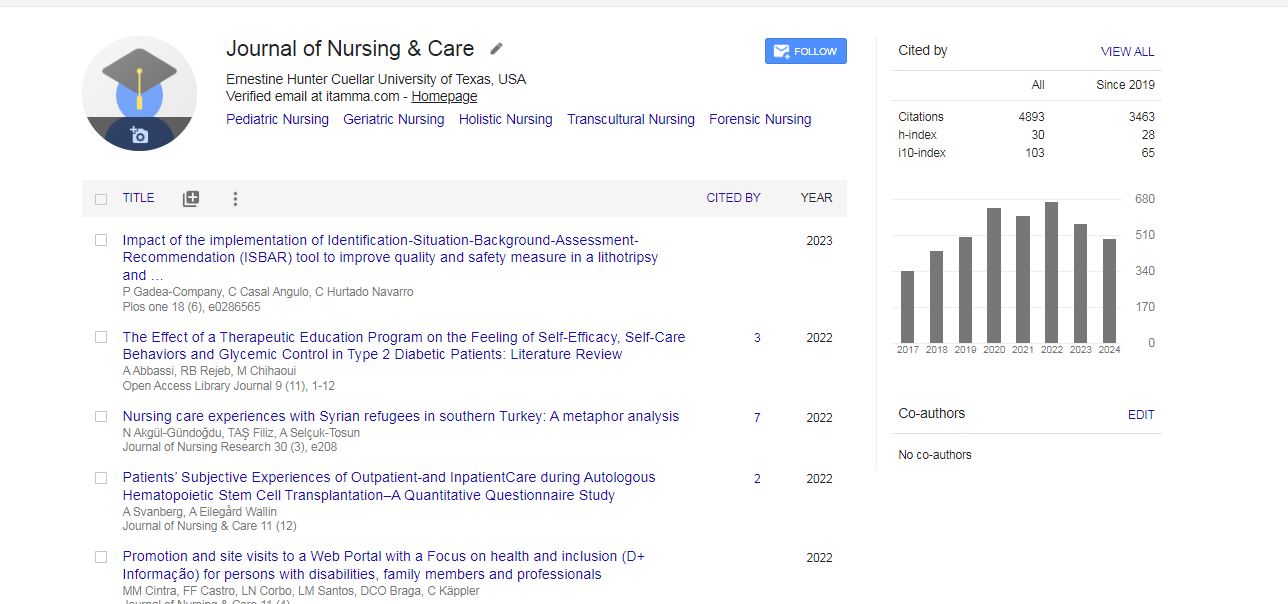
Journal of Nursing & Care received 4230 citations as per Google Scholar report