Commentary - (2025) Volume 10, Issue 5
Received: 01-Sep-2025, Manuscript No. apn-26-179336;
Editor assigned: 03-Sep-2025, Pre QC No. P-179336;
Reviewed: 14-Sep-2025, QC No. Q-179336;
Revised: 22-Sep-2025, Manuscript No. R-179336;
Published:
29-Sep-2025
, DOI: 10.37421/2573-0347.2025.10.454
Citation: Petrova, Elena. Health Informatics: Transforming Nursing Practice and Patient Outcomes. J Adv Practice Nurs 10 (2025):454.
Copyright: © 2025 Petrova E. This is an open-access article distributed under the terms of the Creative Commons Attribution License, which permits unrestricted use,
distribution and reproduction in any medium, provided the original author and source are credited.
Health informatics has emerged as a transformative force in advanced nursing practice, fundamentally reshaping how patient care is delivered and managed. It significantly enhances advanced nursing practice by improving data management, enabling evidence-based decision-making, and fostering patient safety. The integration of clinical data for better patient monitoring and personalized care plans is facilitated, leading to more efficient communication among healthcare teams. The application of informatics tools empowers practitioners to analyze trends, identify risks, and contribute to improved health outcomes and overall system efficiency [1].
Furthermore, advanced practice nurses are increasingly leveraging health informatics for enhanced clinical decision support systems. These systems analyze vast amounts of patient data to provide real-time recommendations, contributing to more accurate diagnoses and optimized treatment plans. This integration is crucial for reducing medical errors and improving patient safety. Informatics also plays a pivotal role in the expansion of telehealth and remote patient monitoring, thereby improving access to care and facilitating effective chronic disease management [2].
The implementation of electronic health records (EHRs) stands as a cornerstone of health informatics in advanced nursing. EHRs streamline documentation processes, enhance interdisciplinary communication, and facilitate the collection of valuable data for research and quality improvement initiatives. The effective utilization of EHRs by advanced practice nurses is essential for ensuring continuity of care and supporting the transition towards value-based healthcare models [3].
Data analytics, a key component powered by health informatics, is equipping advanced practice nurses with the ability to identify patient populations at risk and implement targeted interventions proactively. Predictive analytics, in particular, can forecast disease progression and potential patient deterioration, enabling a more proactive approach to patient care. This data-driven methodology is indispensable for enhancing health outcomes and optimizing the allocation of resources within complex healthcare systems [4].
Patient portals, an integral aspect of health informatics, are significantly enhancing patient engagement and fostering shared decision-making in advanced nursing practice. These portals empower patients by granting them access to their health information and facilitating direct communication with healthcare providers. This increased patient involvement leads to improved adherence to treatment plans and better overall health management [5].
Health informatics systems are recognized as critical tools for driving quality improvement and bolstering patient safety within advanced nursing practice. By aggregating and meticulously analyzing data pertaining to adverse events, near misses, and patient outcomes, informatics tools assist in pinpointing system vulnerabilities and implementing necessary corrective actions. This systematic approach underpins the principles of evidence-based practice and cultivates a robust culture of safety [6].
The integration of telehealth and mobile health (mHealth) applications, powerfully facilitated by health informatics, is actively transforming the landscape of advanced nursing practice. These innovative technologies enable remote consultations, continuous patient monitoring, and the effective delivery of health education. Consequently, they improve access to essential healthcare services for underserved populations and facilitate ongoing patient support [7].
Advanced practice nurses require the development of robust informatics competencies to effectively harness the capabilities of modern healthcare technologies. Comprehensive training in data interpretation, system usability, and data security is indispensable for these practitioners. This ensures they can translate technological advancements into tangible improvements in patient care and operational efficiency [8].
Interoperability among health information systems represents both a significant challenge and a crucial opportunity within the domain of health informatics for advanced nursing. Achieving seamless data exchange between disparate systems is vital for ensuring that comprehensive patient information is readily accessible to all healthcare providers. This accessibility is fundamental to achieving better coordinated care and minimizing redundancy in patient management [9].
The ethical considerations inherent in health informatics, particularly concerning data privacy and security, are of utmost importance for advanced practice nurses. Safeguarding patient data while simultaneously facilitating its judicious use for care delivery and research demands a profound understanding of ethical guidelines and regulatory frameworks. This diligent approach is essential for maintaining and strengthening patient trust [10].
Health informatics plays a crucial role in enhancing advanced nursing practice through improved data management, facilitating evidence-based decision-making, and promoting patient safety. It enables the seamless integration of clinical data for superior patient monitoring, the development of personalized care plans, and more efficient communication among healthcare teams, ultimately empowering practitioners to analyze trends and contribute to better health outcomes and system efficiency [1].
Advanced practice nurses are increasingly utilizing health informatics for sophisticated clinical decision support systems that analyze patient data to offer real-time recommendations, leading to more precise diagnoses and refined treatment strategies. This integration is vital for minimizing medical errors. Moreover, informatics is instrumental in the expansion of telehealth and remote patient monitoring services, thereby increasing healthcare accessibility and improving the management of chronic conditions [2].
The widespread implementation of electronic health records (EHRs) is a central element of health informatics in advanced nursing. EHRs significantly streamline documentation, enhance communication across different disciplines, and facilitate the systematic collection of data essential for research and quality improvement initiatives. Effective EHR utilization by advanced practice nurses is critical for maintaining continuity of care and supporting the shift toward value-based healthcare paradigms [3].
Data analytics, driven by advancements in health informatics, empowers advanced practice nurses to proactively identify at-risk patient populations and implement targeted interventions. The application of predictive analytics can forecast disease progression and patient deterioration, allowing for preemptive care measures. This data-centric approach is fundamental to improving health outcomes and optimizing resource allocation within healthcare organizations [4].
Patient portals, a significant component of health informatics, are enhancing patient engagement and promoting shared decision-making within advanced nursing practice. These portals provide patients with access to their health information and a channel for communication with providers, fostering active participation in their own care. This empowerment contributes to better adherence to treatment regimens and improved overall health management [5].
Health informatics systems are indispensable for driving quality improvement initiatives and enhancing patient safety in advanced nursing. By consolidating and analyzing data related to adverse events, near misses, and patient outcomes, informatics tools help identify systemic weaknesses and guide the implementation of corrective actions. This structured methodology supports evidence-based practice and cultivates a culture committed to safety [6].
The integration of telehealth and mobile health (mHealth) applications, greatly facilitated by health informatics, is revolutionizing advanced nursing practice. These technologies support remote consultations, enable continuous patient monitoring, and facilitate the delivery of health education, thereby expanding access to care for underserved populations and ensuring consistent patient support [7].
To effectively leverage contemporary healthcare technologies, advanced practice nurses must possess strong informatics competencies. Essential training encompasses data interpretation, system usability, and data security protocols, equipping them to translate technological capabilities into enhanced patient care and improved operational efficiency [8].
Interoperability among health information systems presents both considerable challenges and significant opportunities within health informatics for advanced nursing. Achieving the seamless exchange of data between diverse systems is crucial for ensuring that comprehensive patient information is available to all clinicians, ultimately leading to better coordinated care and reduced duplication of efforts [9].
The ethical dimensions of health informatics, including stringent data privacy and security measures, are of paramount importance for advanced practice nurses. Protecting patient data while enabling its use for care delivery and research necessitates a thorough understanding of ethical principles and regulatory frameworks, thereby preserving patient trust [10].
Health informatics is transforming advanced nursing practice by enhancing data management, evidence-based decision-making, and patient safety. It improves patient monitoring, personalization of care, and team communication through tools like electronic health records (EHRs) and data analytics. Informatics also enables clinical decision support systems, telehealth, and patient portals, leading to more accurate diagnoses, better chronic disease management, and increased patient engagement. These advancements require nurses to develop strong informatics competencies. Addressing ethical considerations like data privacy and security, as well as achieving system interoperability, are crucial for realizing the full potential of health informatics in improving patient outcomes and healthcare efficiency.
None
None
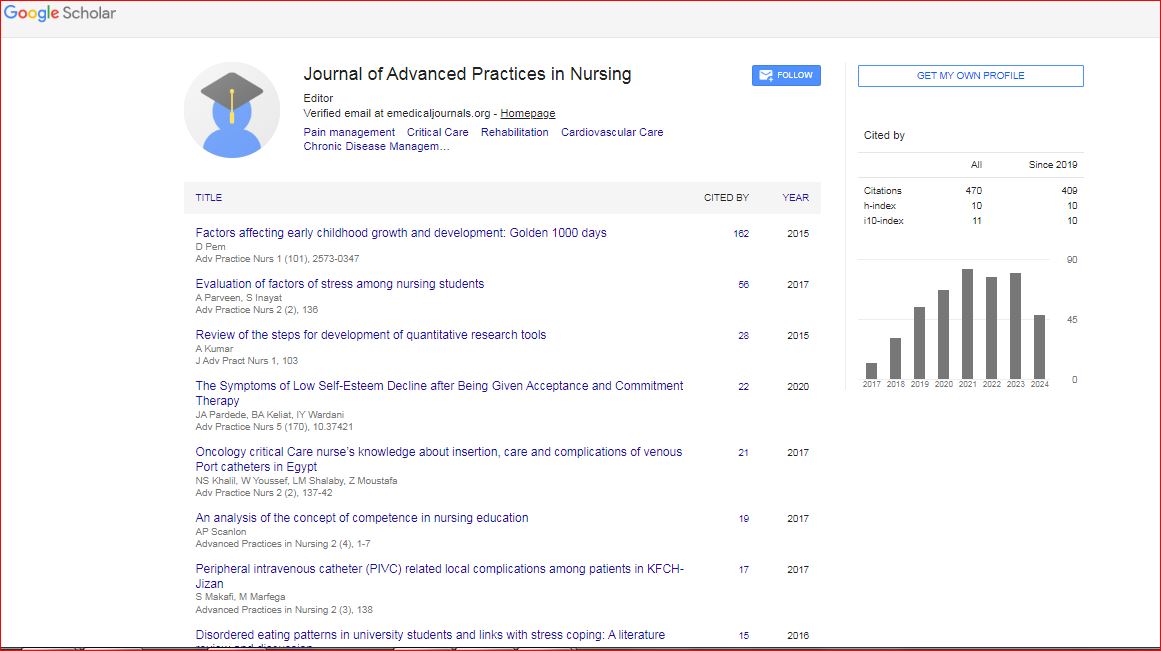
Journal of Advanced Practices in Nursing received 410 citations as per Google Scholar report