Perspective - (2025) Volume 16, Issue 5
Received: 01-Sep-2025, Manuscript No. jhmi-26-178879;
Editor assigned: 03-Sep-2025, Pre QC No. P-178879;
Reviewed: 17-Sep-2025, QC No. Q-178879;
Revised: 22-Sep-2025, Manuscript No. R-178879;
Published:
29-Sep-2025
, DOI: 10.37421/2157-7420.2025.16.614
Citation: Petrov, Boris A.. ”Health Informatics: Driving Preventive Medicine Through Innovation.” J Health Med Informat 16 (2025):614.
Copyright: © 2025 Petrov A. Boris This is an open-access article distributed under the terms of the Creative Commons Attribution License, which permits unrestricted use, distribution and reproduction in any medium, provided the original author and source are credited.
The transformative role of health informatics in advancing preventive medicine is increasingly evident, revolutionizing how we approach disease detection and management. Data analytics, artificial intelligence, and digital health tools are at the forefront of this paradigm shift, enabling earlier disease detection, personalized risk assessments, and the implementation of proactive health strategies. Innovations such as predictive modeling for disease outbreaks and wearable devices for continuous health monitoring are key components of this evolution, with AI-driven platforms further enhancing patient engagement in lifestyle modifications. The overarching goal is to reduce healthcare burdens and improve population health outcomes by shifting focus from reactive treatment to proactive prevention. The integration of machine learning algorithms into public health surveillance represents a critical innovation within preventive medicine. These algorithms possess the capability to analyze vast datasets originating from electronic health records, social media platforms, and environmental sensors. This comprehensive analysis allows for the identification of emerging health threats and more accurate prediction of disease patterns compared to traditional methodologies. Specific applications include forecasting influenza outbreaks and pinpointing populations at elevated risk for chronic diseases. The deployment of these powerful analytical tools for population-level prevention necessitates careful consideration of ethical implications and data privacy. Wearable technology and the Internet of Medical Things (IoMT) are fundamentally reshaping preventive healthcare by facilitating continuous, real-time monitoring of physiological data. This technological advancement allows for the detection of subtle physiological changes that may indicate impending health issues, such as cardiovascular events or metabolic imbalances, often before overt symptoms manifest. The ongoing integration of data streams from these devices presents both challenges in data management and significant potential for personalized interventions. This continuous data flow empowers individuals and healthcare providers to enact early and sustained preventive actions. The application of artificial intelligence within clinical decision support systems (CDSS) offers substantial advancements for preventive medicine. AI-powered CDSS are capable of analyzing a patient's comprehensive medical history, genetic predispositions, and lifestyle factors. Based on this analysis, they can furnish clinicians with evidence-based recommendations for highly personalized preventive care plans. A key benefit is the ability of these systems to identify individuals at high risk for specific diseases, suggest precisely targeted screening protocols, and guide effective lifestyle interventions, all with the ultimate aim of preventing disease onset or slowing its progression. Digital phenotyping, a novel approach to preventive medicine, derives insights from analyzing the digital footprints individuals leave across various online platforms. Patterns observed in smartphone usage, social media interactions, and other digital activities can reveal behavioral and psychological indicators that are strongly associated with mental health risks and the development of chronic diseases. By enabling the early identification of at-risk individuals through non-intrusive means, digital phenotyping supports the timely delivery of preventive interventions and the implementation of personalized health management strategies. The integration of genomics and bioinformatics into personalized preventive medicine holds immense promise. By analyzing an individual's unique genetic makeup, it becomes possible to identify predispositions to a wide range of diseases. This genetic information allows for the development of highly tailored screening protocols and lifestyle recommendations. The synergistic integration of genomic data with existing health informatics platforms fosters a proactive approach to managing health risks, with the potential to prevent the onset or mitigate the severity of both inherited conditions and complex multifactorial diseases. The development of predictive analytics for the effective management of population health represents a significant advancement in the field of preventive medicine. These sophisticated algorithms are designed to analyze aggregated health data, alongside socioeconomic factors and environmental determinants of health. This comprehensive analysis enables the forecasting of future health trends and the precise identification of communities facing elevated health risks. Such foresight is invaluable for public health organizations, allowing them to allocate resources more effectively and implement targeted preventive interventions before widespread outbreaks or substantial increases in chronic disease prevalence occur. The impact of big data analytics in understanding and addressing the social determinants of health is crucial for effective preventive medicine. By integrating diverse datasets that include information on housing, education, and employment with traditional health records, informatics systems can precisely identify how these social factors contribute to significant health disparities. This profound understanding is absolutely essential for the development of highly targeted preventive strategies that effectively address the root causes of poor health outcomes, particularly within vulnerable populations. The evolution of electronic health records (EHRs) into intelligent health information systems marks a cornerstone in modern preventive medicine. These advanced EHR functionalities include integrated risk assessment tools, patient portals designed for comprehensive health education, and automated reminders for necessary screenings. These features collectively empower both clinicians and patients to actively participate in proactive health management. The primary focus is on how these sophisticated systems facilitate continuous patient care and the implementation of highly personalized prevention strategies. The utilization of blockchain technology is being explored to enhance the security and interoperability of health data crucial for preventive medicine initiatives. Blockchain offers the capability to create secure, auditable, and patient-controlled health records. This facilitates the secure sharing of sensitive data for research purposes and the development of personalized prevention strategies, all while rigorously maintaining individual privacy. The potential for blockchain to improve data integrity and enable seamless data exchange across diverse healthcare providers represents a key innovation in this domain.
Health informatics is revolutionizing preventive medicine by leveraging data analytics, artificial intelligence, and digital health tools to enhance early disease detection and personalized risk assessment. These technologies facilitate the implementation of proactive health strategies, moving away from reactive treatment towards prevention. Key innovations include predictive modeling for disease outbreaks and wearable devices for continuous health monitoring, with AI-powered platforms boosting patient engagement in lifestyle changes. The ultimate aim is to reduce healthcare burdens and improve population health outcomes. Machine learning algorithms are critical for advancing public health surveillance within preventive medicine. By analyzing extensive datasets from electronic health records, social media, and environmental sensors, ML can more accurately identify emerging health threats and predict disease patterns than conventional methods. Applications range from forecasting influenza outbreaks to identifying high-risk populations for chronic diseases. Ethical considerations and data privacy are paramount when deploying these advanced analytical tools for population-level preventive measures. Wearable technology and the Internet of Medical Things (IoMT) are transforming preventive healthcare through continuous, real-time physiological data monitoring. This allows for the early detection of subtle health changes, such as impending cardiovascular events or metabolic imbalances, often before symptoms appear. While challenges exist in data integration, the potential for personalized interventions based on this constant data flow is significant, promoting sustained preventive actions and healthier lifestyles. Artificial intelligence integrated into clinical decision support systems (CDSS) provides significant advancements for preventive medicine. These AI-powered systems analyze patient histories, genetic predispositions, and lifestyle factors to offer clinicians evidence-based recommendations for personalized preventive care. They are instrumental in identifying high-risk individuals, suggesting targeted screening, and guiding lifestyle interventions to prevent disease onset or progression. Digital phenotyping offers a novel approach to preventive medicine by analyzing digital footprints to identify behavioral and psychological indicators of health risks. Patterns in smartphone usage, social media activity, and other digital interactions can signal potential mental health issues or chronic disease development. This non-intrusive method enables early detection, supporting timely preventive interventions and personalized health management. Genomics and bioinformatics are central to personalizing preventive medicine. Analyzing an individual's genetic makeup helps identify disease predispositions, enabling tailored screening and lifestyle advice. Integrating genomic data with health informatics platforms supports a proactive approach to managing health risks, potentially preventing or mitigating the impact of inherited and complex diseases. Predictive analytics are significantly advancing population health management in preventive medicine. By analyzing aggregated health data, socioeconomic factors, and environmental determinants, sophisticated algorithms can forecast health trends and identify high-risk communities. This foresight enables public health organizations to optimize resource allocation and implement targeted preventive interventions effectively. Big data analytics are crucial for understanding and addressing social determinants of health in preventive medicine. By combining diverse datasetsâ??including housing, education, and employment information with health recordsâ??informatics systems can pinpoint how these factors contribute to health disparities. This insight is vital for developing targeted preventive strategies that tackle the root causes of poor health in vulnerable populations. Intelligent health information systems, evolved from electronic health records (EHRs), are fundamental to modern preventive medicine. Advanced EHR features like integrated risk assessment, patient portals for education, and automated screening reminders empower clinicians and patients in proactive health management. These systems streamline continuous care and personalized prevention. Blockchain technology enhances the security and interoperability of health data for preventive medicine. It enables secure, auditable, and patient-controlled health records, facilitating data sharing for research and personalized prevention while safeguarding privacy. Blockchain's potential to improve data integrity and interoperability across healthcare providers is a key innovation.
This collection of research highlights the pivotal role of health informatics in advancing preventive medicine. Technologies such as artificial intelligence, machine learning, wearable devices, and digital phenotyping are enabling earlier disease detection, personalized risk assessment, and proactive health strategies. Predictive analytics and big data are being used for population health management and understanding social determinants of health. Genomics and bioinformatics offer tailored preventive approaches, while blockchain technology enhances data security and interoperability. Electronic health records are evolving into intelligent systems to support continuous and personalized preventive care.
None
None
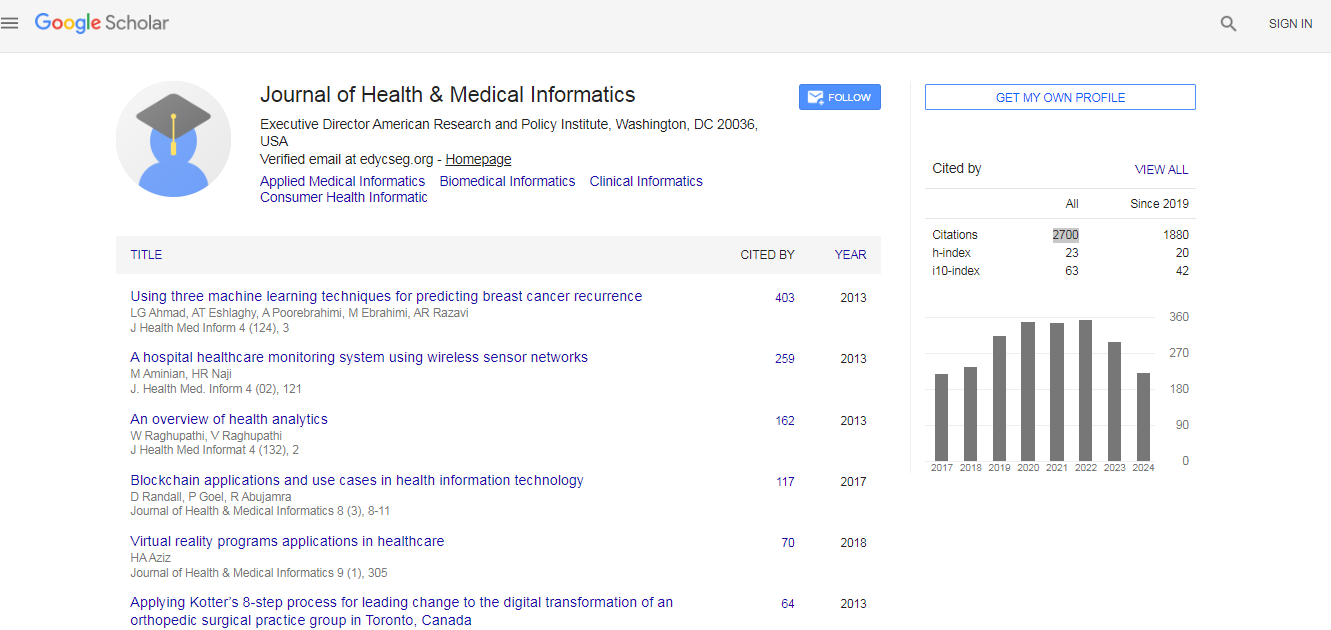
Journal of Health & Medical Informatics received 2700 citations as per Google Scholar report