Brief Report - (2025) Volume 9, Issue 6
Received: 01-Nov-2025, Manuscript No. jgdr-26-179207;
Editor assigned: 03-Nov-2025, Pre QC No. P-179207;
Reviewed: 17-Nov-2025, QC No. Q-179207;
Revised: 24-Nov-2025, Manuscript No. R-179207;
Published:
29-Nov-2025
, DOI: 10.37421/2684-6039.2025.09.291
Citation: Kostova, Maria. ”Gwas: Unraveling Genetic Basis Of Complex Diseases.” J Genet DNA Res 09 (2025):291.
Copyright: © 2025 Kostova M. This is an open-access article distributed under the terms of the Creative Commons Attribution License, which permits unrestricted use, distribution and reproduction in any medium, provided the original author and source are credited.
Genome-Wide Association Studies (GWAS) have fundamentally reshaped our comprehension of complex diseases by identifying genetic variants associated with disease risk. These comprehensive genomic scans aim to pinpoint genetic markers that correlate with specific conditions. For complex diseases, which are shaped by the interplay of multiple genes and environmental factors, GWAS have proven invaluable in identifying susceptibility loci, thereby opening new avenues for targeted therapies and preventive strategies by illuminating underlying biological pathways [1].
The interpretation of findings from GWAS for complex diseases presents a significant challenge due to their inherently polygenic nature. A majority of the identified variants exhibit small effect sizes, contributing only a modest increase to disease risk. Consequently, integrating GWAS data with other 'omics' technologies, such as transcriptomics and proteomics, alongside clinical data and environmental exposures, becomes essential for a holistic understanding of disease etiology. This multi-omics approach facilitates the unraveling of the functional consequences of associated genetic variants and their intricate interactions [2].
Statistical methodologies are in a constant state of evolution, aiming to enhance both the power and accuracy of GWAS, particularly in the context of rare variants and complex genetic interactions. Advanced imputation techniques enable the estimation of genotypes at ungenotyped markers, effectively increasing the sample size and improving the detection of associations. Concurrently, sophisticated statistical models are being developed to rigorously account for population stratification and relatedness, mitigating the risk of spurious associations [3].
The application of GWAS has yielded substantial insights across a spectrum of complex diseases, including cardiovascular diseases, diabetes, and psychiatric disorders. These investigations have identified numerous genetic loci that contribute to disease susceptibility, providing a critical foundation for understanding disease heterogeneity and individual risk profiles. The findings derived from GWAS are increasingly being integrated into clinical practice, informing genetic testing and risk stratification strategies [4].
Significant challenges persist within GWAS, including limitations in sample size, heterogeneity across populations, and the imperative for rigorous replication of findings. Meta-analyses, which combine data from multiple studies, are indispensable for achieving sufficient statistical power to detect associations with small effect sizes. Moreover, elucidating the functional impact of identified variants necessitates experimental validation, often involving techniques such as gene editing, cell-based assays, and the use of animal models [5].
Ethical considerations surrounding GWAS, encompassing data privacy, informed consent, and the potential for genetic discrimination, are of paramount importance. Ensuring responsible data sharing practices and robust privacy protections is critical. Furthermore, public engagement and education regarding the implications of genetic research are vital for fostering trust and facilitating the ethical advancement of the field [6].
The future trajectory of GWAS in the study of complex diseases is anticipated to involve larger and more diverse cohorts, the adoption of advanced analytical methodologies, and the seamless integration of varied data types. Precision medicine initiatives are heavily reliant on GWAS findings for stratifying patients, predicting treatment responses, and developing personalized interventions. Continuous technological advancements in genotyping and sequencing are expected to further refine the resolution and expand the scope of these crucial studies [7].
Fine-mapping approaches play a pivotal role in pinpointing causal variants within the broader regions identified by GWAS. These methods leverage high-density genotype data and statistical inference to prioritize candidate causal variants. A critical subsequent step involves understanding the functional implications of these causal variants through experimental validation, which is essential for translating GWAS discoveries into biological insights and potential therapeutic targets [8].
GWAS have significantly contributed to the study of rare diseases by identifying novel gene associations, although challenges persist due to typically limited sample sizes. Nevertheless, the collective efforts of consortia and the execution of meta-analyses are proving invaluable in bolstering statistical power. The insights generated are critical for enhancing diagnostic accuracy and paving the way for the development of gene-targeted therapies for rare genetic disorders [9].
The integration of machine learning and artificial intelligence is actively transforming the analysis of GWAS data. These computational approaches are adept at identifying complex, non-linear relationships between genetic variants and disease phenotypes that might be overlooked by traditional statistical methods. This synergy offers promising new possibilities for predicting disease risk and unraveling the intricate genetic architecture of complex traits [10].
Genome-Wide Association Studies (GWAS) represent a transformative approach in understanding complex diseases by identifying genetic variations linked to disease susceptibility. These studies systematically examine an individual's entire genome to detect genetic markers associated with particular conditions. For multifactorial diseases, influenced by numerous genes and environmental factors, GWAS have been instrumental in pinpointing genetic regions (loci) that confer increased risk. This has opened up novel avenues for developing targeted therapeutic interventions and preventive strategies by revealing the underlying biological mechanisms involved [1].
Interpreting the results of GWAS in the context of complex diseases is inherently challenging due to the polygenic nature of these conditions, where many genes contribute small effects. Most identified variants confer only a marginal increase in disease risk. Therefore, it is crucial to integrate GWAS data with other high-throughput 'omics' technologies, such as transcriptomics and proteomics, along with detailed clinical information and environmental exposure data, to achieve a comprehensive understanding of disease causation. This integrated multi-omics approach helps to elucidate the functional consequences of associated genetic variants and their interactions with other biological factors [2].
The field of statistical genetics is continuously advancing, with ongoing developments in methodologies designed to improve the power and accuracy of GWAS. This progress is particularly important for the analysis of rare genetic variants and the detection of complex gene-gene interactions. Sophisticated imputation techniques allow researchers to infer genotypes at ungenotyped markers, effectively expanding the dataset and enhancing the ability to detect subtle associations. Furthermore, advanced statistical models are being developed to address potential biases arising from population structure and relatedness among individuals, which can otherwise lead to erroneous findings [3].
The practical application of GWAS has led to significant advancements in the study of a wide array of complex diseases, including prevalent conditions like cardiovascular diseases, diabetes, and various psychiatric disorders. These studies have successfully identified numerous genetic loci contributing to disease susceptibility, thereby establishing a robust foundation for comprehending disease heterogeneity and developing personalized risk profiles for individuals. The knowledge gained from GWAS is increasingly influencing clinical decision-making through the implementation of genetic testing and risk stratification protocols [4].
Despite the successes, GWAS face several persistent challenges. These include limitations imposed by sample size, the inherent heterogeneity within study populations, and the critical need for rigorous replication of initial findings. To overcome the statistical limitations, particularly in detecting associations with small effect sizes, meta-analyses that aggregate data from multiple independent studies are essential. Furthermore, determining the functional significance of identified genetic variants requires dedicated experimental validation, often employing techniques like gene editing, cell-based assays, and studies in animal models [5].
The ethical, legal, and social implications (ELSI) of GWAS are critical and require careful consideration. Key concerns include ensuring the privacy of genetic data, obtaining fully informed consent from participants, and mitigating the risk of genetic discrimination by employers or insurers. It is imperative to establish responsible data sharing frameworks and implement robust privacy protection measures. Public engagement and education are also vital components for building trust and ensuring the ethical progress of genomic research [6].
The future of GWAS in unraveling the genetic basis of complex diseases hinges on several key developments. These include the establishment of larger and more ethnically diverse study cohorts, the refinement of advanced analytical methods, and the integration of a wider range of data types. Precision medicine initiatives, in particular, rely heavily on the insights generated by GWAS for patient stratification, predicting treatment efficacy, and designing personalized therapeutic strategies. Ongoing advancements in genotyping and sequencing technologies will undoubtedly further enhance the resolution and scope of future GWAS [7].
Fine-mapping strategies are crucial for precisely identifying the causal variants within genomic regions that have been flagged as statistically associated by GWAS. These sophisticated methods utilize high-density genotype data combined with statistical inference to prioritize specific candidate causal variants. A critical next step following fine-mapping is to elucidate the functional impact of these causal variants through experimental validation, which is indispensable for translating genomic discoveries into a deeper biological understanding and identifying actionable therapeutic targets [8].
GWAS have made significant contributions to the study of rare diseases, a field often constrained by limited sample sizes. These studies have successfully identified novel gene associations, and the power of consortia and meta-analyses has been crucial in overcoming statistical hurdles. The insights derived from these efforts are vital for improving diagnostic accuracy and are instrumental in the development of gene-specific therapies for rare genetic disorders [9].
The application of advanced computational techniques, specifically machine learning and artificial intelligence, is revolutionizing the analysis of GWAS data. These methods possess the capability to detect intricate non-linear relationships between genetic variants and disease phenotypes that may not be apparent with traditional statistical approaches. This integration of AI and machine learning holds immense potential for improving disease risk prediction and for a more profound understanding of the complex genetic architecture underlying various traits [10].
Genome-Wide Association Studies (GWAS) are pivotal in identifying genetic variants associated with complex diseases by scanning the entire genome. While they reveal susceptibility loci and inform targeted therapies, interpreting their findings is challenging due to the polygenic nature of diseases and small effect sizes of identified variants. Integrating GWAS with multi-omics data, clinical information, and environmental factors is crucial for a comprehensive understanding. Statistical methodologies are continually evolving to improve GWAS accuracy, especially for rare variants and complex interactions. These studies have provided significant insights into diseases like cardiovascular conditions, diabetes, and psychiatric disorders, informing clinical practice through genetic testing and risk stratification. Key challenges include sample size limitations and the need for replication, often addressed by meta-analyses. Ethical considerations regarding data privacy and potential discrimination are paramount. Future directions involve larger, diverse cohorts, advanced analytics, and AI integration for precision medicine. Fine-mapping is essential to pinpoint causal variants, and experimental validation is needed to understand their functional impact. GWAS also aids in studying rare diseases by identifying gene associations, crucial for diagnosis and gene-targeted therapies. Overall, GWAS represents a powerful tool for unraveling the genetic basis of disease.
None
None
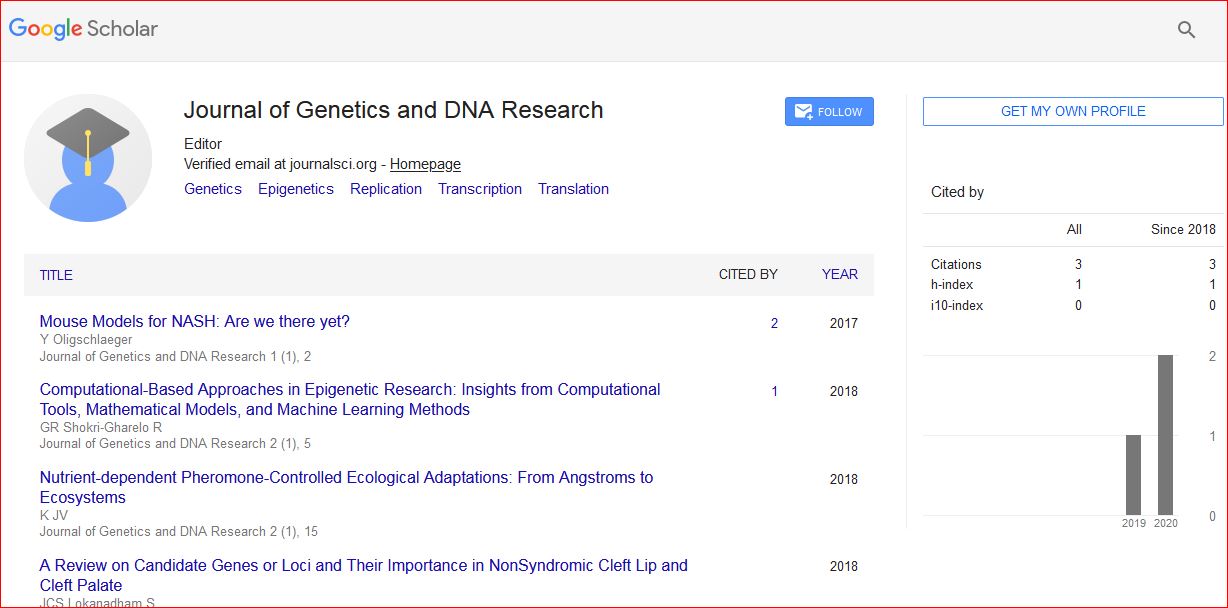
Journal of Genetics and DNA Research received 3 citations as per Google Scholar report