Commentary - (2025) Volume 9, Issue 2
Received: 02-Apr-2025, Manuscript No. jgge-25-173721;
Editor assigned: 04-Apr-2025, Pre QC No. P-173721;
Reviewed: 18-Apr-2025, QC No. Q-173721;
Revised: 23-Apr-2025, Manuscript No. R-173721;
Published:
30-Apr-2025
, DOI: 10.37421/2684-4567.2025.9.159
Citation: Alvarez, Rafael G.. ”GWAS: Powering Discovery and Precision Medicine.” J Genet Genom 09 (2025):159.
Copyright: © 2025 Alvarez G. Rafael This is an open-access article distributed under the terms of the Creative Commons Attribution License, which permits unrestricted use,
distribution and reproduction in any medium, provided the original author and source are credited.
Genome-wide association studies (GWAS) continue to evolve, with recent advancements in statistical methodologies significantly enhancing their power and resolution. These innovations move beyond single-SNP analysis, embracing fine-mapping, multi-omics integration, and machine learning approaches to dissect the genetic architecture of complex traits more effectively. What this really means is that these new methods are crucial for translating raw association signals into meaningful biological insights, thereby improving our understanding of disease mechanisms [1].
GWAS has made substantial progress in unraveling the genetic underpinnings of complex psychiatric disorders, including schizophrenia, bipolar disorder, and major depression. These studies have identified numerous risk loci and provided insights into shared genetic architecture across different conditions. Ultimately, GWAS has moved beyond simple associations to reveal intricate biological pathways and offer new avenues for therapeutic development [2].
The translational potential of genome-wide association studies is becoming increasingly evident, particularly in the realm of precision medicine. Investigations are exploring the practical applications of polygenic risk scores for disease prediction, prevention, and guiding therapeutic decisions. The discussion highlights an evolving understanding of genetic architecture, emphasizing that GWAS findings are moving beyond mere association to become actionable clinical tools, ultimately enhancing personalized healthcare strategies [3].
A critical area of focus is the need for greater ancestral diversity in GWAS to ensure genetic findings are equitably applicable across global populations. Current efforts review strategies for expanding cohorts to include underrepresented groups and discuss the methodological challenges and benefits of conducting GWAS in diverse populations. The core message is clear: increasing diversity is not just about fairness; here's the thing, it's essential for improving the predictive power and clinical utility of genetic discoveries for everyone [4].
Complementing traditional GWAS findings, insights from rare genetic variation are proving invaluable for a more comprehensive understanding of common diseases. Methods for integrating rare variant analysis with common variant associations are being discussed, highlighting how this combined approach offers a more complete picture of disease etiology. Essentially, by looking at both ends of the allele frequency spectrum, we gain deeper biological understanding and identify potential therapeutic targets [5].
GWAS has a powerful impact on identifying and validating drug targets. Genetic associations can provide robust evidence for causality, which helps reduce the risk of clinical trial failures. This means that by pinpointing specific genes and pathways implicated in disease, GWAS offers a clear roadmap for developing effective and safer therapeutics, fundamentally changing drug discovery pipelines [6].
In oncology, GWAS has progressed significantly in uncovering genetic susceptibility loci for various cancers. These studies have improved our understanding of cancer etiology, identifying both common and rare variants associated with different cancer types. What this really shows is that GWAS provides valuable insights for risk assessment, early detection, and the development of targeted prevention strategies in cancer [7].
The profound impact of GWAS extends to cardiovascular medicine. Numerous genetic loci associated with various cardiovascular diseases, including coronary artery disease, stroke, and hypertension, have been identified. Here's the thing: these discoveries have not only enhanced our understanding of disease mechanisms but are also paving the way for improved risk prediction, preventive strategies, and the development of novel therapies tailored to an individual's genetic profile [8].
Integrating GWAS data with functional genomics information is crucial for uncovering the molecular mechanisms underlying disease associations. Various computational methods combine data from eQTLs, chromatin accessibility, and other functional assays to pinpoint causal genes and regulatory elements. Let's break it down: this approach is critical for moving beyond statistical associations to understand the biological consequences of genetic variants, accelerating our understanding of disease pathology [9].
Finally, the intersection of GWAS and epigenetics is exploring how epigenetic modifications can mediate or modify the effects of genetic variants identified by GWAS. This addresses the challenges in integrating these two layers of biological information and highlights opportunities for a more comprehensive understanding of complex disease etiology, particularly gene-environment interactions. What this really means is that combining genetic and epigenetic insights offers a richer view of disease development and progression [10].
Genome-wide association studies (GWAS) have undergone significant methodological evolution, moving beyond simplistic single-SNP analyses to embrace more sophisticated approaches. Recent advances in statistical methodologies are enhancing the power and resolution of these studies, incorporating fine-mapping techniques, multi-omics integration, and machine learning. This comprehensive integration is crucial for effectively dissecting the intricate genetic architecture of complex traits. What this really means is that these innovations are pivotal for transforming raw genetic association signals into actionable biological insights, thereby deepening our understanding of underlying disease mechanisms and ultimately improving health outcomes [1].
The application of GWAS has yielded remarkable progress in specific disease areas, particularly within psychiatric disorders. Studies have successfully unraveled the genetic underpinnings of conditions like schizophrenia, bipolar disorder, and major depression, leading to the identification of numerous risk loci. These findings have not only elucidated the unique genetic components of individual disorders but also revealed shared genetic architectures across different psychiatric conditions. Here's the thing, this progression signifies a shift beyond basic associations, now revealing complex biological pathways and opening new avenues for therapeutic development and intervention strategies [2]. Similarly, the impact of GWAS is profound in oncology, uncovering genetic susceptibility loci for various cancers by identifying both common and rare variants associated with different cancer types. What this really shows is that GWAS provides valuable insights for risk assessment, early detection, and the development of targeted prevention strategies in cancer [7]. Moreover, in cardiovascular medicine, GWAS has made significant contributions by identifying numerous genetic loci linked to various cardiovascular diseases, including coronary artery disease, stroke, and hypertension. These discoveries have enhanced our understanding of disease mechanisms and are paving the way for improved risk prediction, preventive strategies, and the development of novel therapies tailored to an individual's genetic profile [8].
Beyond understanding disease, GWAS findings hold immense translational potential, particularly in advancing precision medicine. The practical applications of polygenic risk scores are being actively explored for their utility in disease prediction, prevention, and informing therapeutic decisions. This evolving understanding of genetic architecture emphasizes that GWAS outcomes are transitioning from mere statistical associations to robust, actionable clinical tools, which promise to enhance personalized healthcare strategies significantly [3]. Furthermore, the power of GWAS extends to drug discovery, where it plays a critical role in identifying and validating drug targets. Genetic associations offer robust evidence for causality, which is vital for reducing the high risk of clinical trial failures. By pinpointing specific genes and pathways implicated in disease, GWAS provides a clear roadmap for developing more effective and safer therapeutics, fundamentally reshaping modern drug discovery pipelines [6].
To ensure the equitable applicability and utility of genetic discoveries across global populations, there's a crucial emphasis on increasing ancestral diversity in GWAS. Efforts are underway to expand study cohorts to include historically underrepresented groups, addressing the methodological challenges and recognizing the substantial benefits of conducting GWAS in diverse populations. The core message here is that boosting diversity is not solely about fairness; it's essential for enhancing the predictive power and overall clinical utility of genetic findings for everyone, everywhere [4]. This approach is complemented by leveraging insights from rare genetic variations alongside traditional GWAS findings to gain a more complete understanding of common diseases. Integrating rare variant analysis with common variant associations helps to offer a more holistic picture of disease etiology. Essentially, by examining the full spectrum of allele frequencies, researchers can achieve deeper biological understanding and identify novel therapeutic targets [5].
Finally, the integration of GWAS data with functional genomics and epigenetic information represents a crucial next step for uncovering the molecular mechanisms underlying disease associations. Various computational methods are being developed to combine data from sources like eQTLs and chromatin accessibility, aiming to pinpoint causal genes and regulatory elements [9]. The intersection of GWAS and epigenetics specifically addresses how epigenetic modifications can mediate or modify the effects of genetic variants. Integrating these two layers of biological information tackles challenges and opens opportunities for a more comprehensive understanding of complex disease etiology, especially gene-environment interactions. What this really means is that combining genetic and epigenetic insights offers a richer, multi-faceted view of disease development and progression, moving beyond isolated genetic associations to a more integrated biological understanding [10].
Genome-wide association studies (GWAS) have significantly transformed our understanding of the genetic architecture underlying complex diseases and traits. Recent advancements in statistical methods for GWAS are enhancing their power and resolution, moving beyond single-SNP analysis to integrate multi-omics data and machine learning approaches, which helps translate raw association signals into biological insights. These studies have been crucial in unraveling the genetic underpinnings of complex psychiatric disorders like schizophrenia and bipolar disorder, identifying numerous risk loci and shared genetic architectures across conditions. What this really means is that GWAS provides intricate biological pathways and new avenues for therapeutic development. Furthermore, GWAS is poised to impact precision medicine, with practical applications of polygenic risk scores in disease prediction, prevention, and guiding therapeutic decisions, making these findings actionable clinical tools. There's a critical need for greater ancestral diversity in GWAS to ensure equitable applicability of genetic findings globally, as increasing diversity improves predictive power and clinical utility for everyone. Integrating rare genetic variation with common variant associations offers a more complete picture of disease etiology and identifies potential therapeutic targets. Here's the thing, GWAS has also proven powerful in identifying and validating drug targets, providing robust evidence for causality and reducing clinical trial failures by pinpointing specific genes and pathways. These studies have made substantial progress in oncology, uncovering genetic susceptibility loci for various cancers, and in cardiovascular medicine, enhancing understanding of disease mechanisms and paving the way for improved risk prediction and novel therapies. Ultimately, combining GWAS data with functional genomics and epigenetic information provides a comprehensive view of disease development and progression.
None
None
1. Xin L, Xiyan Y, Yun L. "Recent advances in statistical methods for genome-wide association studies".J Hum Genet 66 (2021):71-87.
Indexed at, Google Scholar, Crossref
2. Jian Y, Enda MB, Naomi RW. "Genome-wide association studies of psychiatric disorders".Lancet Psychiatry 6 (2019):947-957.
Indexed at, Google Scholar, Crossref
3. Michael EZ, Jessica VVR, Ewan RG. "The translational potential of genome-wide association studies".Transl Psychiatry 14 (2024):44.
Indexed at, Google Scholar, Crossref
4. Katrina ABFL, Amanda LS, Alisa KM. "Current efforts to increase diversity in genome-wide association studies".Trends Genet 39 (2023):569-583.
Indexed at, Google Scholar, Crossref
5. Jennifer EB, Emily KS, Lauren EJ. "Leveraging rare variation to dissect the genetics of common disease".Am J Hum Genet 107 (2020):567-578.
Indexed at, Google Scholar, Crossref
6. Eric SL, David MA, Stacey BG. "From GWAS to targets: how to use human genetics to enable drug discovery".Science 371 (2021):eaba6120.
Indexed at, Google Scholar, Crossref
7. Chen C, Xiaochang W, Weimin Y. "Recent advances in cancer genome-wide association studies".Genomics Proteomics Bioinformatics 20 (2022):994-1004.
Indexed at, Google Scholar, Crossref
8. Sekar K, Patrick TE, Daniel JR. "Genome-wide association studies in cardiovascular medicine".Nat Rev Cardiol 18 (2021):7-19.
Indexed at, Google Scholar, Crossref
9. Ran T, Weihao X, Yi L. "Integrative analysis of genome-wide association studies and functional genomics data".Brief Bioinform 22 (2021):bbab091.
Indexed at, Google Scholar, Crossref
10. Roneil GS, Kianoush K, Andrew DJ. "Bridging the gap between GWAS and epigenetics: challenges and opportunities".Front Genet 11 (2020):580978.
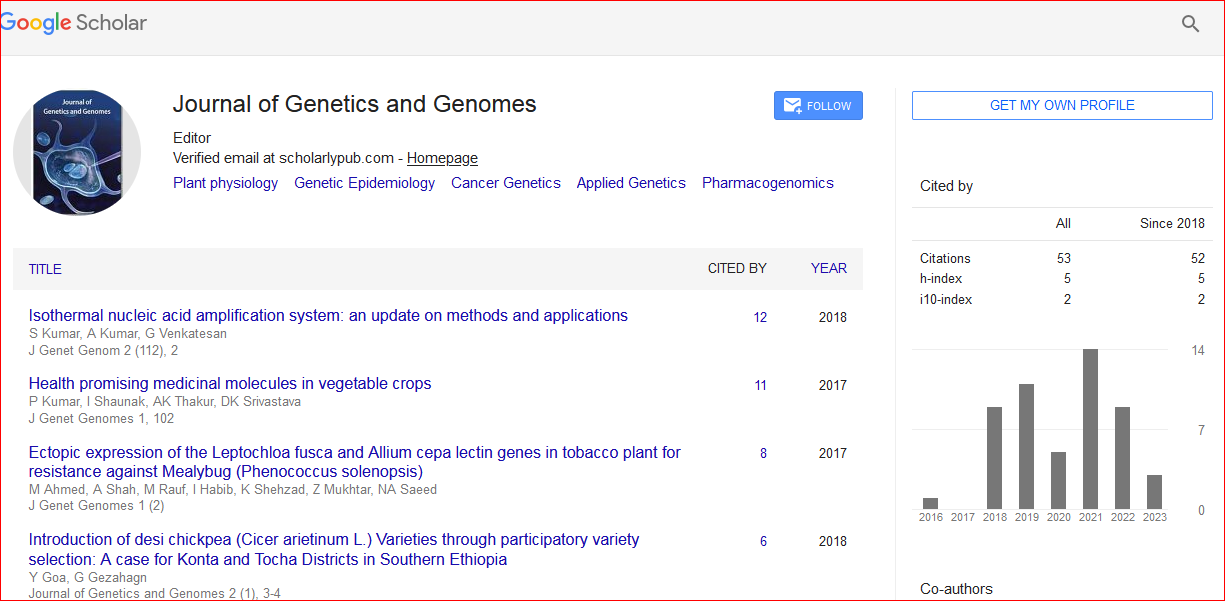
Journal of Genetics and Genomes received 65 citations as per Google Scholar report