Perspective - (2025) Volume 9, Issue 2
Received: 01-Apr-2025, Manuscript No. ahbs-26-182408;
Editor assigned: 03-Apr-2025, Pre QC No. P-182408;
Reviewed: 17-Apr-2025, QC No. Q-182408;
Revised: 22-Apr-2025, Manuscript No. R-182408;
Published:
29-Apr-2025
, DOI: 10.37421/2952-8097.2025.9.310
Citation: Silva, Jose R.. "Gut-Brain Axis: A Vital Network For
Health." J Anim Health Behav Sci 09 (2025):310.
Copyright: © 2025 Silva R. Jose This is an open-access article distributed under the terms of the Creative Commons Attribution License, which permits unrestricted use,
distribution and reproduction in any medium, provided the original author and source are credited.
The intricate relationship between the gut microbiome and the brain, known as the microbiome-gut-brain axis, is a fundamental aspect of animal health and behavior. This complex communication network plays a pivotal role in modulating various physiological processes within the host, including immunity and neurodevelopment, ultimately influencing critical behavioral aspects such as mood, cognition, and stress responses. Disruptions within this axis, stemming from factors like dietary imbalances, antibiotic use, or chronic stress, can precipitate significant alterations in behavior and contribute to disease development. Therefore, a comprehensive understanding of this bidirectional communication is paramount for devising effective strategies aimed at enhancing animal welfare and improving disease management outcomes [1].
Dietary interventions that specifically target the gut microbiome represent a highly promising avenue for effectively modulating animal behavior and overall health. The strategic incorporation of specific prebiotics and probiotics can lead to a reshaping of the microbial composition within the gut. This altered microbial landscape, in turn, promotes the production of beneficial metabolites that exert a direct impact on the gut-brain axis. Consequently, these interventions can translate into observable improvements, such as a reduction in anxiety-like behaviors and an enhanced capacity for stress resilience, underscoring the significant potential of nutritional science in the field of behavioral research [2].
The influence of the gut microbiome extends profoundly to the host's immune system, which is intrinsically and intricately linked with the brain's functions. A state of dysbiosis, characterized by an imbalance in the gut microbial community, can trigger persistent inflammatory responses. This chronic inflammation can propagate to the brain, leading to neuroinflammation and contributing to the manifestation of behavioral deficits. Recognizing and understanding this interconnected gut-immune-brain axis is therefore vital for developing effective approaches to manage inflammatory conditions and address their associated behavioral consequences in animals [3].
Exposure to antibiotics can have a substantial and often detrimental impact on the gut microbiome, frequently resulting in a reduction in microbial diversity and a significant alteration in the microbiome's functional capacity. These profound microbial changes can disrupt the delicate balance of the gut-brain axis, potentially leading to undesirable behavioral alterations and an increased susceptibility to stress. In light of these findings, the judicious use of antibiotics and the active exploration of alternative therapeutic strategies are crucial for maintaining the health of the gut microbiome and, by extension, for supporting optimal animal behavior [4].
Stress stands out as a particularly potent modulator of both the gut microbiome and the overall integrity of the gut-brain axis. Early life stress, in particular, can exert long-lasting effects on the composition of the gut microbiota and the developmental trajectory of the nervous system. These early-life experiences can ultimately lead to profound alterations in stress responses and the development of specific behavioral phenotypes. Therefore, gaining a deeper understanding of these stress-induced changes is of critical importance for enhancing animal welfare and for effectively mitigating the impact of stress-related disorders [5].
Metabolites produced by gut bacteria, with short-chain fatty acids (SCFAs) being a prime example, serve as critical signaling molecules within the gut-brain axis. These SCFAs possess the capacity to influence key neurological processes, including neurotransmitter synthesis, the integrity of the blood-brain barrier, and the modulation of neuroinflammation. By affecting these pathways, SCFAs can have a significant impact on mood and cognitive functions. Consequently, ongoing research into these microbial metabolites offers valuable insights into the identification of novel therapeutic targets for a range of conditions [6].
The substantial role of the gut microbiome in influencing animal behavior is increasingly being recognized and studied across a wide spectrum of species, encompassing both companion animals and livestock. A deeper understanding of species-specific microbial profiles and their distinct impacts on behavior is essential for the development of tailored management strategies. Such tailored approaches are critical for optimizing animal welfare and for enhancing overall productivity in various animal husbandry settings [7].
Neurotransmitters such as serotonin and dopamine, whose production and signaling are significantly influenced by the activity of gut microbes, are fundamental regulators of mood and behavior. Dysbiosis within the gut microbiome can lead to alterations in the synthesis and signaling pathways of these crucial neurochemicals, which can manifest as observable behavioral issues, including aggression or lethargy. Current research efforts are actively focused on elucidating the precise mechanisms through which gut bacteria exert their influence on these vital neurological pathways [8].
The vagus nerve acts as a primary and indispensable conduit for the bidirectional communication that occurs between the gut and the brain. Gut microbes possess the ability to activate vagal afferent pathways, thereby influencing a range of central nervous system functions. These functions are critical for regulating mood, appetite, and the body's overall stress response. Therefore, a thorough understanding of this vital neural connection is essential for fully comprehending the multifaceted scope and operation of the microbiome-gut-brain axis [9].
The field of animal behavior science is undergoing a significant evolution as it increasingly integrates research on the gut microbiome. This interdisciplinary approach is proving to be essential for advancing our fundamental knowledge regarding the biological underpinnings of animal behavior. Specifically, it is shedding light on how complex microbial communities influence critical cognitive and emotional processes such as learning, memory, social interactions, and emotional states, thereby paving the way for the development of novel therapeutic and management strategies in veterinary and animal science [10].
The microbiome-gut-brain axis represents a critical communication network that profoundly influences animal health and behavior. Gut microbiota play a significant role in modulating host physiology, immunity, and neurodevelopment, ultimately impacting mood, cognition, and stress responses. Disruptions in this axis, frequently caused by factors such as diet, antibiotic use, or stress, can lead to observable behavioral alterations and disease development. Understanding this bidirectional communication is key to developing effective strategies for improved animal welfare and disease management [1].
Dietary interventions targeting the gut microbiome offer a promising strategy for modulating behavior and health in animals. Specific prebiotics and probiotics can effectively shape the microbial composition, leading to the production of beneficial metabolites that exert influence on the gut-brain axis. This influence can manifest as reduced anxiety-like behaviors and improved stress resilience, highlighting the significant potential of nutritional strategies in the field of animal behavioral science [2].
The gut microbiome's influence extends to the immune system, which is intricately linked with the brain. Dysbiosis, or an imbalance in gut bacteria, can trigger chronic inflammation, impacting neuroinflammation and contributing to behavioral deficits. Comprehending this gut-immune-brain connection is vital for addressing inflammatory conditions and their associated behavioral manifestations in animals [3].
Antibiotic exposure significantly impacts the gut microbiome, often leading to reduced diversity and altered functional capacity. These changes can disrupt the gut-brain axis, potentially contributing to behavioral alterations and increased susceptibility to stress. Prudent antibiotic use and the exploration of alternatives are crucial for maintaining gut health and, consequently, for supporting positive animal behavior [4].
Stress is a potent modulator of the gut microbiome and the gut-brain axis. Early life stress, in particular, can have long-lasting effects on microbial composition and neural development, leading to altered stress responses and behavioral phenotypes. Understanding these stress-induced changes is critical for improving animal welfare and mitigating stress-related disorders [5].
Metabolites produced by gut bacteria, such as short-chain fatty acids (SCFAs), are key signaling molecules in the gut-brain axis. SCFAs can influence neurotransmitter synthesis, blood-brain barrier integrity, and neuroinflammation, thereby impacting mood and cognition. Research into these microbial metabolites offers insights into novel therapeutic targets for various conditions [6].
The gut microbiome's role in animal behavior is increasingly recognized across various species, including companion animals and livestock. Understanding species-specific microbial profiles and their impact on behavior can inform tailored management strategies to enhance animal welfare and productivity [7].
Neurotransmitters such as serotonin and dopamine, significantly influenced by gut microbes, are crucial for regulating mood and behavior. Alterations in the production and signaling of these neurochemicals due to gut dysbiosis can manifest as behavioral issues like aggression or lethality. Research is actively exploring the mechanisms by which gut bacteria modulate these vital pathways [8].
The vagus nerve serves as a primary conduit for communication between the gut and the brain. Gut microbes can activate vagal afferent pathways, influencing central nervous system functions related to mood, appetite, and stress. Understanding this neural connection is vital for comprehending the full scope of the microbiome-gut-brain axis [9].
The field of animal behavior science is increasingly integrating microbiome research to understand the biological underpinnings of behavior. This interdisciplinary approach is essential for advancing our knowledge of how microbial communities influence learning, memory, social interactions, and emotional states in animals, paving the way for novel therapeutic and management strategies [10].
The microbiome-gut-brain axis is a critical communication network impacting animal health and behavior. Gut microbiota influence physiology, immunity, and neurodevelopment, affecting mood, cognition, and stress. Disruptions due to diet, antibiotics, or stress can lead to behavioral changes and disease. Dietary interventions using prebiotics and probiotics can modulate the microbiome and improve behavior. The gut microbiome also interacts with the immune system, influencing neuroinflammation and behavior. Antibiotic exposure can negatively affect the gut microbiome and the gut-brain axis. Early life stress can have lasting impacts on the microbiome and behavior. Microbial metabolites, like SCFAs, act as signaling molecules influencing mood and cognition. The vagus nerve is a key communication pathway in this axis. Understanding this axis is vital for improving animal welfare and developing targeted strategies for managing behavior and disease.
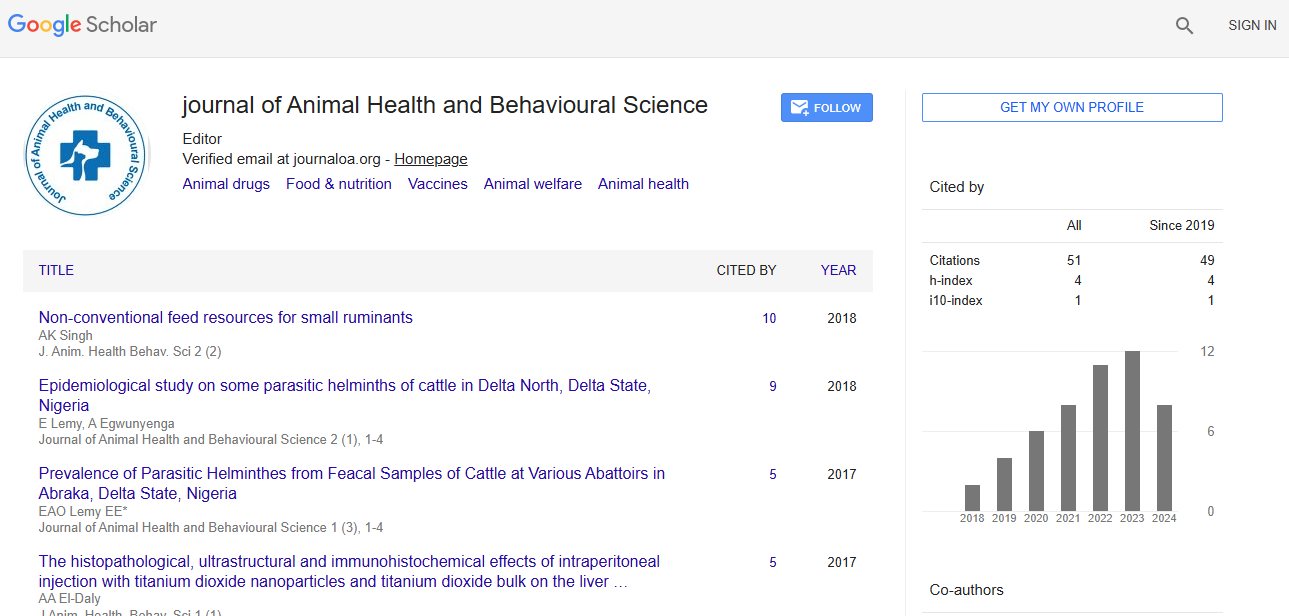
Journal of Animal Health and Behavioural Science received 38 citations as per Google Scholar report