Short Communication - (2025) Volume 15, Issue 6
Received: 01-Dec-2025, Manuscript No. mccr-25-178210;
Editor assigned: 03-Dec-2025, Pre QC No. P-178210;
Reviewed: 17-Dec-2025, QC No. Q-178210;
Revised: 22-Dec-2025, Manuscript No. R-178210;
Published:
29-Dec-2025
, DOI: 10.37421/2161-0444.2025.15.817
Citation: Osei, Benjamin K. ”Green Chemistry: Sustainable Drug Development.” Med Chem 15 (2025):817.
Copyright: © 2025 Osei K. Benjamin This is an open-access article distributed under the terms of the Creative Commons Attribution License, which permits unrestricted use, distribution and reproduction in any medium, provided the original author and source are credited.
The pharmaceutical industry is undergoing a transformative shift towards sustainability, driven by the imperative to minimize environmental impact and enhance human safety throughout the drug lifecycle. This evolution is underpinned by the principles of green chemistry, which are increasingly being integrated into every stage of drug development and manufacturing. The adoption of greener synthetic routes and the utilization of renewable feedstocks are fundamental to this approach, aiming to reduce reliance on finite resources and decrease the generation of hazardous byproducts. Furthermore, the development of biodegradable drug delivery systems is crucial for mitigating the long-term environmental persistence of pharmaceutical compounds [1].
Biocatalysis, leveraging the exquisite selectivity and efficiency of enzymes, presents a powerful sustainable alternative to conventional chemical catalysis. These biological catalysts operate under mild, often aqueous conditions, significantly reducing energy consumption and waste generation. Their ability to catalyze complex transformations, particularly in the synthesis of chiral intermediates, makes them highly valuable in modern pharmaceutical manufacturing [2].
Supercritical fluids, notably supercritical carbon dioxide (scCO2), are emerging as environmentally benign solvents in pharmaceutical processes. Their tunable solvency properties, combined with facile separation and the elimination of hazardous organic solvents, offer significant advantages for greener extraction and purification of active pharmaceutical ingredients (APIs), contributing to a reduced environmental footprint [3].
Flow chemistry, also known as continuous manufacturing, represents a significant paradigm shift in drug synthesis. This technology allows for precise control over reaction parameters, enhanced safety through smaller reaction volumes, and minimized waste generation. The ability to scale down reactor size and improve heat and mass transfer aligns perfectly with the objectives of green chemistry by promoting efficiency and reducing resource consumption [4].
Designing for degradation is a critical component of sustainable drug development, ensuring that drug molecules and their formulations break down into innocuous substances post-use. This proactive approach minimizes environmental persistence and reduces potential ecotoxicity, with biodegradable polymers for drug delivery systems serving as a prime example of this design philosophy [5].
Microwave-assisted organic synthesis provides substantial benefits by dramatically reducing reaction times, improving product yields, and lowering energy consumption compared to traditional heating methods. This efficient technique is highly applicable across various synthetic steps in drug discovery, thereby promoting greener and more efficient laboratory practices within the pharmaceutical sector [6].
Computational chemistry plays an indispensable role in the design of greener drugs and processes by enabling predictive modeling. This in silico approach allows for early assessment of the toxicity and environmental impact of potential drug candidates and synthetic intermediates, facilitating the prioritization of compounds with superior safety and sustainability profiles [7].
The development of novel catalytic systems, including organocatalysts and metal-organic frameworks (MOFs), significantly advances sustainable drug synthesis. These catalysts offer high activity and selectivity under mild reaction conditions, often serving as environmentally benign replacements for hazardous or precious metal catalysts, thereby leading to more sustainable chemical transformations [8].
Solvent selection is a paramount consideration in green pharmaceutical synthesis. The strategic replacement of volatile organic compounds (VOCs) with greener alternatives such as water, ionic liquids, or deep eutectic solvents can drastically reduce the environmental footprint associated with drug manufacturing. The choice of solvent profoundly influences reaction efficiency, product isolation, and overall process safety [9].
Lifecycle assessment (LCA) stands as a powerful analytical tool for comprehensively evaluating the environmental impact of drug development and manufacturing processes. By considering the entire lifecycle, from raw material sourcing to final disposal, LCA effectively identifies critical areas for improvement and guides the implementation of more sustainable practices across the pharmaceutical industry [10].
Green and sustainable chemistry principles are fundamental to the modern pharmaceutical industry, aiming to mitigate environmental harm and bolster safety throughout the drug development pipeline. This paradigm involves the deliberate adoption of greener synthetic routes, the strategic utilization of renewable feedstocks, and the creation of biodegradable drug delivery systems. These initiatives not only address pressing environmental concerns but frequently result in more cost-effective and efficient drug manufacturing processes, aligning economic viability with ecological responsibility [1].
The integration of biocatalysis, particularly through the use of enzymes, offers a highly sustainable alternative to traditional chemical catalysis in pharmaceutical synthesis. Biocatalysts are characterized by their exceptional selectivity and their ability to function under mild, aqueous conditions at ambient temperature and pressure, thereby substantially reducing waste generation. These attributes make them exceptionally attractive for the intricate synthesis of chiral intermediates essential for many modern pharmaceuticals [2].
Supercritical fluids, with supercritical carbon dioxide (scCO2) being a prominent example, are increasingly recognized for their utility as environmentally friendly solvents in drug development. They provide advantages such as tunable solvency, straightforward separation from reaction products, and the complete elimination of hazardous organic solvents, thereby contributing to significantly greener extraction and purification protocols for active pharmaceutical ingredients (APIs) [3].
Flow chemistry, also referred to as continuous manufacturing, is revolutionizing drug synthesis by providing enhanced control over reaction parameters, improved safety profiles, and a marked reduction in waste. This technology facilitates the miniaturization of reactors, optimizes heat and mass transfer, and enables on-demand production capabilities, all of which are in direct alignment with the core objectives of green chemistry [4].
Designing molecules for degradation is a critical aspect of developing sustainable pharmaceuticals. This involves the deliberate design of drug molecules and their associated formulations to ensure they break down into innocuous substances after their intended therapeutic use. This approach is vital for minimizing their persistence in the environment and reducing potential ecotoxicity, with biodegradable polymers in drug delivery systems serving as a key example [5].
Microwave-assisted organic synthesis presents significant advantages in terms of drastically reduced reaction times, improved reaction yields, and considerably lower energy consumption when compared to conventional heating methods. This technique is highly adaptable to a wide array of synthetic steps within drug discovery, thereby contributing to greener and more efficient laboratory practices [6].
Computational chemistry plays a vital role in the design of greener pharmaceuticals and manufacturing processes through predictive modeling. This in silico methodology allows for the early assessment of the potential toxicity and environmental impact of drug candidates and synthetic intermediates, thereby guiding the selection of compounds with favorable safety and sustainability profiles [7].
The advancement of novel catalytic systems, such as organocatalysts and metal-organic frameworks (MOFs), makes substantial contributions to the sustainability of drug synthesis. These catalysts often exhibit high activity and selectivity under mild reaction conditions, frequently replacing hazardous or precious metal catalysts and promoting more environmentally benign chemical transformations [8].
The judicious selection of solvents is a critical factor in achieving green pharmaceutical synthesis. The substitution of volatile organic compounds (VOCs) with greener alternatives, including water, ionic liquids, or deep eutectic solvents, can dramatically diminish the environmental footprint of drug manufacturing processes. The choice of solvent directly impacts reaction efficiency, product isolation strategies, and the overall safety of the process [9].
Lifecycle assessment (LCA) emerges as a robust tool for the comprehensive evaluation of the environmental impact associated with drug development and manufacturing. By meticulously considering every stage of a drug's lifecycle, from the extraction of raw materials to its ultimate disposal, LCA can pinpoint critical areas for environmental improvement and inform the implementation of more sustainable practices throughout the entire pharmaceutical industry [10].
The pharmaceutical industry is increasingly adopting green chemistry principles to enhance sustainability and safety in drug development and manufacturing. Key strategies include developing greener synthetic routes, using renewable resources, and designing biodegradable drug delivery systems. Biocatalysis, utilizing enzymes, offers selective and waste-reducing alternatives to traditional catalysis. Supercritical fluids like scCO2 provide environmentally friendly solvent options for extraction and purification. Flow chemistry enables better control, safety, and reduced waste through continuous manufacturing. Designing for degradation minimizes environmental persistence of drugs. Microwave-assisted synthesis and novel catalysts like organocatalysts improve efficiency and reduce energy consumption. Computational chemistry aids in predicting toxicity and environmental impact. Careful solvent selection, favoring greener alternatives, is crucial. Lifecycle assessment (LCA) provides a holistic approach to evaluating and improving environmental performance throughout a drug's existence.
None
None
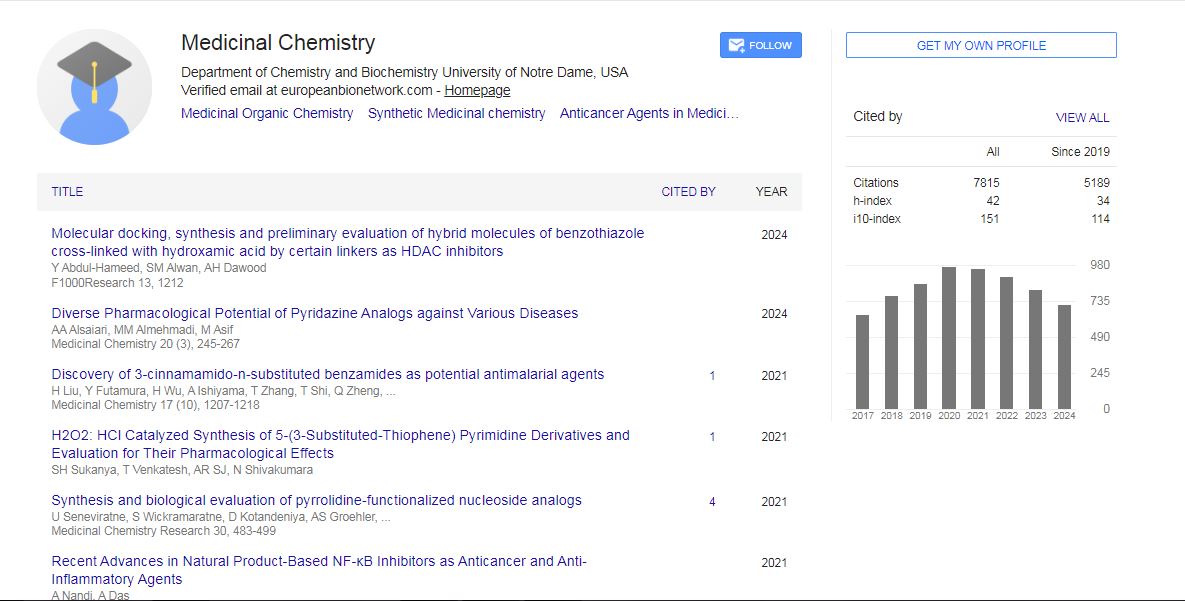
Medicinal Chemistry received 6627 citations as per Google Scholar report