Commentary - (2025) Volume 12, Issue 6
Received: 01-Dec-2025, Manuscript No. jreac-26-185808;
Editor assigned: 03-Dec-2025, Pre QC No. P-185808;
Reviewed: 17-Dec-2025, QC No. Q-185808;
Revised: 22-Dec-2025, Manuscript No. R-185808;
Published:
29-Dec-2025
, DOI: 10.37421/2380-2391.2025.12.462
Citation: Johansen, Ingrid. ”Green Analytical Chemistry: Advancing Sustainable Practices.” J Environ Anal Chem 12 (2025):462.
Copyright: © 2025 Johansen I. This is an open-access article distributed under the terms of the Creative Commons Attribution License, which permits unrestricted use,
distribution and reproduction in any medium, provided the original author and source are credited.
The field of analytical chemistry is undergoing a significant transformation driven by the principles of green chemistry, aiming to minimize environmental impact while maintaining analytical efficacy. This shift is crucial in addressing the growing concerns about chemical waste generation and the sustainability of laboratory practices. A key focus is on developing and implementing strategies that reduce waste at its source, moving towards more environmentally benign analytical methodologies [1].
The adoption of bioanalytical methods presents a promising avenue for greener environmental monitoring. These approaches often require smaller sample volumes and produce less chemical waste compared to traditional techniques, aligning with the goals of sustainable science [2].
Supercritical fluids, such as carbon dioxide, are emerging as valuable green solvents in chromatographic separations. Their use in supercritical fluid chromatography (SFC) offers advantages in reducing organic solvent consumption and enhancing separation efficiency, thereby contributing to waste reduction [3].
Microfluidic devices represent another significant advancement in sustainable analytical chemistry. By miniaturizing analytical systems, these devices drastically reduce the consumption of samples and reagents, leading to greener processes with lower waste generation and often improved sensitivity [4].
Ionic liquids are being explored for their potential as environmentally friendly solvents and catalysts in analytical extraction techniques. Their application can enhance extraction efficiency while simultaneously minimizing the generation of hazardous waste, contributing to greener analytical workflows [5].
Microwave-assisted extraction (MAE) is a valuable green sample preparation technique that offers substantial benefits in reducing extraction times, solvent consumption, and energy usage. This leads to a notable decrease in laboratory waste generation, promoting more sustainable analytical practices [6].
Renewable solvents, particularly deep eutectic solvents (DESs), are gaining traction in analytical chemistry as alternatives to hazardous organic solvents. Their utilization can significantly reduce waste and improve the overall sustainability of analytical procedures, making them a key area of research [7].
The principles of analytical sustainability extend to various analytical techniques, including spectroscopy. By optimizing methods, reducing sample sizes, and employing greener reagents, waste generation in spectroscopic analysis can be significantly minimized, promoting more environmentally conscious practices [8].
Solid-phase extraction (SPE) methods are being re-evaluated and developed with a focus on green sorbent materials and reduced solvent volumes. The objective is to minimize the environmental footprint associated with sample preparation, especially for environmental analysis, making these techniques more sustainable [9].
The integration of automation and robotics into analytical laboratories plays a vital role in enhancing efficiency and reducing waste. Automated systems offer precise control over reagent volumes and minimize manual operations, consequently leading to a substantial decrease in waste generation and a more sustainable laboratory environment [10].
Green analytical chemistry emphasizes waste reduction and the development of sustainable laboratory practices through various innovative approaches. One of the core principles involves minimizing the environmental footprint of chemical analysis by employing strategies such as solvent substitution, miniaturization, and the utilization of renewable resources [1].
In the realm of environmental monitoring, bioanalytical methods are being increasingly adopted as a green alternative. These methods, including biosensors and immunoassays, are designed to use less sample volume and generate considerably less chemical waste than conventional analytical techniques, supporting a more sustainable approach to environmental assessment [2].
Supercritical fluid chromatography (SFC) stands out as a green alternative for analytical separations, primarily due to its ability to employ supercritical fluids as mobile phases. This technique significantly reduces the consumption of organic solvents, which are often a major source of waste in traditional chromatography, and can also improve separation performance [3].
Microfluidic devices are instrumental in achieving greener analytical processes by enabling the miniaturization of analytical systems. This leads to a substantial reduction in the required sample and reagent volumes, consequently minimizing waste generation and often enhancing analytical sensitivity and efficiency [4].
The use of ionic liquids in analytical extraction techniques offers a promising pathway towards greener processes. These unique solvents can act as both environmentally friendly solvents and catalysts, improving extraction efficiency while markedly reducing the generation of hazardous waste streams [5].
Microwave-assisted extraction (MAE) is recognized for its efficiency and green credentials in sample preparation. By employing microwave energy, MAE significantly reduces extraction times, solvent volumes, and energy consumption, leading to a substantial decrease in the overall waste generated in analytical laboratories [6].
Deep eutectic solvents (DESs) are a class of renewable solvents being explored as sustainable alternatives to conventional organic solvents in analytical chemistry. Their application can lead to a considerable reduction in waste and enhance the overall sustainability of various analytical procedures, making them an attractive option for greener methodologies [7].
Sustainability in spectroscopy involves optimizing analytical methods to reduce waste. This includes minimizing sample sizes, using greener reagents, and refining operational parameters to achieve analytical goals with a lower environmental impact, thereby promoting greener spectroscopic analysis [8].
In the context of environmental sample analysis, greener solid-phase extraction (SPE) methods are being developed. These methods focus on utilizing environmentally friendly sorbent materials and minimizing solvent consumption, thereby reducing the environmental burden associated with sample preparation procedures [9].
Automation and robotics are increasingly integrated into analytical laboratories to bolster efficiency and minimize waste. Automated systems allow for precise control over experimental parameters, including reagent dispensing, which can significantly reduce the consumption of materials and the generation of waste, contributing to a more sustainable laboratory operation [10].
This collection of research highlights advancements in green analytical chemistry aimed at reducing environmental impact. Key strategies include the adoption of bioanalytical methods, supercritical fluid chromatography, and microfluidic devices to minimize sample and reagent usage. The use of green solvents like ionic liquids and deep eutectic solvents, along with techniques such as microwave-assisted extraction and greener solid-phase extraction, are crucial for waste reduction. Furthermore, sustainable practices in spectroscopy and the integration of automation in laboratories are essential for achieving environmentally friendly analytical processes. These collective efforts contribute to a more sustainable future for chemical analysis.
None
None
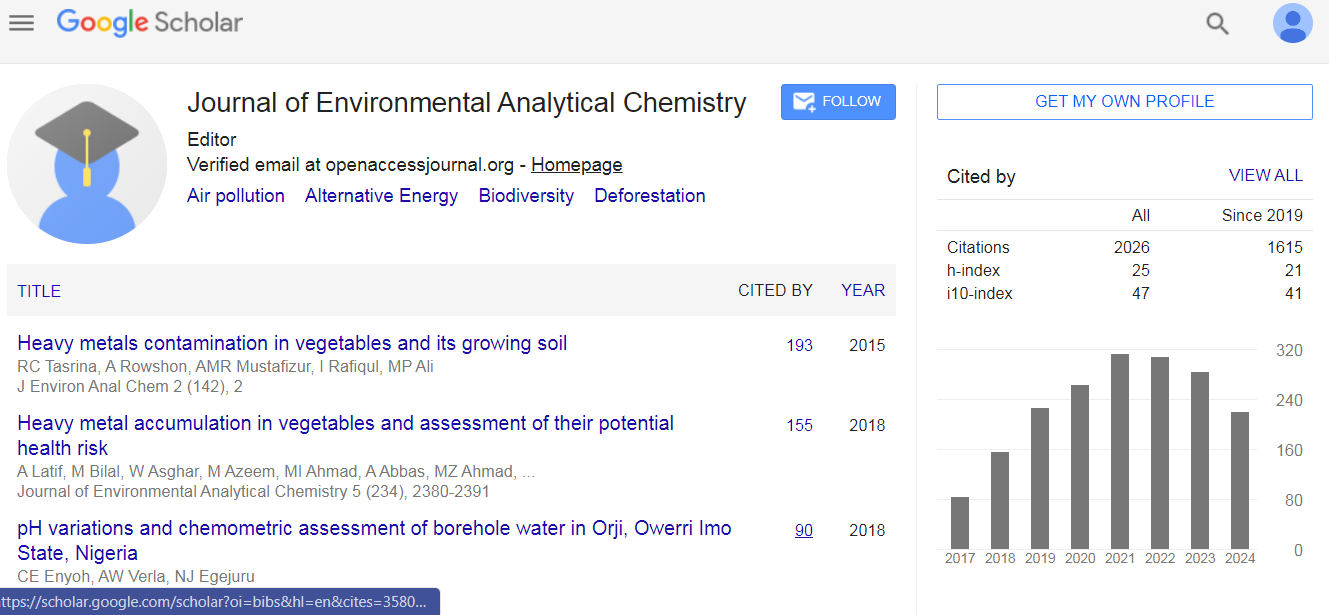
Journal of Environmental Analytical Chemistry received 1781 citations as per Google Scholar report