Brief Report - (2025) Volume 13, Issue 5
Received: 01-Sep-2025, Manuscript No. economics-26-186066;
Editor assigned: 03-Sep-2025, Pre QC No. P-186066;
Reviewed: 17-Sep-2025, QC No. Q-186066;
Revised: 22-Sep-2025, Manuscript No. R-186066;
Published:
29-Sep-2025
, DOI: 10.37421/2375-4389.2025.13.542
Citation: Rahman, Nur Aisyah. ”Globalization’s Impact: Growth,
Inequality, and Policy Solutions.” J Glob Econ 13 (2025):542.
Copyright: © 2025 Rahman A. Nur This is an open-access article distributed under the terms of the Creative Commons Attribution License, which permits unrestricted use,
distribution and reproduction in any medium, provided the original author and source are credited.
Globalization, propelled by the intricate web of interconnected supply chains, has fundamentally transformed the global distribution of income. While this phenomenon has spurred economic expansion and lifted a significant number of individuals out of poverty in various regions, it has concurrently amplified income disparities both within and between nations. This complex interplay is frequently attributed to a confluence of factors, including technological advancements that favor skilled labor, the contraction of manufacturing sectors in developed economies, and an uneven distribution of the benefits derived from international trade. A thorough examination of these dynamics necessitates a sophisticated analytical framework that meticulously considers trade policies, the adaptive capacities of labor markets, and the pivotal role of international governing bodies in shaping these outcomes [1].
The burgeoning complexity and fragmentation of global supply chains have been identified as significant contributors to the widening cholesm in income distribution. While multinational corporations often realize substantial cost reductions through these intricate networks, workers, particularly those in lower-skilled positions, frequently experience wage stagnation or outright job losses. This precarious situation is exacerbated by the ongoing trends of offshoring production and increasing automation, which further diminish the bargaining power of labor. Consequently, the study underscores an urgent need for proactive policy interventions, focusing on enhancing educational opportunities, facilitating robust retraining programs, and establishing comprehensive social safety nets to effectively mitigate these adverse socioeconomic consequences [2].
The multifaceted impact of globalization and the deepening integration of supply chains on income inequality is critically examined through the dual lenses of trade liberalization and rapid technological progress. The empirical findings strongly suggest a bifurcated effect: while the aggregate economic output of nations may witness an increase, the resultant gains are demonstrably not distributed equitably among the populace. The paper further articulates that the implementation of policies specifically designed to foster inclusive growth, such as substantial investments in human capital development and the reinforcement of labor market institutions, are absolutely crucial for effectively managing the complex distributional ramifications inherent in global economic integration [3].
This article undertakes a rigorous analysis of the intricate relationship between active participation in global supply chains and the discernible upward trend in income inequality observed predominantly within developed economies. It posits a compelling argument that the widespread outsourcing of manufacturing activities to countries with lower labor costs, when combined with the pervasive adoption of advanced automation technologies, has significantly eroded the bargaining power of low-skilled labor. This dynamic has, in turn, led to a widening chasm between the income generated by capital and that earned by labor. The authors advocate for the implementation of targeted policies aimed at stimulating domestic job creation and providing essential support for workers who have been displaced by these structural shifts [4].
The paper delves into the nuanced mechanisms through which globalization and the expansive proliferation of global supply chains exert their influence on income inequality across diverse segments of the workforce, particularly differentiating between skill groups. The central thesis suggests that while highly skilled workers typically benefit from heightened demand for their expertise and consequently command higher wages, low-skilled workers often encounter intensified competition and stagnant wage levels. In light of these findings, the study strongly advocates for substantial investments in education and continuous skills development initiatives as essential prerequisites for achieving a more equitable distribution of the economic benefits engendered by globalization [5].
This study meticulously examines the evolving characteristics of global supply chains and their profound implications for income inequality within developing economies. It highlights that while increased engagement in these complex chains can indeed generate new employment opportunities, it also carries the inherent risk of inducing wage polarization if not managed with careful consideration and strategic foresight. The authors place significant emphasis on the indispensable role of robust institutional frameworks and coherent policy coordination in ensuring that the advantages derived from supply chain integration are broadly and equitably shared among all segments of the population [6].
The paper offers a comprehensive and authoritative overview of the intricate ways in which globalization, specifically through the establishment and expansion of sophisticated global supply chains, has significantly influenced the patterns of income inequality on a worldwide scale. It elaborates on the theoretical pathways through which these transformative processes operate, encompassing the differential impacts on labor demand dynamics, the mechanisms of technological diffusion across borders, and the increasing mobility of capital. The authors emphatically underscore the paramount importance of concerted international cooperation and the implementation of well-designed national policies as critical imperatives for effectively addressing the profound distributional challenges that arise [7].
This research endeavor meticulously explores the differential impact that global supply chains exert on income inequality, specifically focusing on the internal dynamics within multinational corporations and their host countries. It critically examines how the strategic geographical distribution of different production stages and value-added activities profoundly influences prevailing wage structures and the overall distribution of income. The study strongly suggests that the adoption of policies designed to facilitate effective knowledge transfer and foster the development of local capacities is absolutely essential for achieving equitable economic development within these contexts [8].
The study undertakes a detailed analysis of the causal relationship between the increasing fragmentation of production processes and the notable rise in income inequality, particularly within the broader context of globalized supply chains. It posits that while this fragmentation can undeniably enhance operational efficiency and productivity, it simultaneously harbors the potential to precipitate greater wage disparities. This occurs because distinct tasks and roles within the intricate supply chain are often rewarded at significantly different levels. The paper subsequently proposes strategic approaches aimed at augmenting worker skills and fostering upward socioeconomic mobility throughout the entire value chain [9].
This article critically examines the profound influence that disruptions within global supply chains, such as those vividly experienced during recent global crises, have on the prevailing patterns of income inequality. It posits that while such disruptions invariably create short-term economic adversies for all involved, they disproportionately impact households with lower incomes. This exacerbation of existing inequalities stems from factors such as limited financial reserves, precarious employment situations, and diminished access to essential goods and services during periods of instability [10].
Globalization, driven by the interconnectedness of supply chains, has dramatically reshaped global income distribution. This process has led to economic growth and poverty reduction in some areas but has also widened income inequality within and between nations, influenced by factors like skill-biased technological change and the decline of manufacturing in developed countries [1].
The increasing complexity and fragmentation of global supply chains are identified as key drivers of growing income disparities. While firms benefit from cost efficiencies, lower-skilled workers often face stagnant wages or job losses due to offshoring and automation, highlighting the need for policies in education, retraining, and social safety nets [2].
Trade liberalization and technological advancements, within the framework of global supply chain integration, have a dual effect on income inequality. Although overall economic output may rise, the gains are not equitably distributed, underscoring the importance of inclusive growth policies like human capital investment and strengthened labor institutions [3].
In developed economies, participation in global supply chains, coupled with manufacturing outsourcing and automation, has weakened the bargaining power of low-skilled labor, widening the gap between capital and labor income. Policies promoting domestic job creation and supporting displaced workers are thus crucial [4].
Global supply chains influence income inequality by affecting labor demand differently across skill groups. Highly skilled workers tend to benefit from increased demand and wages, while low-skilled workers face greater competition and wage stagnation, emphasizing the need for investments in education and skills development for equitable benefit distribution [5].
For developing countries, increased participation in global supply chains can create employment but also lead to wage polarization if not managed effectively. Robust institutional frameworks and policy coherence are vital to ensure that the benefits of supply chain integration are broadly shared [6].
The formation of complex global supply chains has significantly influenced global income inequality through differential impacts on labor demand, technological diffusion, and capital mobility. Addressing these distributional challenges requires concerted international cooperation and well-designed national policies [7].
The geographical distribution of production stages within global supply chains influences wage structures and income distribution within multinational corporations and their host countries. Policies supporting knowledge transfer and local capacity building are essential for equitable development [8].
The fragmentation of production within global supply chains, while enhancing efficiency, can lead to greater wage disparities due to varying rewards for different tasks. Strategies to improve worker skills and foster upward mobility are proposed to mitigate this effect [9].
Disruptions in global supply chains disproportionately affect lower-income households, exacerbating existing inequalities due to limited savings, precarious employment, and reduced access to essential goods, as observed during events like the COVID-19 pandemic [10].
Globalization and the expansion of global supply chains have profoundly impacted global income distribution, leading to both economic growth and increased inequality. Factors such as technological change, outsourcing, and the uneven distribution of trade benefits contribute to this disparity. While firms often benefit from cost efficiencies, workers, particularly those with lower skills, face stagnant wages or job losses. This situation necessitates policy interventions focused on education, retraining, and social safety nets to ensure more equitable outcomes. Investments in human capital and the strengthening of labor market institutions are crucial for managing the distributional consequences of global economic integration. Furthermore, disruptions in supply chains can disproportionately affect vulnerable populations, highlighting the need for inclusive growth strategies and international cooperation.
None
None
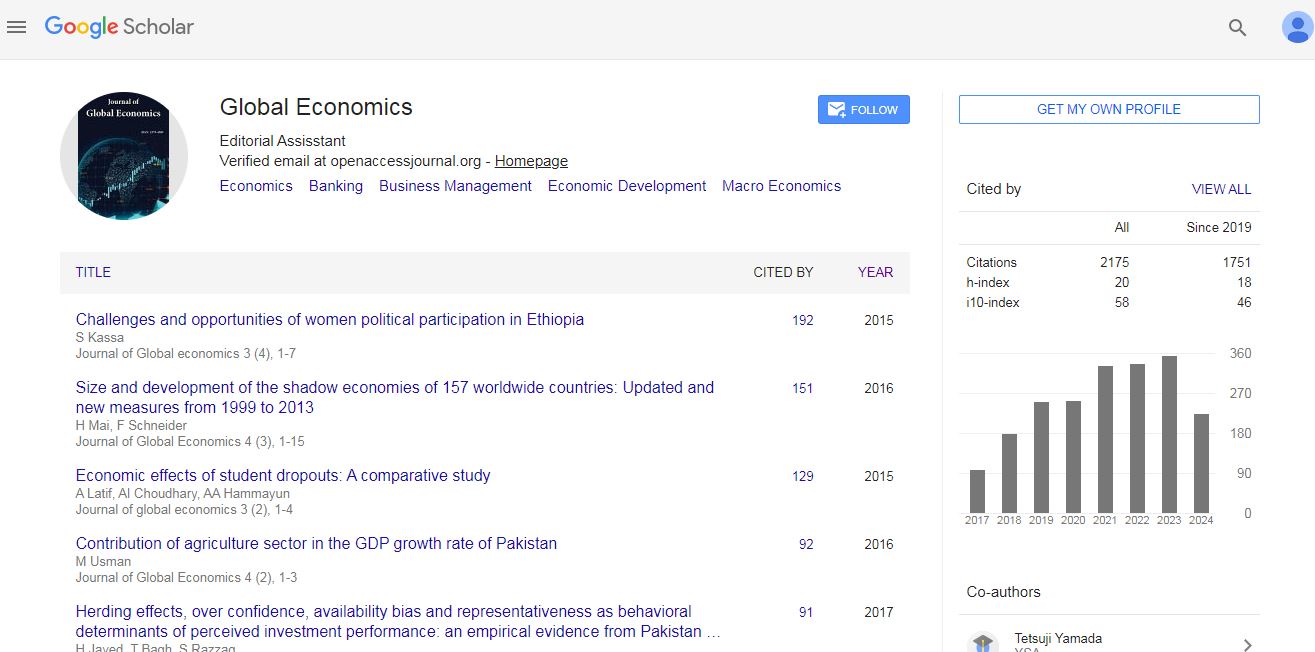
Journal of Global Economics received 2175 citations as per Google Scholar report