Opinion - (2025) Volume 16, Issue 4
Received: 01-Jul-2025, Manuscript No. hycr-25-174943;
Editor assigned: 03-Jul-2025, Pre QC No. P-174943;
Reviewed: 17-Jul-2025, QC No. Q-174943;
Revised: 22-Jul-2025, Manuscript No. R-174943;
Published:
29-Jul-2025
, DOI: 10.37421/2157-7587.2025.16.614
Citation: Marlowe, Ethan. ”Global Rivers: Climate, Human Driven Hydrological Change.” Hydrol Current Res 16 (2025):614.
Copyright: © 2025 Marlowe E. This is an open-access article distributed under the terms of the Creative Commons Attribution License, which permits unrestricted use,
distribution and reproduction in any medium, provided the original author and source are credited.
This study analyzes the hydrological impacts of land use and land cover changes (LULCC) in the upper Blue Nile River Basin, showing increases in agricultural land and decreases in forest cover between 1990 and 2017 led to notable changes in streamflow, surface runoff, and evapotranspiration. Specifically, converting natural vegetation to cropland intensified surface runoff and reduced baseflow, highlighting the basin's water resources vulnerability and the need for sustainable land management practices [1].
Research also investigates projected impacts of climate change on hydrological processes and water resources in the Yarlung Tsangpo River Basin, indicating a likely increase in temperature and precipitation. This leads to earlier snowmelt, increased glacier runoff, and altered river flow regimes, influencing timing and magnitude of streamflow, potentially affecting water availability for downstream regions. This highlights the need for adaptive water resource management strategies [2].
A comprehensive review offers insight into how global change, encompassing climate change and anthropogenic influences like dam construction and water withdrawals, impacts river flow regimes globally. It emphasizes that while climate change directly alters precipitation and temperature, human activities often exacerbate or modify these hydrological responses. This underscores the complexity of disentangling these drivers and the urgent need for integrated water management policies to sustain freshwater ecosystems and human water security [3].
Future changes in hydrological extremes, floods and droughts, are projected within the Danube River Basin using CMIP6 climate models. The analysis suggests a potential increase in the frequency and intensity of both extreme high and low flows, indicating heightened risk of hydrological hazards. These findings highlight the critical need for basin-wide adaptation strategies, improved flood and drought early warning systems, and transboundary water management to mitigate adverse impacts on ecosystems and human populations [4].
Another paper examines how urbanization globally alters river flow regimes, concluding that urban development typically leads to increased impervious surfaces. This accelerates surface runoff and decreases groundwater recharge, often resulting in higher peak flows during storm events (flash floods) and reduced baseflow during dry periods. Such changes severely impact aquatic ecosystems and urban water quality. The study emphasizes the critical need for sustainable urban planning that incorporates green infrastructure and stormwater management solutions [5].
A global synthesis assesses widespread impacts of large dams on river flow and sediment regimes worldwide. It quantifies how dams significantly reduce downstream river discharge, alter natural seasonal flow patterns, and trap vast amounts of sediment, leading to sediment starvation downstream. These changes drastically modify river morphology, impact riparian and aquatic ecosystems, and affect delta stability, underscoring profound and often irreversible environmental consequences of large-scale river fragmentation [6].
Streamflow predictions in data-scarce basins, using the Mekong River Basin as a case study, under scenarios of changing climate and land-use, demonstrate that combining remote sensing data with hydrological models can effectively overcome data limitations. Results indicate significant alterations in the Mekong's streamflow, with implications for water management, agriculture, and hydropower generation, emphasizing robust modeling approaches in regions with limited ground observations [7].
The combined effects of climate change on hydrological regimes and water availability in the Yellow River Basin, China, are evaluated. Using ensemble climate projections, it predicts a decrease in future annual runoff and increased variability, leading to greater water scarcity in this already water-stressed region. Findings highlight that while precipitation patterns are uncertain, rising temperatures will likely increase evapotranspiration and reduce effective runoff, posing significant challenges for agricultural irrigation, industrial water supply, and ecological preservation [8].
A review synthesizes long-term trends and variability in global river discharge, drawing on comprehensive analysis of observational records and model outputs. It identifies regional differences in discharge changes, with some areas experiencing significant increases (e.g., Arctic basins) and others decreases (e.g., arid and semi-arid regions). The paper attributes these trends to a combination of climate variability, climate change-induced alterations in precipitation and temperature, and increasing human water withdrawals, reflecting the dynamic nature of global freshwater resources [9].
Research investigates the distinct and combined impacts of climate change and human activities on river discharge in the Yangtze River Basin, China. It quantifies that while climate change influences natural hydrological cycles, human interventions, particularly dam construction and water diversion for irrigation, have been the dominant drivers altering the river's flow patterns. The study emphasizes the complex interplay between natural and anthropogenic factors, highlighting the challenge of sustainable water resource management in heavily exploited large river systems [10].
River basins worldwide face significant alterations to their hydrological regimes due to various global change drivers. For instance, the upper Blue Nile River Basin experienced notable changes in streamflow, surface runoff, and evapotranspiration between 1990 and 2017, primarily driven by land use and land cover changes (LULCC), particularly the expansion of agricultural land and reduction in forest cover. This conversion intensified surface runoff and reduced baseflow, underscoring the basinâ??s vulnerability and the critical need for sustainable land management practices [1]. Similarly, the Yarlung Tsangpo River Basin is projected to see increased temperature and precipitation, leading to earlier snowmelt, increased glacier runoff, and altered river flow regimes. These shifts will impact streamflow timing and magnitude, affecting water availability downstream and necessitating adaptive water resource management [2].
Another point is that a broader perspective reveals global change, encompassing both climate change and anthropogenic influences like dam construction and water withdrawals, significantly impacts river flow regimes worldwide. Climate change directly alters precipitation and temperature, yet human activities often exacerbate or modify these hydrological responses, creating a complex interplay that demands integrated water management policies to sustain freshwater ecosystems and human water security [3]. Focusing on extremes, the Danube River Basin is projected to experience an increase in the frequency and intensity of both floods and droughts under CMIP6 climate scenarios. These findings emphasize the urgent need for basin-wide adaptation strategies, improved early warning systems, and transboundary water management to mitigate adverse impacts [4].
Human-induced changes are profound. Urbanization, for example, globally alters river flow regimes by increasing impervious surfaces. This leads to accelerated surface runoff and decreased groundwater recharge, resulting in higher peak flows during storms (flash floods) and reduced baseflow during dry periods. These changes severely impact aquatic ecosystems and urban water quality, highlighting the necessity of sustainable urban planning and green infrastructure [5]. Large dams represent another major anthropogenic influence, globally reducing downstream river discharge and altering natural seasonal flow patterns. They trap vast amounts of sediment, causing sediment starvation downstream, which drastically modifies river morphology, impacts riparian and aquatic ecosystems, and affects delta stability. These are often irreversible environmental consequences of large-scale river fragmentation [6].
Addressing these complex changes often requires advanced modeling. For data-scarce regions like the Mekong River Basin, combining remote sensing with hydrological models effectively projects future streamflow dynamics under changing climate and land-use scenarios. Significant alterations in the Mekongâ??s streamflow have implications for water management, agriculture, and hydropower, stressing the importance of robust modeling approaches [7]. In the Yellow River Basin, China, ensemble climate projections indicate a decrease in future annual runoff and increased variability, intensifying water scarcity. Rising temperatures are expected to increase evapotranspiration and reduce effective runoff, posing substantial challenges for agriculture, industry, and ecological preservation [8].
Synthesizing long-term trends in global river discharge from observational records and model outputs shows regional differences, with some Arctic basins experiencing increases and arid regions facing decreases. These trends are attributed to a combination of climate variability, climate change-induced alterations in precipitation and temperature, and increasing human water withdrawals, reflecting the dynamic nature of global freshwater resources [9]. Specifically, in the Yangtze River Basin, China, while climate change influences natural hydrological cycles, human interventions like dam construction and water diversion have been the dominant drivers altering the riverâ??s flow patterns. This complex interplay of natural and anthropogenic factors poses a significant challenge for sustainable water resource management in heavily exploited large river systems [10].
Global river basins are experiencing significant hydrological changes driven by both climate change and diverse human activities. Land use changes, particularly agricultural expansion, increase surface runoff and reduce baseflow, impacting water resources like in the Blue Nile Basin. Climate change is altering temperature, precipitation, snowmelt, and glacier runoff, leading to modified river flow regimes and affecting water availability in basins such as the Yarlung Tsangpo. The combined effects of climate change and anthropogenic factors, including dam construction and water withdrawals, exacerbate these alterations, influencing river flow globally and intensifying hydrological extremes like floods and droughts, as seen in the Danube River Basin. Urbanization similarly increases impervious surfaces, accelerating runoff and reducing groundwater recharge, which impacts urban water quality and aquatic ecosystems. Large dams globally reduce downstream discharge, alter flow patterns, and trap sediment, causing profound environmental consequences. Studies using hydrological models and remote sensing in data-scarce basins, like the Mekong, help predict these complex streamflow alterations. The Yellow and Yangtze River Basins illustrate how climate change, combined with human interventions, leads to decreased runoff, increased variability, and significant water scarcity, emphasizing the intricate challenge of managing freshwater resources sustainably amid these dynamic global changes.
None
None
Indexed at, Google Scholar, Crossref
Indexed at, Google Scholar, Crossref
Indexed at, Google Scholar, Crossref
Indexed at, Google Scholar, Crossref
Indexed at, Google Scholar, Crossref
Indexed at, Google Scholar, Crossref
Indexed at, Google Scholar, Crossref
Indexed at, Google Scholar, Crossref
Indexed at, Google Scholar, Crossref
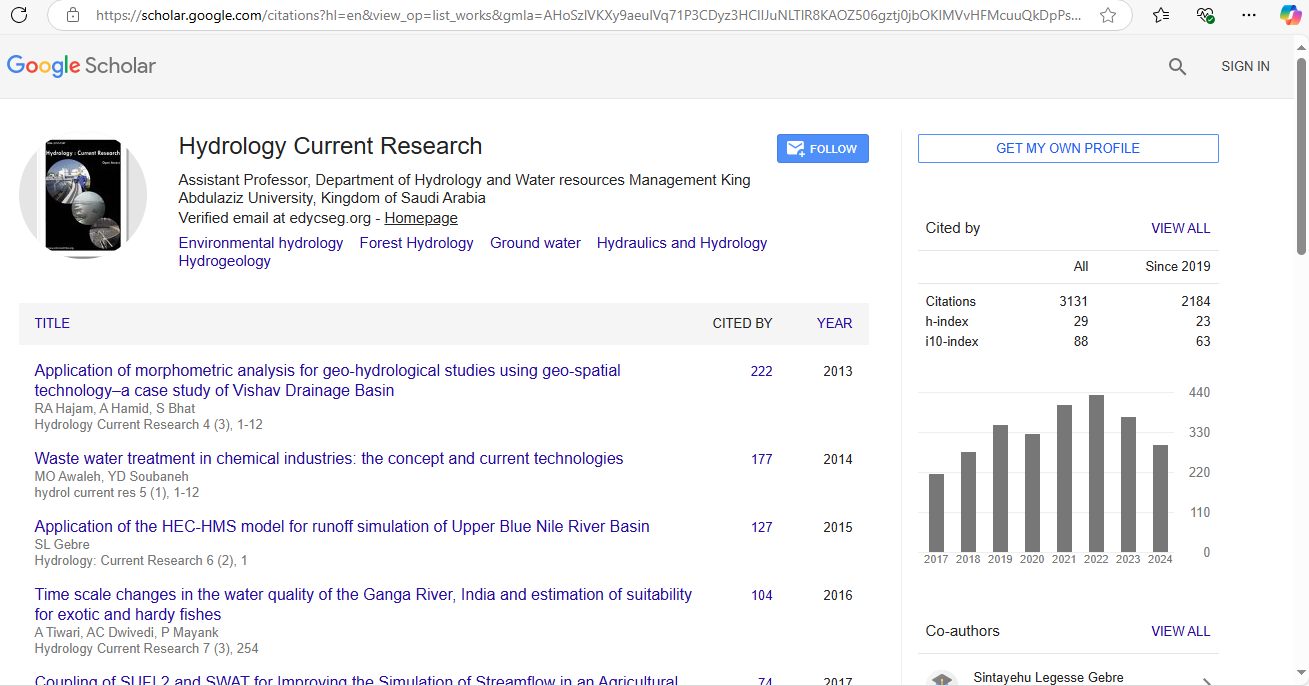
Hydrology: Current Research received 2843 citations as per Google Scholar report