Brief Report - (2025) Volume 15, Issue 5
Received: 01-Oct-2025, Manuscript No. jprm-25-174465;
Editor assigned: 03-Oct-2025, Pre QC No. P-174465;
Reviewed: 17-Oct-2025, QC No. Q-174465;
Revised: 22-Oct-2025, Manuscript No. R-174465;
Published:
29-Oct-2025
, DOI: 10.37421/2161-105X.2025.15.759
Citation: Varma, Arjun. ”Global Respiratory Medicine: Innovations and Progress.” J Pulm Respir Med 15 (2025):759.
Copyright: © 2025 Varma A. This is an open-access article distributed under the terms of the Creative Commons Attribution License, which permits unrestricted use, distribution and reproduction in any medium, provided the original author and source are credited.
This collection offers an insightful look into the complex world of respiratory health, highlighting significant advancements and challenges across diverse conditions. For instance, the current landscape for treating Chronic Obstructive Pulmonary Disease (COPD) is thoroughly examined, alongside a forward-looking perspective on where future therapeutic directions are headed. Key breakthroughs and active research initiatives are brought to light, providing a clear understanding of effective current treatments and innovations we can expect to see influencing patient care soon [1].
Focusing on severe asthma, a solid overview of its intricate diagnosis and effective management strategies is provided. Readers are brought up to speed on the latest approaches, with a strong emphasis on personalized care plans and the crucial impact of targeted therapies specifically designed to help patients navigate the complexities of this challenging and often debilitating condition [2].
Similarly, idiopathic pulmonary fibrosis receives a comprehensive, worldwide review, diligently covering everything from its initial recognition to the most effective management techniques. This paper serves as a vital resource for anyone seeking to understand the nuanced aspects of Idiopathic Pulmonary Fibrosis (IPF), meticulously detailing current diagnostic methods and the various treatment strategies employed across different global regions [3].
Significant and often life-changing strides in treating cystic fibrosis are also closely scrutinized within this body of work. The primary focus here is on the major advancements achieved in therapeutic approaches, particularly underscoring the transformative effect of Cystic Fibrosis Transmembrane Conductance Regulator (CFTR) modulators, which are profoundly reshaping what is possible for patients living with this chronic condition and improving their quality of life [4].
Furthermore, the latest and most impactful advancements in treating non-small cell lung cancer are explored in impressive depth. The discussion vividly details how new therapies are actively reshaping patient outcomes, giving special attention to groundbreaking targeted treatments and immunotherapies, which collectively represent considerable and hopeful progress in the ongoing fight against this formidable disease [5].
A critical review of severe acute respiratory infections details cutting-edge developments not only in their rapid diagnosis but also in their comprehensive management. It outlines the remarkable progress made in accurately identifying these infections, often quickly, and the evolving strategies for effective treatment, both of which are absolutely crucial for mitigating their widespread impact on public health [6].
Further insights are gained from articles exploring the latest discoveries in pulmonary hypertension, with a sharp focus on new understandings of how the disease develops at a fundamental level and the innovative treatments that are steadily coming forward. This provides a valuable and evolving perspective on the changing landscape of care for individuals facing this serious and often life-threatening condition [7].
Interstitial lung diseases are given a clear and concise examination, directly addressing the often-complex diagnostic process and outlining various practical strategies for managing them effectively. This acts as an essential guide for clinicians who are navigating the inherent challenges of Interstitial Lung Diseases (ILDs), offering current perspectives on recognized best practices [8].
A comprehensive, worldwide perspective on sleep apnea is also presented, offering crucial insights into its diagnosis and the diverse range of treatment approaches employed globally. This article powerfully underscores the widespread nature and impact of this condition, emphasizing the critical importance of tailored interventions for markedly improving patient health and overall quality of life on a global scale [9].
Lastly, the critical link between pervasive air pollution and the rising incidence of respiratory illnesses is meticulously analyzed from a crucial global viewpoint. This analysis profoundly highlights how environmental factors significantly affect lung health across the entire world, stressing the undeniable and urgent need for robust public health interventions and decisive policy changes to effectively lessen these significant and growing health risks [10].
This extensive collection offers an insightful and comprehensive look into contemporary respiratory medicine, exploring a wide array of conditions ranging from chronic, debilitating diseases to acute infections and the profound impacts of environmental factors. Key overarching themes evident across these articles include significant and often rapid advances in therapeutic strategies, the continuous refinement of diagnostic methodologies, and a crucial global perspective on disease prevalence and management. Together, these pieces collectively highlight the dynamic and ongoing evolution in our understanding and treatment of respiratory ailments, reflecting a commitment to improving patient lives globally [1, 2, 3, 4, 5, 6, 7, 8, 9, 10].
One prominent and particularly exciting area of advancement lies in the innovative treatment of several chronic and severe respiratory conditions. For Chronic Obstructive Pulmonary Disease (COPD), research delves deeply into understanding the current treatment landscape, while simultaneously casting an informed eye towards future innovations and potential breakthroughs in therapeutic approaches that promise to alleviate symptoms and slow disease progression [1]. Similarly, cystic fibrosis has witnessed truly exciting progress, especially through the profound and transformative impact of Cystic Fibrosis Transmembrane Conductance Regulator (CFTR) modulators, which are fundamentally reshaping patient care and vastly improving quality of life for those living with the condition [4]. In the challenging realm of oncology, specifically with non-small cell lung cancer, treatments are rapidly evolving. New therapies, such as highly targeted treatments and groundbreaking immunotherapies, are significantly reshaping patient outcomes and offering new hope [5]. These developments collectively underscore a critical shift towards more effective, precision-based, and tailored interventions that directly improve the quality of life and prognosis for a wide range of patients.
The areas of diagnosis and management remain absolutely critical components across many diverse respiratory diseases, with continuous and rigorous efforts being made to refine and implement best practices. Severe asthma, for example, greatly benefits from updated strategies that specifically emphasize personalized approaches and innovative targeted therapies, reflecting a deeper and more nuanced understanding of its inherent complexities [2]. Conditions like idiopathic pulmonary fibrosis (IPF) and interstitial lung diseases (ILDs) demand comprehensive and often intricate diagnostic methods coupled with diverse, flexible management strategies. These are frequently viewed from a global perspective to adequately account for significant regional differences in presentation and care [3, 8]. Furthermore, severe acute respiratory infections have experienced rapid progress in their accurate identification and the development of evolving, highly effective treatment protocols, which are undeniably vital for safeguarding public health and preventing widespread outbreaks [6]. The primary focus within these areas is on improving clinical outcomes through precise, timely, and evidence-based interventions.
Beyond the scope of specific diseases, this influential body of work also acutely emphasizes broader global health challenges and offers emerging, crucial insights into disease pathogenesis. Sleep apnea, for instance, is meticulously examined from a worldwide perspective, detailing its complex diagnosis and the wide variety of treatment approaches employed across different cultures and healthcare systems. This discussion powerfully highlights the widespread nature and impact of this condition, underscoring the necessity of tailored interventions to significantly improve patient health and overall quality of life on a global scale [9]. The critical and increasingly urgent link between pervasive air pollution and the rising incidence of respiratory illnesses is also thoroughly explored globally. This analysis profoundly highlights how environmental factors significantly affect lung health across the entire world, stressing the undeniable and urgent need for robust public health interventions and decisive policy changes to effectively lessen these significant and growing health risks [10].
Finally, new discoveries in pulmonary hypertension are shedding valuable light on its complex pathogenesis and concurrently leading to the emergence of innovative therapeutic strategies. This provides crucial and evolving insights into the changing landscape of care for individuals facing this serious and life-threatening condition [7]. Collectively, these articles powerfully illustrate a scientific and medical field deeply committed to advancing patient care through continuous, rigorous research and diligent clinical application. From the development of sophisticated genetic modulators to advanced immunotherapies, and from vital global epidemiological studies to refined diagnostic techniques, the unwavering push for better outcomes in respiratory health is abundantly clear. The emphasis on personalized care, international collaboration, and proactively addressing environmental determinants highlights a truly holistic and forward-thinking approach to tackling respiratory challenges worldwide.
This extensive collection reviews significant and recent advancements across the entire field of respiratory medicine, covering a broad spectrum of conditions from chronic obstructive diseases to acute infections and environmental health impacts. It thoroughly details both the current therapeutic landscape and offers a glimpse into future directions for Chronic Obstructive Pulmonary Disease (COPD) [1], while also highlighting substantial progress in severe asthma management through sophisticated personalized and targeted treatments [2]. Noteworthy advances in treating cystic fibrosis are discussed, particularly emphasizing the transformative impact of Cystic Fibrosis Transmembrane Conductance Regulator (CFTR) modulators on patient care [4]. The collection additionally covers critical breakthroughs in non-small cell lung cancer treatment, which include groundbreaking targeted therapies and innovative immunotherapies that are reshaping patient outcomes [5]. Global perspectives are consistently provided for complex conditions such as idiopathic pulmonary fibrosis, exploring its diagnosis and management [3], and for sleep apnea, detailing diverse treatment approaches worldwide [9]. A crucial link between air pollution and respiratory disease is also examined from a global viewpoint, underscoring environmental impacts and the need for public health interventions [10]. Furthermore, articles discuss recent developments in diagnosing and managing severe acute respiratory infections, interstitial lung diseases, and new insights into pulmonary hypertension pathogenesis and emerging therapeutic strategies [6, 7, 8]. Overall, the compiled data clearly illustrates a dynamic and evolving medical field keenly focused on enhancing patient outcomes through continuous innovation, the widespread adoption of personalized care strategies, and a heightened awareness of global health challenges.
None
None
1. Klaus FR, Henrik W, Alberto P. "Advances in the treatment of chronic obstructive pulmonary disease: current evidence and future directions.".Lancet Respir Med 11 (2023):585-597.
Indexed at, Google Scholar, Crossref
2. Andrew M, Mona B, Ian P. "Severe asthma: an update on diagnosis and management.".Lancet Respir Med 8 (2020):104-114.
Indexed at, Google Scholar, Crossref
3. Ganesh R, Luca R, Christopher JR. "Idiopathic pulmonary fibrosis: a global perspective on diagnosis and treatment.".Lancet Respir Med 10 (2022):504-517.
Indexed at, Google Scholar, Crossref
4. Jane CD, Eric WA, Andrew B. "Cystic fibrosis: advances in therapy.".Lancet Respir Med 8 (2020):405-415.
Indexed at, Google Scholar, Crossref
5. Roy SH, Daniel M, Eric B. "Advances in the treatment of non-small cell lung cancer.".Nature 619 (2023):494-504.
Indexed at, Google Scholar, Crossref
6. Arnold SM, Rebeccah EM, Octavio R. "Severe acute respiratory infections: recent advances in diagnosis and management.".Lancet Respir Med 9 (2021):99-112.
Indexed at, Google Scholar, Crossref
7. Marc H, Raphaël G, David M. "Pulmonary hypertension: new insights into pathogenesis and emerging therapeutic strategies.".Lancet Respir Med 10 (2022):1083-1094.
Indexed at, Google Scholar, Crossref
8. Athol UW, Nisha H, Katerina MA. "Interstitial lung disease: diagnosis and management.".Lancet Respir Med 8 (2020):300-312.
Indexed at, Google Scholar, Crossref
9. Adam VB, N. TA, Peter RE. "Sleep apnoea: a global perspective on diagnosis and treatment.".Lancet Respir Med 9 (2021):1007-1018.
Indexed at, Google Scholar, Crossref
10. Dean ES, John RB, Sara DM. "Air pollution and respiratory disease: a global perspective.".Lancet Respir Med 10 (2022):111-120.
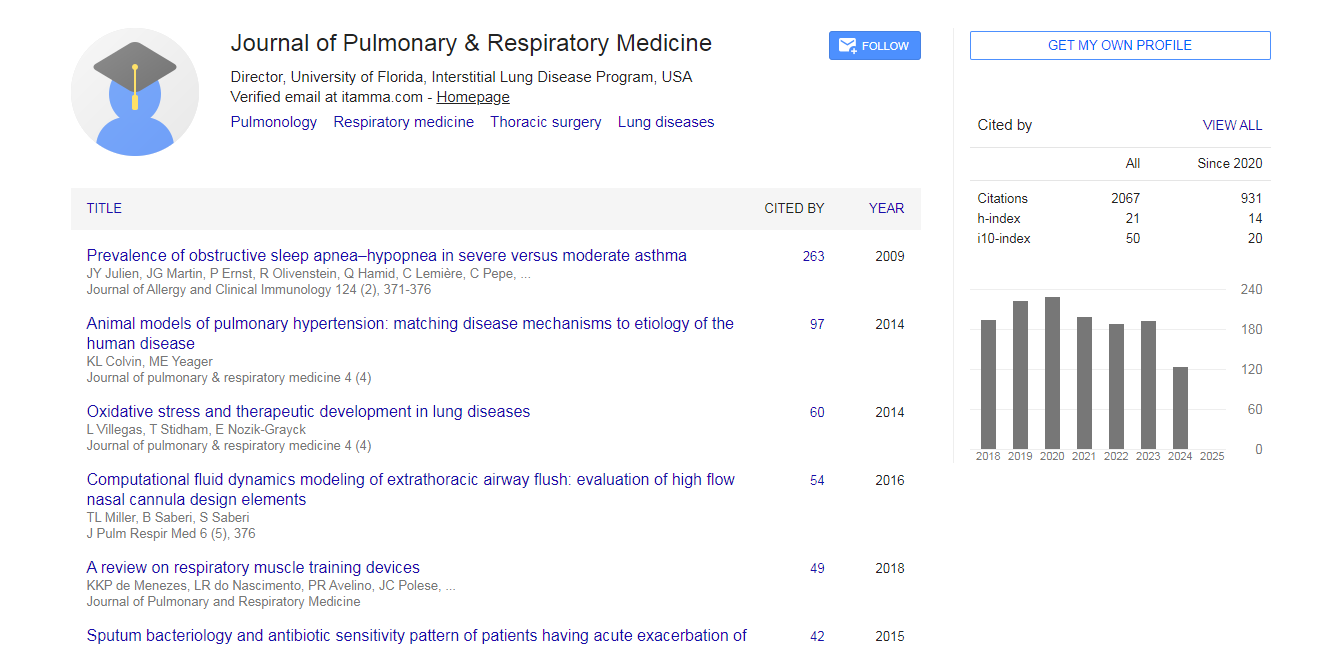
Pulmonary & Respiratory Medicine received 1690 citations as per Google Scholar report