Perspective - (2025) Volume 15, Issue 3
Received: 30-May-2025, Manuscript No. jmcj-25-176489;
Editor assigned: 02-Jun-2025, Pre QC No. P-176489;
Reviewed: 13-Jun-2025, QC No. Q-176489;
Revised: 20-Jun-2025, Manuscript No. R-176489;
Published:
27-Jun-2025
, DOI: 10.37421/2165-7912.2025.15.617
Citation: Moreno, Alicia. "Global Media: Power, Platforms, Culture." J Mass Communicat Journalism 15(2025):617.
Copyright: © 2025 Moreno A. This is an open-access article distributed under the terms of the Creative Commons Attribution License, which permits unrestricted use, distribution and reproduction in any medium, provided the original author and source are credited.
Global media studies are a vibrant and evolving field, constantly adapting to new technologies and geopolitical realities. Here's the thing, understanding the contemporary media landscape demands a re-evaluation of established concepts, particularly regarding power dynamics. One critical re-examination argues for a more nuanced understanding of power within global media, moving beyond traditional Western-centric frameworks. This perspective highlights the shifting geopolitical landscape and the emergence of new media powers, advocating for a re-evaluation of media flows and their impact on cultural and political spheres [1].
What this really means is that traditional views often miss the complexity of how media operates globally. It is essential to challenge existing paradigms, especially those that perpetuate North-centric views of digital media flows. For instance, some research focuses specifically on the Global South, arguing that emerging digital platforms and practices in these regions are not merely passive recipients but active sites of innovation and cultural production. This perspective demands a thorough re-evaluation of concepts such as 'periphery' and 'digital divide' [2].
Let's break it down further. The rise of social media has fundamentally reshaped global communication. Existing scholarship on global social media and the formation of networked publics synthesizes how these platforms facilitate cross-border communication and information flow. This profoundly influences political discourse, collective action, and identity formation on a global scale, while also outlining crucial future research directions in this rapidly evolving domain [3].
The global digital media landscape is also an arena of intense competition. An investigation into this landscape reveals an intensifying discursive struggle for cultural hegemony. Different actors and nations are leveraging digital platforms to shape narratives and influence perceptions. This highlights the complex interplay of power, culture, and technology in contemporary media flows, where narratives are continuously contested and redefined [4].
Cultural influence is not static, and new forms of transnational media are emerging. A compelling study, for example, examines how transnational media, specifically Chinese television dramas, contribute to shaping a global imaginary among African audiences. This research explores the cultural flows and reception dynamics, revealing how media narratives from emerging global powers influence local identities and perceptions, thereby challenging traditional Western media dominance and offering diverse cultural perspectives [5].
The structure of media industries themselves is undergoing massive transformation. The phenomenon of platformization within global media industries has significant implications for media production, distribution, and consumption, particularly affecting the Global South. This development offers opportunities for localized content and new forms of engagement, but it also brings challenges related to data sovereignty, algorithmic biases, and economic inequalities in a landscape increasingly dominated by powerful platforms [6].
Beyond traditional media, news dissemination is also experiencing profound shifts. Digital technologies have reshaped global news flows, altering established hierarchies of news production and consumption. This involves the decentralization of news sources and the rise of citizen journalism. These changes have significant implications for journalistic practices and media ecosystems worldwide, emphasizing a complex interplay of local and global narratives in shaping public understanding [7].
The foundational infrastructure and governance of the internet play a pivotal role in these transformations. Global internet governance is seen as critically important in shaping future media flows, especially highlighting the challenges faced by developing countries. This discussion includes issues of infrastructure access, data localization, and digital rights, underscoring the need for inclusive policy frameworks to ensure equitable participation in the global digital media landscape [8].
Amidst these globalizing forces, the preservation of local cultures remains a key concern. It is imperative to maintain cultural diversity amidst increasingly globalized media flows. Public Service Media (PSM) plays a crucial role here, as PSM organizations are vital for producing and disseminating local content, fostering national identity, and providing platforms for diverse voices in an era dominated by transnational commercial media [9].
Finally, the economic and social aspects of media flows are constantly evolving, giving rise to new forms of communication and commerce. Influencer marketing, for example, is a rapidly expanding field within global media flows. Research into this area dissects the mechanisms through which influencers operate across borders, shaping consumer culture and disseminating content. It analyzes the evolving strategies, ethical considerations, and economic implications of this new form of mediated communication on a worldwide scale, marking a significant shift in marketing and communication paradigms [10].
Global media studies continue to evolve, moving past traditional, often Western-centric, understandings of power. It's clear there's a need to critically re-examine these power concepts, considering the shifting geopolitical landscape and the emergence of new media powers. This involves a fundamental re-evaluation of media flows and their broad impact on cultural and political spheres [1]. In tandem with this, a growing body of work challenges North-centric views of digital media flows, specifically by focusing on the Global South. This perspective argues that emerging digital platforms and practices in these regions are not passive recipients but rather active sites of innovation and cultural production, prompting a demand for rethinking concepts like 'periphery' and the 'digital divide' [2].
Digital platforms, particularly social media, are central to contemporary global media flows. Research synthesizes existing scholarship on global social media and the formation of networked publics, illustrating how these platforms enable cross-border communication and information flow. This significantly influences political discourse, collective action, and identity formation on a global scale, and also sets a clear agenda for future research [3]. These platforms also serve as battlegrounds for cultural influence. An investigation into the global digital media landscape reveals an intensifying discursive struggle for cultural hegemony, where different actors and nations strategically leverage digital platforms to shape narratives and influence perceptions, highlighting the complex interplay of power, culture, and technology [4]. The impact extends to soft power; for instance, a study of transnational media, specifically Chinese television dramas, demonstrates how they contribute to shaping a global imaginary among African audiences. This highlights how media narratives from emerging global powers influence local identities and perceptions, effectively challenging traditional Western media dominance [5].
The structure of global media industries is also undergoing profound changes, largely driven by platformization. This phenomenon has significant implications for media production, distribution, and consumption, especially within the Global South. While it offers opportunities for localized content and new forms of engagement, it also presents substantial challenges concerning data sovereignty, algorithmic biases, and economic inequalities within a platform-dominated environment [6]. In parallel, digital technologies have thoroughly reshaped global news flows, disrupting traditional hierarchies of news production and consumption. This shift includes the decentralization of news sources and the rise of citizen journalism, carrying profound implications for journalistic practices and media ecosystems worldwide, emphasizing the intricate relationship between local and global narratives [7]. Underlying these transformations is the critical role of global internet governance in shaping future media flows. This is particularly pertinent for developing countries, which face significant challenges related to infrastructure access, data localization, and digital rights, underscoring the need for inclusive policy frameworks to ensure equitable participation in the global digital media landscape [8].
Amidst these globalizing trends, the imperative of maintaining cultural diversity remains a prominent concern. Public Service Media (PSM) is highlighted as playing a crucial role in this regard, as PSM organizations are vital for producing and disseminating local content, fostering national identity, and providing platforms for diverse voices in an era increasingly dominated by transnational commercial media [9]. Furthermore, the economic landscape of media is continuously innovated. For example, influencer marketing has emerged as a rapidly expanding field within global media flows. A review of this field dissects the mechanisms through which influencers operate across borders, actively shaping consumer culture and disseminating content. This analysis covers evolving strategies, ethical considerations, and the economic implications of this novel form of mediated communication on a worldwide scale [10].
The provided articles offer a comprehensive look into the complex dynamics of global media flows. They critically re-examine the concept of power in global media studies, advocating for a nuanced understanding beyond traditional Western viewpoints and recognizing the rise of new media powers and shifting geopolitical landscapes [1]. A significant focus lies on challenging North-centric perspectives by emphasizing the Global South's role as an active site of innovation and cultural production in digital media, rather than merely a recipient [2]. The scholarship also delves into how global social media platforms foster networked publics, impacting cross-border communication, political discourse, collective action, and identity formation on a worldwide scale [3]. Another key theme explored is the intensifying struggle for cultural hegemony within the global digital media environment, analyzing how various actors utilize digital platforms to influence narratives and perceptions [4]. Here, transnational media, exemplified by Chinese television dramas in Africa, illustrate how emerging global powers shape cultural flows and local identities, thereby challenging Western media dominance [5]. The phenomenon of platformization in global media industries is also analyzed, revealing opportunities for localized content, particularly in the Global South, alongside critical challenges concerning data sovereignty, algorithmic biases, and economic disparities [6]. Digital technologies have profoundly reshaped global news flows, decentralizing news production and consumption, and influencing journalistic practices globally [7]. Additionally, the articles highlight the vital role of global Internet governance in determining future media flows, especially addressing the infrastructure, data, and digital rights challenges faced by developing nations [8]. The importance of Public Service Media in preserving cultural diversity by producing local content and supporting national identity in a transnational media environment is also underscored [9]. Lastly, the expanding influence of influencer marketing across global media flows is examined, detailing its mechanisms in shaping consumer culture and its ethical and economic implications worldwide [10].
None
None
Indexed at, Google Scholar, Crossref
Indexed at, Google Scholar, Crossref
Indexed at, Google Scholar, Crossref
Indexed at, Google Scholar, Crossref
Indexed at, Google Scholar, Crossref
Indexed at, Google Scholar, Crossref
Indexed at, Google Scholar, Crossref
Indexed at, Google Scholar, Crossref
Indexed at, Google Scholar, Crossref
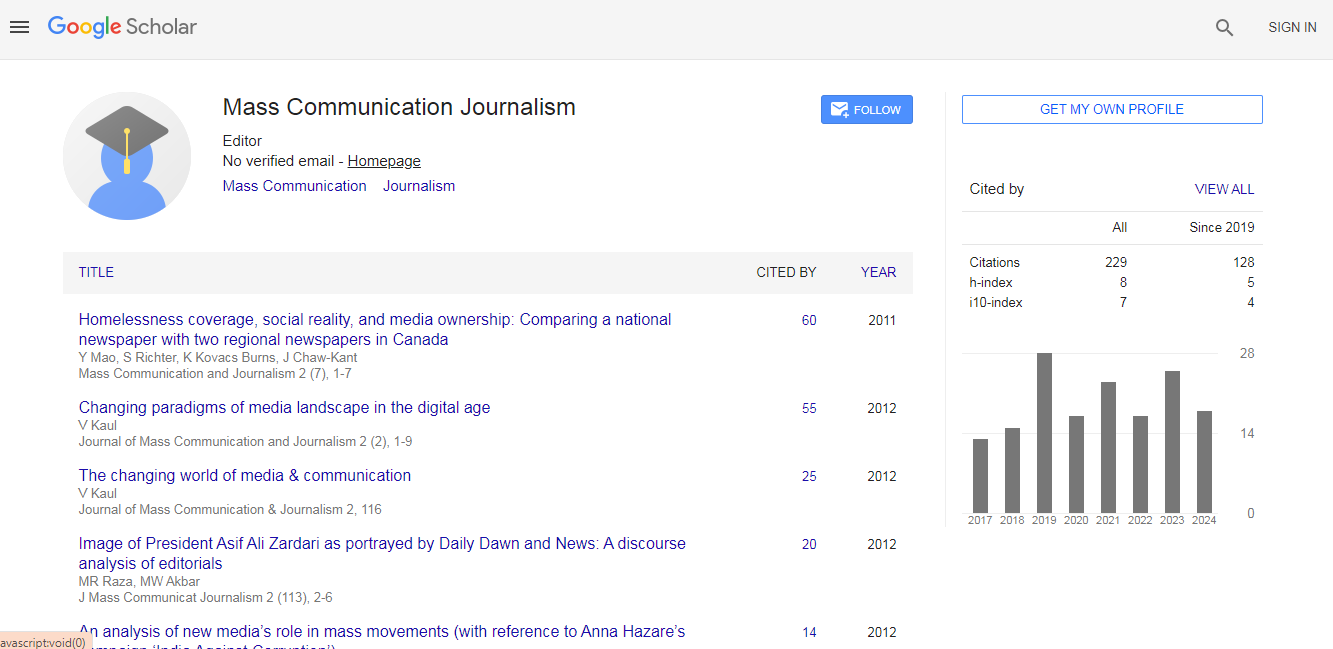
Journal of Mass Communication & Journalism received 205 citations as per Google Scholar report