Opinion - (2025) Volume 16, Issue 5
Received: 01-Sep-2025, Manuscript No. assj-25-174791;
Editor assigned: 03-Sep-2025, Pre QC No. P-174791;
Reviewed: 17-Sep-2025, QC No. Q-174791;
Revised: 22-Sep-2025, Manuscript No. R-174791;
Published:
29-Sep-2025
, DOI: 10.37421/2151-6200.2025.16.685
Citation: Morel, Thiago. ”Global Health Decolonization: Power, Knowledge, Justice.” Arts Social Sci J 16 (2025):685
Copyright: © 2025 Morel T. This is an open-access article distributed under the terms of the Creative Commons Attribution License, which permits unrestricted use, distribution and reproduction in any medium, provided the original author and source are credited
The field of global health increasingly confronts its historical and ongoing entanglements with colonial structures and power dynamics. This critical recognition calls for a decolonial turn, aiming to dismantle entrenched inequities and foster genuinely equitable and just health systems worldwide. Decolonizing global health represents a fundamental shift in how knowledge is produced, power is distributed, and interventions are designed and implemented. A foundational article introduces a framework for critically analyzing and acting on the decolonization of global health. It identifies key domains of coloniality, such as knowledge production and power imbalances, proposing actionable strategies for structural change. The authors emphasize shifting from Eurocentric paradigms to more equitable, community-led approaches [1].
In a similar vein, a pivotal piece argues for a distinctly decolonial approach to global mental health research. This perspective moves beyond 'othering' non-Western populations. It advocates for recognizing and integrating diverse cultural understandings of mental illness, challenging the universal application of Western psychiatric frameworks, and empowering local voices in research design and implementation [2].
The very understanding and nuanced application of "decolonization" within global health academic literature is explored through a thematic analysis. This research highlights varied interpretations, from superficial inclusivity to profound structural critiques, emphasizing the need for deeper engagement with power dynamics, historical injustices, and the active dismantling of colonial legacies within the field [3].
Further critically examining the "postcolonial turn" in global health scholarship, a comprehensive review assesses its conceptual foundations and practical implications. It discusses how postcolonial theory has effectively exposed persistent colonial power structures within global health initiatives, urging a more profound deconstruction of knowledge hierarchies and practices to achieve genuine equity [4].
Ethical considerations are paramount. One significant article explicitly advocates for integrating a decolonial perspective into global health research ethics. It challenges the universal application of Western ethical frameworks, highlighting how colonial power dynamics can undermine equitable research partnerships and exploit communities. The authors propose robust ethical guidelines centered on justice, reciprocity, and local epistemologies [5].
A strong call for critical reflection and decisive action is issued concerning the colonial underpinnings of knowledge production in global health. This commentary urges actively decolonizing curricula, research methodologies, and funding structures to dismantle systemic biases and foster genuine inclusivity. The authors emphasize valuing diverse knowledge systems and empowering marginalized voices [6].
Envisioning a truly postcolonial public health, another impactful piece advocates for moving beyond Western-centric approaches to health equity. It rigorously critiques the historical and ongoing colonial influences on public health theory and practice, advocating for a profound paradigm shift that centers indigenous knowledge, local contexts, and community self-determination in achieving health justice [7].
The coloniality embedded in global health data collection and use is also brought to the forefront, with an explicit call for decolonial data justice. This work exposes how dominant data practices perpetuate inequalities and misrepresent marginalized populations. It proposes clear principles for ethical, equitable, and locally-driven data governance that fundamentally respects indigenous data sovereignty [8].
The vital role of indigenous knowledge systems in decolonizing global health education is powerfully highlighted. This perspective argues compellingly for integrating these diverse epistemologies into curricula and pedagogy. The aim is to challenge Western intellectual hegemony, foster culturally responsive healthcare, and promote a more holistic understanding of health and well-being [9].
Finally, postcolonial perspectives are rigorously applied to examine mental health service delivery specifically in low- and middle-income countries. This analysis critiques how Western models of care often fail to account for local cultural contexts and historical traumas, advocating for culturally relevant, community-based interventions that address the social and political determinants of mental health [10].
Collectively, these scholarly contributions paint a comprehensive picture of the challenges and opportunities inherent in decolonizing global health. They consistently underscore the urgent need for systemic change, a re-centering of marginalized voices, and an unwavering commitment to justice and equity across all global health practices and research.
The pervasive influence of colonial legacies within global health demands rigorous critical examination and transformative action. A collection of recent scholarly works collectively unpacks the multifaceted nature of decolonization and postcolonial thought within this critical field, revealing both the conceptual depth and the urgent practical implications across diverse domains.
Central to this discourse are foundational analyses that provide frameworks for understanding and engaging with decolonization. One such framework offers critical analysis and actionable strategies for addressing coloniality in global health, specifically targeting areas like knowledge production and deeply entrenched power imbalances. It advocates for a fundamental shift from Eurocentric paradigms towards more equitable, community-led approaches [1]. Furthermore, a thematic analysis reveals the varied interpretations of "decolonization" itself in academic literature, ranging from superficial inclusivity to profound structural critiques. This highlights the ongoing necessity for deeper engagement with power dynamics, historical injustices, and the active dismantling of colonial legacies [3].
The application of decolonial and postcolonial perspectives to mental health is another crucial thematic area. One piece argues for a decolonial approach to global mental health research, urging movement beyond the 'othering' of non-Western populations. It champions the integration of diverse cultural understandings of mental illness, challenging the universal application of Western psychiatric frameworks, and empowering local voices in research [2]. Complementing this, other postcolonial perspectives are applied to mental health service delivery in low- and middle-income countries. This analysis critiques how Western models often overlook local cultural contexts and historical traumas, advocating for culturally relevant, community-based interventions that address the social and political determinants of mental health [10].
Decolonizing knowledge production and education forms another significant thread. This includes a commentary that urges critical reflection on the colonial underpinnings of knowledge production in global health. It calls for actively decolonizing curricula, research methodologies, and funding structures to dismantle systemic biases, foster genuine inclusivity, and empower marginalized voices [6]. Directly related, the vital role of indigenous knowledge systems in decolonizing global health education is highlighted. This argues for integrating these diverse epistemologies into curricula and pedagogy to challenge Western intellectual hegemony, foster culturally responsive healthcare, and promote a holistic understanding of health and well-being [9].
Ethical practice and data governance are also undergoing a decolonial re-evaluation. One article advocates for integrating a decolonial perspective into global health research ethics. It directly challenges the universal application of Western ethical frameworks, exposing how colonial power dynamics can undermine equitable research partnerships and exploit communities, proposing ethical guidelines rooted in justice and reciprocity [5]. Additionally, the coloniality embedded in global health data collection and use is critically examined. A call for decolonial data justice exposes how dominant data practices perpetuate inequalities and misrepresent marginalized populations, proposing principles for ethical, equitable, and locally-driven data governance that respects indigenous data sovereignty [8].
Finally, the broader conceptual shifts towards postcolonial public health are explored. A review critically examines the "postcolonial turn" in global health scholarship, assessing its conceptual foundations and practical implications. It discusses how postcolonial theory has exposed persistent colonial power structures, advocating for a deeper deconstruction of knowledge hierarchies to achieve genuine equity [4]. Concurrently, another article envisions a postcolonial public health that moves beyond Western-centric approaches to health equity. It critiques historical and ongoing colonial influences on public health theory and practice, advocating for a paradigm shift that centers indigenous knowledge, local contexts, and community self-determination in achieving health justice [7].
In essence, these works provide a comprehensive roadmap for transforming global health into a truly equitable and just endeavor. They collectively champion the dismantling of colonial structures across research, education, ethics, and practice, asserting the paramount importance of local contexts, indigenous epistemologies, and community empowerment.
The provided literature collectively addresses the urgent imperative to decolonize global health, moving beyond Eurocentric paradigms and entrenched colonial legacies. Several articles propose frameworks for critical analysis and action, emphasizing the dismantling of power imbalances and the re-evaluation of knowledge production in global health. This includes advocating for a decolonial approach to global mental health research, which challenges the universal application of Western psychiatric frameworks and empowers local voices. The concept of "decolonization" itself is subject to thematic analysis, revealing varied interpretations from superficial inclusivity to deep structural critiques, underscoring the need to engage with historical injustices. The discourse extends to the "postcolonial turn" in global health scholarship, exposing persistent colonial power structures and calling for a deconstruction of knowledge hierarchies. Ethical considerations are central, with calls to integrate decolonial perspectives into research ethics, questioning Western frameworks, and prioritizing justice and reciprocity. Decolonizing knowledge production generally, through curricula, methodologies, and funding, is crucial for fostering genuine inclusivity and valuing diverse knowledge systems. Furthermore, the literature envisions a postcolonial public health that centers indigenous knowledge, local contexts, and community self-determination to achieve health justice. Data collection and use are identified as domains rife with coloniality, necessitating decolonial data justice principles and respect for indigenous data sovereignty. The integration of indigenous knowledge systems is also vital for decolonizing global health education, challenging Western intellectual hegemony and promoting culturally responsive care. Finally, postcolonial perspectives are applied to mental health service delivery in low- and middle-income countries, advocating for culturally relevant, community-based interventions. This body of work strongly advocates for a transformative shift towards equitable, community-led, and contextually grounded global health practices.
None
None
Indexed at, Google Scholar, Crossref
Indexed at, Google Scholar, Crossref
Indexed at, Google Scholar, Crossref
Indexed at, Google Scholar, Crossref
Indexed at, Google Scholar, Crossref
Indexed at, Google Scholar, Crossref
Indexed at, Google Scholar, Crossref
Indexed at, Google Scholar, Crossref
Indexed at, Google Scholar, Crossref
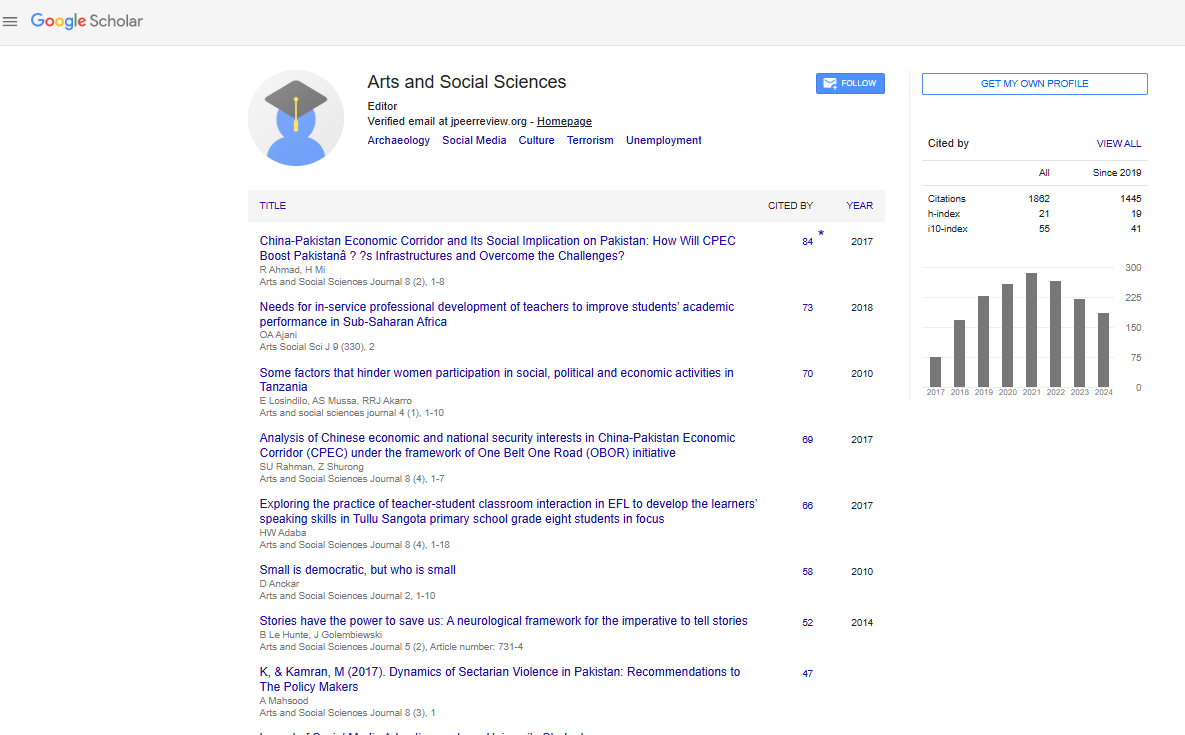
Arts and Social Sciences Journal received 1413 citations as per Google Scholar report