Opinion - (2025) Volume 11, Issue 4
Received: 01-Aug-2025, Manuscript No. jpnp-25-175504;
Editor assigned: 04-Aug-2025, Pre QC No. P-175504;
Reviewed: 18-Aug-2025, QC No. Q-175504;
Revised: 22-Aug-2025, Manuscript No. R-175504;
Published:
29-Aug-2025
, DOI: 10.37421/2472-0992.2025.11.375
Citation: Svensson, Ingrid. ”Global Food Security: Multifaceted Challenges, Integrated Solutions.” J Pharmacogn Nat Prod 11 (2025):375.
Copyright: © 2025 Svensson I. This is an open-access article distributed under the terms of the Creative Commons Attribution License, which permits unrestricted use, distribution and reproduction in any medium, provided the original author and source are credited.
Global food security is a complex and pressing issue, influenced by a myriad of environmental, social, economic, and political factors. The profound impact of climate change on food systems, for instance, remains a central concern. This challenge involves understanding its multifaceted effects on agricultural production, food availability, access, utilization, and overall stability [1].
Climate change manifests through rising temperatures, altered precipitation patterns, and extreme weather events, which directly threaten crop yields and livestock, especially in vulnerable regions. Addressing these threats requires urgent adaptation and mitigation strategies to protect global food supplies [1].
In parallel, achieving sustainable food security critically depends on agricultural innovations and supportive policies [2].
It's clear that adopting advanced farming techniques, improving resource efficiency, and implementing effective agricultural policies are crucial for overcoming current food system challenges [2].
This becomes even more vital when considering ongoing population growth and escalating environmental degradation, which continuously strain existing resources and production capabilities. Such innovations can pave the way for more resilient and productive food systems that meet future demands [2].
Developing countries face unique and often severe hurdles in bolstering food security, necessitating a focused examination of these challenges and identifying viable opportunities [3].
Key barriers include widespread poverty, ongoing conflicts, significant climate vulnerability, and inadequate infrastructure. Yet, there's hope in promising interventions like technology adoption, improved market access, and targeted social protection programs, all designed to enhance resilience and improve food access for the most vulnerable populations [3].
Understanding these specific contexts allows for the development of tailored, effective solutions. The intricate link between food security and nutritional status also demands significant attention [4].
A strong inverse relationship exists, where food insecurity frequently correlates with various forms of malnutrition. This can range from undernutrition and micronutrient deficiencies to, paradoxically, obesity, often resulting from the consumption of less nutritious, cheaper foods [4].
These findings strongly emphasize the need for integrated approaches that address both consistent food access and the fundamental quality of dietary intake, ensuring that food is not only available but also provides adequate nutrition [4].
Effective climate change adaptation strategies are indispensable for safeguarding food security, particularly in the most vulnerable regions globally [5].
A range of approaches, including the development and deployment of drought-resistant crops, the implementation of water-efficient irrigation systems, the adoption of diversified farming methods, and the establishment of early warning systems, hold immense potential [5].
These strategies are essential for enhancing agricultural resilience against the accelerating impacts of climate change, thereby protecting livelihoods and food sources [5].
Recent global crises underscore the fragility of our food systems, with the economic repercussions of events like COVID-19 having significant impacts on food security [6].
The pandemic caused extensive supply chain disruptions, led to widespread income losses, and highlighted how policy responses, or lack thereof, exacerbated food insecurity, especially for marginalized communities [6].
This situation clearly illustrates the deep interconnectedness of global health crises with the inherent vulnerabilities within food systems, calling for a more robust and responsive global framework [6].
Urban environments present their own distinct set of challenges and opportunities for ensuring food security [7].
Issues include limited access to fresh produce, an over-reliance on distant and often fragile supply chains, and high food costs, which disproportionately affect urban dwellers [7].
However, promising solutions are emerging through initiatives like urban agriculture, the promotion of local food systems, and improved urban planning that integrates food system considerations from the outset [7].
Furthermore, the intersection of gender and food security is a critical area requiring careful consideration [8].
Gender inequalities, particularly those affecting women's access to vital resources, their participation in decision-making processes, and their labor opportunities, significantly influence household food security outcomes [8].
Addressing these disparities is not just a matter of equity but a necessity for improving overall food security, demanding gender-transformative approaches that empower women within food systems [8].
The resilience of food supply chains is paramount for maintaining consistent food security, with recent global crises offering invaluable lessons [9].
Analysis reveals vulnerabilities such as excessive reliance on single sources and a lack of diversification within these chains [9].
To counteract these weaknesses, strategies like localized production, investment in robust infrastructure, and improved governance are proposed. These measures aim to enhance supply chains' ability to withstand shocks and ensure reliable food access for all [9].
Finally, the contribution of sustainable agricultural practices to achieving food security cannot be overstated [10].
Practices such as agroecology, organic farming, and precision agriculture offer pathways to enhance productivity while simultaneously conserving natural resources and improving livelihoods [10].
By fostering long-term food availability and access, these practices also mitigate environmental impacts, representing a holistic approach to securing food for future generations [10].
This comprehensive perspective underscores the multifaceted nature of food security, highlighting the need for integrated, innovative, and equitable solutions across all domains.
The intricate global challenge of food security is comprehensively addressed across various research, highlighting key interconnected themes. Climate change stands out as a primary driver of food insecurity, profoundly affecting agricultural systems worldwide [1]. Rising global temperatures, unpredictable precipitation patterns, and an increase in extreme weather events directly imperil crop yields and livestock, particularly in regions already vulnerable to environmental stressors. This necessitates immediate and strategic interventions, combining both adaptation measures to cope with inevitable changes and mitigation efforts to reduce further climate impact on food production [1, 5]. For instance, developing drought-resistant crops, implementing efficient irrigation techniques, diversifying farming systems, and establishing early warning systems are crucial adaptation strategies that bolster agricultural resilience against these escalating climatic pressures [5].
To counteract these environmental threats and ensure long-term food availability, agricultural innovations and supportive policy frameworks are indispensable [2, 10]. Modern farming techniques, alongside efforts to enhance resource efficiency, are fundamental to overcoming systemic food challenges, especially in the context of expanding global populations and environmental degradation [2]. The adoption of sustainable agricultural practices, including agroecology, organic farming, and precision agriculture, demonstrates significant potential. These methods not only boost productivity but also play a vital role in conserving natural resources and improving livelihoods, thereby securing food availability and access while simultaneously minimizing ecological footprints [10]. Such integrated approaches are critical for fostering a resilient and sustainable global food system.
However, the pursuit of food security is not without significant socio-economic hurdles, particularly evident in developing countries and urban environments [3, 7]. In many developing nations, persistent poverty, ongoing conflicts, inherent climate vulnerability, and inadequate infrastructure form substantial barriers to food access and stability [3]. Promising interventions, however, include leveraging technology, improving access to markets, and implementing targeted social protection programs to enhance local resilience and ensure more equitable food distribution [3]. Similarly, urban settings present distinct challenges such as restricted access to fresh produce, over-reliance on distant and often fragile supply chains, and elevated food costs [7]. Solutions for urban food security often involve promoting urban agriculture, fostering local food initiatives, and integrating food systems more effectively into urban planning [7].
Beyond production and access, the relationship between food security and nutritional status is critically important, revealing a direct link between food insecurity and various forms of malnutrition [4]. This includes undernutrition and micronutrient deficiencies, but also, surprisingly, obesity, often linked to the consumption of cheaper, less nutritious foods [4]. This underscores the necessity for holistic strategies that not only ensure food availability but also emphasize dietary quality. Furthermore, global crises, such as the COVID-19 pandemic, have exposed significant vulnerabilities within food systems [6, 9]. The pandemic led to widespread supply chain disruptions, severe income losses, and highlighted how policy responses, or their absence, intensified food insecurity, particularly for already marginalized communities [6].
These recent events have provided valuable lessons regarding the resilience of food supply chains [9]. Analysis indicates that vulnerabilities often stem from an over-reliance on single sources and a general lack of diversification within these crucial networks. To address these weaknesses, strategies promoting localized production, robust infrastructural development, and improved governance are proposed to enhance the capacity of supply chains to withstand future shocks and consistently ensure food access [9]. Moreover, a critical review highlights how gender inequalities profoundly influence household food security outcomes [8]. Womenâ??s limited access to resources, restricted decision-making power, and unequal labor opportunities exacerbate food insecurity. This necessitates gender-transformative approaches that empower women, recognizing their central role in achieving equitable and sustainable food security globally [8]. The multifaceted nature of food security requires an integrated, adaptive, and equitable approach, considering all these interacting factors.
The array of research underscores the multifaceted nature of global food security, identifying climate change as a primary threat due to its impact on agricultural production and resource stability [1, 5]. Adaptation strategies, like drought-resistant crops and efficient irrigation, are vital for agricultural resilience [5]. Innovations in farming techniques and supportive policies are equally crucial for sustainable food systems, particularly given population growth and environmental degradation [2, 10]. Developing countries face unique barriers such as poverty and conflict, requiring targeted interventions like technology adoption and social protection programs [3]. Food security is deeply intertwined with nutritional status, where insecurity often leads to malnutrition, including both undernutrition and diet-related obesity, emphasizing the need for both food access and dietary quality [4]. Recent crises, like the COVID-19 pandemic, exposed significant vulnerabilities in food supply chains, causing economic repercussions and exacerbating insecurity for marginalized populations [6]. This highlights the need for resilient supply chains through localized production and improved infrastructure [9]. Urban environments present distinct challenges like limited fresh produce access and high costs, with potential solutions in urban agriculture and improved planning [7]. Gender inequalities also play a significant role, affecting womenâ??s access to resources and influencing household food security, thus necessitating gender-transformative approaches [8]. Ultimately, achieving comprehensive food security demands integrated strategies encompassing environmental sustainability, technological innovation, equitable access, and resilient infrastructure.
None
None
Ishrat S, Abdul L, Ahsan R. "Impact of Climate Change on Food Security: A Review".J. Food Sci. Technol. 59 (2022):2073-2083.
Indexed at, Google Scholar, Crossref
Arshad H, Farhan S, Arbab NK. "Sustainable food security: The role of agricultural innovations and policies".Environ. Sci. Pollut. Res. 29 (2021):20703-20716.
Indexed at, Google Scholar, Crossref
Sana A, Muhammad A, Zafar K. "Enhancing food security in developing countries: A review of challenges and opportunities".Food Sci. Nutr. 10 (2022):1729-1744.
Indexed at, Google Scholar, Crossref
Zafar A, Asif H, Safdar K. "Food security and nutritional status: A systematic review of global evidence".J. Hum. Nutr. Diet. 36 (2023):747-761.
Indexed at, Google Scholar, Crossref
Md. MR, Mohammad SI, Md. SR. "Climate change adaptation strategies for food security in vulnerable regions: A systematic review".Environ. Sci. Pollut. Res. 27 (2020):20562-20579.
Indexed at, Google Scholar, Crossref
Sonia A, Debarati M, Md. JH. "Economic impacts of COVID-19 on food security: A global perspective".Food Policy 103 (2021):102047.
Indexed at, Google Scholar, Crossref
Huai C, Jing L, Meng W. "Urban food security challenges and opportunities: A systematic review".Urban For. Urban Green. 74 (2022):127598.
Indexed at, Google Scholar, Crossref
Nida F, Muhammad S, Amjad K. "Gender and food security: A critical review of current literature and future directions".J. Rural Stud. 103 (2023):102919.
Indexed at, Google Scholar, Crossref
Vivek Y, Amit K, Shivam S. "Resilience of food supply chains for food security: Lessons from global crises".Food Control 142 (2022):108603.
Indexed at, Google Scholar, Crossref
Md. MR, Md. SI, Farhana K. "Sustainable agricultural practices and food security: A global review".Agron. Sustain. Dev. 43 (2023):74.
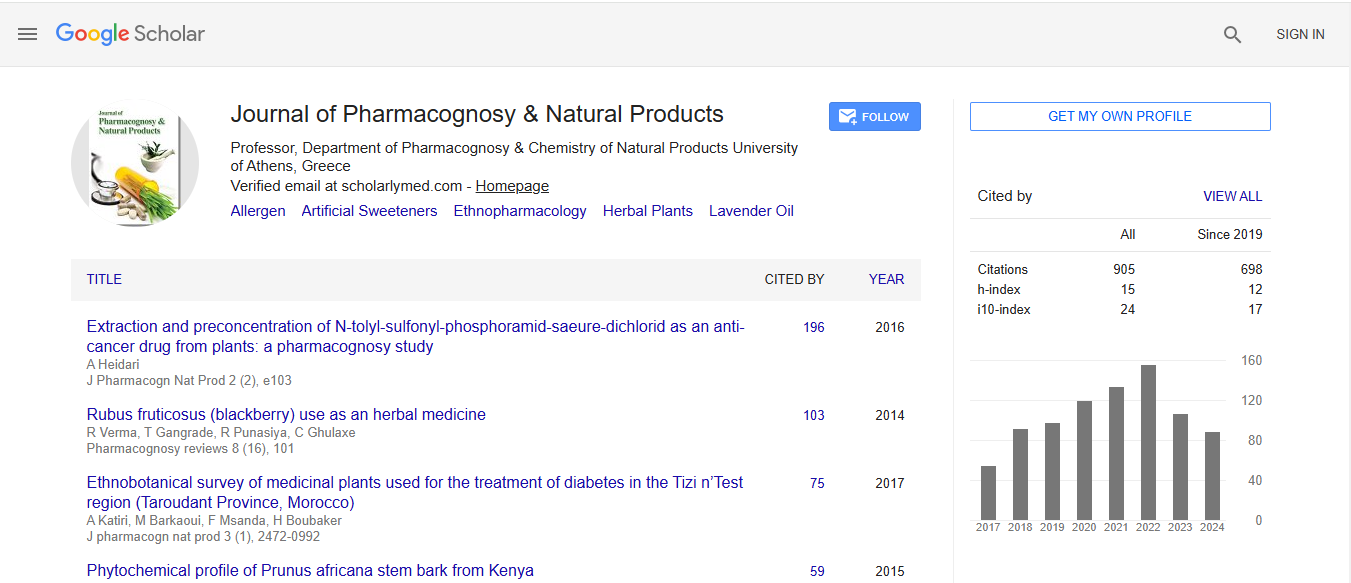
Journal of Pharmacognosy & Natural Products received 606 citations as per Google Scholar report