Opinion - (2025) Volume 15, Issue 4
Received: 31-Jul-2025, Manuscript No. jmcj-25-176901;
Editor assigned: 04-Aug-2025, Pre QC No. P-176901;
Reviewed: 18-Aug-2025, QC No. Q-176901;
Revised: 21-Aug-2025, Manuscript No. R-176901;
Published:
28-Aug-2025
, DOI: 10.37421/2165-7912.2025.15.634
Citation: Monteiro, Rafael G.. Global Digital Media: Power, Culture, Trust, Decolonization. J Mass Communicat Journalism 15(2025):634.
Copyright: © 2025 Monteiro G. Rafael This is an open-access article distributed under the terms of the Creative Commons Attribution License, which permits unrestricted use, distribution and reproduction in any medium, provided the original author and source are credited.
The contemporary global media landscape is a dynamic and multifaceted arena, grappling with geopolitical shifts, evolving cultural identities, technological advancements, and persistent ethical dilemmas. This collection of research sheds light on various critical aspects that define media's role in an interconnected world. This article critically examines contemporary global media flows, highlighting how geopolitical power dynamics shape the circulation and consumption of digital content. It discusses the rise of non-Western media powers and the ongoing tensions between national interests and global platforms[1].
This study explores how digital media platforms influence the formation and expression of cultural identities in a globally interconnected environment. It highlights both the homogenization and hybridization of cultures, demonstrating the complex interplay between local and global influences on individual and group identities[2].
This article re-evaluates the relationship between global media and local contexts, arguing that cultural flows are not merely unidirectional but involve complex processes of appropriation, resistance, and hybridization at the local level. It challenges simplistic notions of media imperialism in the digital era[3].
This article analyzes the profound impact of global streaming services on media industries worldwide, focusing on the tension between their global reach and the demand for localized content. It discusses how these platforms navigate cultural specificities while pursuing universal appeal, reshaping content production and consumption patterns[4].
This article examines the erosion of trust in journalism within the global digital sphere, primarily due to the proliferation of misinformation and disinformation. It discusses how global media ecosystems exacerbate these challenges and proposes strategies for journalists to rebuild credibility in an increasingly fragmented information landscape[5].
This paper investigates the persistent digital divide within the context of global media access, analyzing how disparities in internet infrastructure and usage patterns perpetuate inequalities. It highlights the challenges in achieving truly equitable global media participation, despite the expansion of digital technologies[6].
This study examines the transformation of news production in the era of media globalization, focusing on how transnational journalism and digital collaboration are reshaping newsrooms. It highlights the opportunities and challenges for journalists working across borders and cultures, impacting news agendas and professional practices[7].
This article addresses critical ethical challenges faced by global media in an era of digital disruption, particularly concerning journalism and its role in democracy. It discusses issues of accountability, truth, and responsibility, offering frameworks for navigating complex ethical dilemmas in a globally interconnected information environment[8].
This article proposes a postcolonial critique of contemporary global media studies, particularly concerning digital platforms. It argues for decolonizing prevailing frameworks, advocating for approaches that foreground marginalized voices and power imbalances in the production and dissemination of global media content[9].
This article conducts a comparative analysis of global media narratives surrounding climate change, examining how different framing strategies influence public engagement and policy responses across various cultural contexts. It highlights the challenges of communicating complex environmental issues in a globalized media landscape[10].
Together, these studies offer a comprehensive perspective on the intricate relationship between global media, technology, culture, and society, highlighting both the immense potential and the significant challenges that define this ever-evolving field.
The global media environment is heavily influenced by geopolitical power dynamics, which dictate how digital content circulates and is consumed. There's a noticeable rise of non-Western media powers, leading to ongoing tensions as national interests clash with the reach of global platforms [1]. This means cultural flows are more complex than simple unidirectional movements. Instead, we see intricate processes of appropriation, resistance, and hybridization playing out at local levels, effectively challenging older ideas of media imperialism in the digital era [3].
The implications for cultural identities are profound. Digital media platforms significantly shape how these identities form and are expressed in an interconnected world. This includes both the homogenization of cultures and, conversely, their hybridization, showing the complex interplay between local and global forces on individual and group identities [2]. On a related note, the growth of global streaming services has a deep impact on media industries worldwide. These services must navigate the tension between their vast global reach and the fundamental demand for content that resonates locally. Successfully doing so involves managing cultural specificities while aiming for universal appeal, ultimately reshaping content production and consumption patterns [4].
In the realm of journalism, trust is increasingly eroding within the global digital sphere. This decline is largely attributable to the proliferation of misinformation and disinformation. Global media ecosystems often exacerbate these challenges, creating a fragmented information landscape where journalists must actively devise strategies to rebuild their credibility [5]. This struggle for trust occurs alongside a significant transformation in news production due to media globalization. Transnational journalism and digital collaboration are actively reshaping newsrooms, presenting both opportunities and considerable challenges for journalists who work across different borders and cultures. These changes directly impact news agendas and fundamental professional practices [7].
Beyond trust, global media faces critical ethical challenges, especially concerning journalism's crucial role in democracy during this period of digital disruption. Issues of accountability, truth, and responsibility are central to these discussions, necessitating robust frameworks to navigate complex ethical dilemmas within our globally interconnected information environment [8]. Moreover, a critical perspective argues for decolonizing prevailing frameworks within contemporary global media studies, particularly concerning digital platforms. This postcolonial critique advocates for approaches that foreground marginalized voices and address inherent power imbalances in how global media content is produced and disseminated [9].
Persistent inequalities also define the global media landscape, notably through the digital divide. This divide relates to global media access, where disparities in internet infrastructure and usage patterns continue to perpetuate inequalities. Achieving truly equitable global media participation remains a challenge, even with the widespread expansion of digital technologies [6]. Finally, global media narratives surrounding critical issues like climate change are subject to comparative analysis. Different framing strategies employed by media outlets influence public engagement and policy responses across diverse cultural contexts. This highlights the inherent difficulties in effectively communicating complex environmental issues within a highly globalized media landscape [10].
Here's the thing: contemporary global media is a complex web. Geopolitical power dynamics are at play, shaping digital content circulation and consumption, with non-Western media gaining influence and creating friction between national interests and global platforms. Digital platforms themselves significantly impact cultural identities, showing both homogenization and hybridization as local and global forces interact. We're seeing a re-evaluation of how global media interacts with local contexts, revealing that cultural flows involve appropriation and resistance, not just one-way influence. The rise of global streaming services, for example, is redefining media industries by balancing universal appeal with the crucial demand for localized content. This reconfigures production and consumption globally. Trust in journalism is a big concern; misinformation and disinformation are rampant in the digital sphere, challenging credibility. This connects to broader inequalities, as the digital divide continues to limit equitable global media access through disparities in internet infrastructure and usage. Journalism itself is undergoing a transformation. Transnational collaboration and digital tools are reshaping newsrooms, presenting new challenges and opportunities for working across borders. This raises ethical questions for global media, particularly regarding journalism's role in democratic societies, pushing for new frameworks for accountability and truth. What this really means is that we need to decolonize our understanding of global media, advocating for marginalized voices and acknowledging power imbalances on digital platforms. Ultimately, even global media narratives on issues like climate change are shaped by cultural contexts, influencing public engagement and policy responses.
None
None
Yothin J, John K, Youngjoo K. "The Geopolitics of Global Media Flows: A Critical Assessment of Current Trends".Int Commun Gaz 84 (2022):323-341.
Indexed at, Google Scholar, Crossref
Li C, Shu Y, Xuan L. "Digital Media and Cultural Identities in a Globalized World: A Comparative Study".Glob Media Commun 17 (2021):27-44.
Indexed at, Google Scholar, Crossref
Tariq R, Uma K, Rakesh K. "Global Media and the Local: Re-examining the Dynamics of Cultural Flows".Glob Media Commun 15 (2019):310-327.
Indexed at, Google Scholar, Crossref
Silvio W, Daya KT, Nick C. "The Rise of Global Streaming Services and the Challenge of Media Localization".Int Commun Gaz 85 (2023):3-23.
Indexed at, Google Scholar, Crossref
Edson CTJ, Jin Z, Beibei L. "Journalism and Trust in the Global Digital Sphere: Challenges from Misinformation and Disinformation".Journalism Studies 22 (2021):1001-1018.
Indexed at, Google Scholar, Crossref
Nick C, Andreas H, Friedrich K. "The Digital Divide and Global Media Access: Examining Inequalities in Internet Infrastructure and Usage".New Media Soc 24 (2022):1715-1735.
Indexed at, Google Scholar, Crossref
Alessio C, Antonis K, Rasmus KN. "The Globalized Newsroom: Transnational Journalism and Digital Collaboration".Digital Journalism 8 (2020):531-549.
Indexed at, Google Scholar, Crossref
Stephen JAW, Clifford GC, Herman W. "Global Media Ethics in the Age of Digital Disruption: Challenges for Journalism and Democracy".Int J Press/Politics 25 (2020):435-454.
Indexed at, Google Scholar, Crossref
Daya KT, Malini R, Rahul K. "Decolonizing Global Media Studies: Towards a Postcolonial Critique of Digital Platforms".Media Culture Soc 41 (2019):979-997.
Indexed at, Google Scholar, Crossref
Maxwell TB, Camelia N, Hamid R. "Global Media Narratives of Climate Change: A Comparative Analysis of Framing and Public Engagement".Environ Commun 17 (2023):289-307.
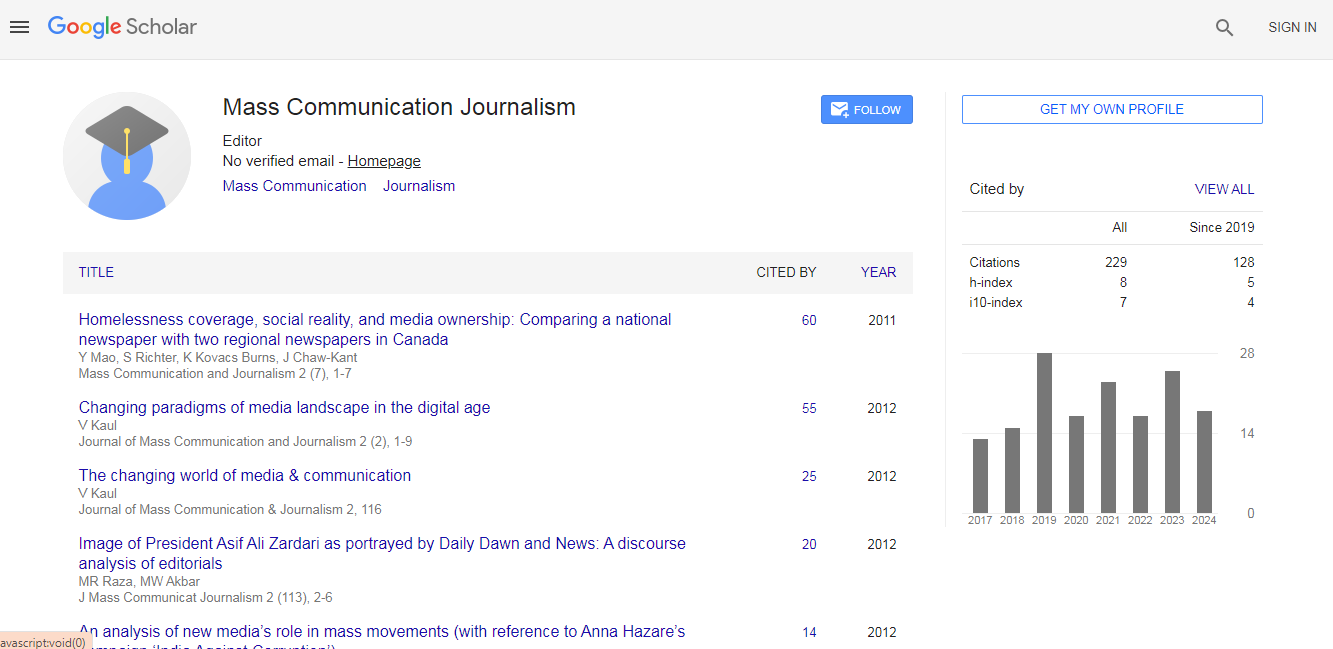
Journal of Mass Communication & Journalism received 205 citations as per Google Scholar report