Short Communication - (2025) Volume 10, Issue 6
Received: 01-Dec-2025, Manuscript No. jcct-26-183283;
Editor assigned: 03-Dec-2025, Pre QC No. P-183283;
Reviewed: 17-Dec-2025, QC No. Q-183283;
Revised: 22-Dec-2025, Manuscript No. R-183283;
Published:
29-Dec-2025
, DOI: 10.37421/2577-0535.2025.9.346
Citation: Kowalska, Teresa. ”Global Cancer Trials: Accelerating Drug Development, Ensuring Access.” J Cancer Clin Trials 10 (2025):346.
Copyright: © 2025 Kowalska T. This is an open-access article distributed under the terms of the Creative Commons Attribution License, which permits unrestricted use, distribution and reproduction in any medium, provided the original author and source are credited.
The global landscape of cancer clinical trials is undergoing a profound transformation, driven by the imperative to accelerate the development of novel therapies and ensure their equitable accessibility worldwide. This evolution is largely characterized by an increasing emphasis on multicenter collaborations, which pool resources, expertise, and patient populations to achieve statistically robust outcomes more efficiently. The necessity for standardized protocols and harmonized regulatory pathways has become paramount to navigate the complexities of international research endeavors and overcome geographical and institutional barriers, thereby enhancing the overall power of clinical research [1].
Implementing international multicenter trials presents a unique set of challenges, demanding effective communication, the cultivation of trust among diverse research teams, and sophisticated project management strategies. The successful execution of these complex trials hinges on meticulous planning and adaptive approaches to address variations in healthcare systems and patient demographics across different regions. By embracing innovative methodologies, researchers aim to better capture real-world evidence and ensure that trial results are generalizable and impactful on a global scale [2].
The technological infrastructure supporting global cancer trial collaboration is a critical determinant of success. Decentralized clinical trial models, leveraging remote monitoring, electronic data capture, and digital health technologies, offer significant advantages. These advancements streamline operational processes, reduce the burden on patients, and ultimately improve the quality and integrity of data collected in large-scale international studies, paving the way for more efficient and patient-friendly research designs [3].
Navigating the intricate web of divergent regulatory requirements across different countries is a significant hurdle in multicenter international cancer trials. Harmonization efforts are therefore essential to expedite trial approvals and enhance global feasibility. Strategies such as pre-competitive consortia and proactive engagement with international regulatory agencies are crucial for overcoming these obstacles and fostering a more streamlined research environment [4].
Data sharing models are fundamental to the advancement of collaborative cancer research, embodying the principles of open science and promoting reproducibility. Secure data repositories are vital for facilitating knowledge discovery while addressing the ethical and practical considerations of data sharing. Frameworks that meticulously balance transparency with patient privacy and intellectual property rights are indispensable for fostering trust and maximizing the value of shared data in global research initiatives [5].
The patient-centric aspects of global cancer trial collaboration are gaining increasing recognition. Involving patients in trial design, improving accessibility to trials for diverse populations, and ensuring equitable benefit sharing are crucial for ethical and effective research. Culturally sensitive approaches and robust patient engagement strategies are essential for enhancing trial participation, improving outcomes, and ensuring that research truly serves the needs of patients worldwide [6].
Artificial intelligence (AI) and machine learning (ML) are emerging as powerful tools for optimizing global multicenter cancer trials. AI-driven approaches can significantly enhance patient stratification, trial site selection, and the predictive modeling of treatment response. These technologies hold the promise of dramatically increasing trial efficiency and refining the precision of therapeutic interventions, leading to more personalized and effective cancer treatments [7].
Drawing lessons from completed multicenter trials, researchers have identified key success factors for global collaborative frameworks in cancer research. Strong leadership, a shared vision among partners, and robust governance structures are consistently highlighted as crucial elements. These frameworks provide valuable insights and practical recommendations for establishing and effectively managing international research partnerships, ensuring long-term sustainability and impact [8].
Financial and resource allocation models play a pivotal role in the sustainability of global cancer trial collaborations. Strategies for securing funding, implementing cost-sharing mechanisms, and managing budgets efficiently across multiple institutions and countries are essential. Transparent financial reporting and equitable resource distribution are paramount for ensuring the successful and ethical execution of international research endeavors [9].
Ethical considerations and best practices are foundational to the integrity and fairness of multicenter cancer trials conducted globally. Issues such as informed consent, data privacy, benefit sharing, and cultural sensitivity require careful attention. Adherence to international ethical guidelines and the establishment of robust ethical review committees are vital for safeguarding participants and ensuring the scientific and moral validity of global research initiatives [10].
The evolving landscape of global collaboration in multicenter cancer clinical trials is critically examined, highlighting the indispensable need for standardized protocols, advanced data sharing platforms, and harmonized regulatory pathways. These elements are crucial for accelerating drug development and guaranteeing equitable access to innovative therapies. The formation of consortiums and federated networks is presented as a viable strategy for transcending geographical and institutional limitations, thereby amplifying the efficiency and statistical power inherent in clinical research endeavors [1].
The implementation of international multicenter cancer trials is fraught with challenges, yet also offers significant opportunities for scientific advancement. Success in these complex undertakings is contingent upon fostering effective communication channels, cultivating mutual trust among geographically dispersed research teams, and employing rigorous project management methodologies. The article advocates for the adoption of adaptive trial designs and sophisticated statistical approaches to more accurately capture real-world evidence across diverse patient populations and varied healthcare systems [2].
Technological infrastructure forms the bedrock of successful global collaboration in cancer research trials. The study delves into the advantages offered by decentralized clinical trial models, which integrate remote monitoring, electronic data capture systems, and contemporary digital health technologies. Such innovations are poised to streamline operational workflows, alleviate patient burdens, and elevate the overall quality of data obtained in large-scale international investigations [3].
Regulatory harmonization is a cornerstone for the effective execution of multicenter international cancer trials. The authors explore strategies designed to navigate the often-complex and divergent regulatory requirements encountered across different nations. Emphasis is placed on the significance of pre-competitive consortia and sustained engagement with international regulatory bodies to expedite trial approvals and enhance the feasibility of conducting research on a global scale [4].
Data sharing models in collaborative cancer research are critically assessed, underscoring the benefits derived from open science principles and secure data repositories. These initiatives are vital for promoting research reproducibility and accelerating the pace of knowledge discovery. The paper further addresses the ethical and practical dimensions of data sharing, proposing frameworks that adeptly balance the imperative for transparency with the critical need to protect patient privacy and intellectual property rights [5].
The patient-centric dimension of global cancer trial collaboration is highlighted as a critical component for ethical and effective research. This includes actively involving patients in the trial design process, enhancing the accessibility of trials to diverse demographic groups, and ensuring equitable distribution of benefits derived from research. The authors champion the use of culturally sensitive approaches and comprehensive patient engagement strategies to bolster trial participation and improve patient outcomes [6].
The application of artificial intelligence (AI) and machine learning (ML) in global multicenter cancer trials is explored as a means of optimization. The authors propose AI-driven methodologies for enhanced patient stratification, judicious selection of trial sites, and the development of predictive models for treatment response. They posit that these advanced technologies can substantially improve trial efficiency and the precision of therapeutic interventions, leading to more targeted and effective treatments [7].
A review of successful global collaborative frameworks in cancer research provides valuable lessons learned from multicenter trials. The paper identifies critical success factors, including strong leadership, a unified vision, and well-defined governance structures. These insights offer practical recommendations for the establishment and effective management of international research partnerships, ensuring their long-term viability and impact [8].
The examination of financial and resource allocation models is crucial for the sustainability of global cancer trial collaborations. The authors discuss strategies for securing enduring funding, implementing equitable cost-sharing mechanisms, and managing budgets efficiently across multiple institutions and national borders. Transparent financial reporting and fair resource distribution are emphasized as essential for the successful conduct of these complex trials [9].
Ethical considerations and adherence to best practices are paramount in the global conduct of multicenter cancer trials. The article addresses key issues such as obtaining informed consent, safeguarding data privacy, ensuring benefit sharing, and practicing cultural sensitivity. The authors advocate for strict compliance with international ethical guidelines and the establishment of comprehensive ethical review committees to uphold the integrity and fairness of global research endeavors [10].
This collection of research highlights key aspects of global multicenter cancer clinical trials. It emphasizes the need for standardized protocols, data sharing, and harmonized regulations to accelerate drug development and ensure equitable access to therapies. Challenges in implementing international trials include communication, trust-building, and project management, which can be addressed through adaptive designs and advanced statistical methods. Technological advancements like decentralized trials and AI are improving efficiency and patient experience. Regulatory harmonization and ethical considerations are crucial for trial feasibility and integrity. Patient engagement and culturally sensitive approaches are vital for diverse participation. Financial models for sustainable funding and equitable resource allocation are essential for the success of these global collaborative efforts. Lessons learned from past trials emphasize the importance of strong leadership and governance.
None
None
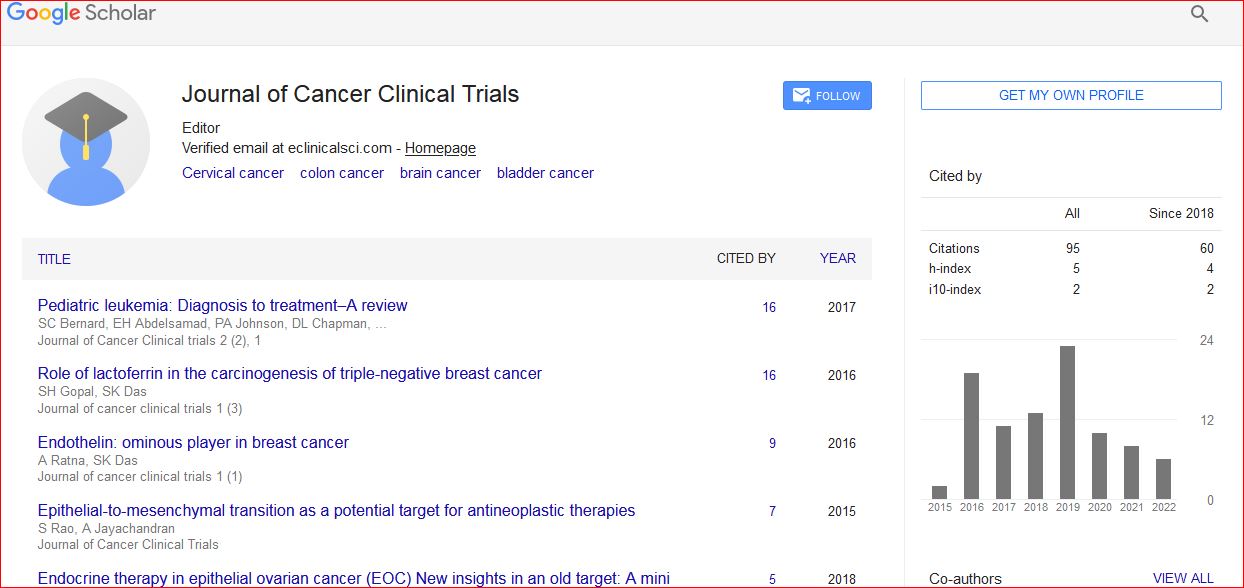
Journal of Cancer Clinical Trials received 95 citations as per Google Scholar report