Commentary - (2025) Volume 10, Issue 3
Received: 01-May-2025, Manuscript No. apn-26-179091;
Editor assigned: 04-May-2025, Pre QC No. P-179091;
Reviewed: 14-May-2025, QC No. Q-179091;
Revised: 21-May-2025, Manuscript No. R-179091;
Published:
28-May-2025
, DOI: 10.37421/2573-0347.2025.10.430
Citation: Hammond, Lila. Geriatric Polypharmacy: Multidisciplinary Strategies For Safety. J Adv Practice Nurs 10 (2025):430.
Copyright: © 2025 Hammond L. This is an open-access article distributed under the terms of the Creative Commons Attribution License, which permits unrestricted use,
distribution and reproduction in any medium, provided the original author and source are credited.
The multifaceted challenge of geriatric polypharmacy necessitates a comprehensive and nuanced approach within healthcare systems to mitigate potential risks and optimize patient well-being. Advanced nursing interventions are emerging as pivotal strategies in managing complex medication regimens for older adults. These interventions aim to systematically address the risks associated with the concurrent use of multiple medications, a common occurrence in this demographic, thereby enhancing patient safety and therapeutic efficacy. The critical role of nurses in conducting thorough medication reviews is increasingly recognized, offering a frontline defense against adverse drug events and improving overall care quality [1].
Pharmacist-led medication reconciliation has demonstrated significant promise in reducing adverse drug events among elderly patients. By employing structured processes that meticulously gather patient history and medication lists, pharmacists can effectively minimize prescribing errors and consequently lower hospital admission rates. This collaborative effort underscores the importance of interprofessional teamwork in safeguarding patients from medication-related harm [2].
The integration of technology into polypharmacy management for the elderly is proving to be a transformative development. Systematic reviews highlight how electronic health records, specialized medication management applications, and telehealth platforms can substantially improve medication adherence, facilitate seamless communication among healthcare providers, and empower patients to take a more active role in their treatment plans [3].
Within the primary care setting, the practice of deprescribing unnecessary medications in older adults is gaining traction as a crucial component of geriatric care. Primary care physicians are adopting practical strategies and employing patient-centered communication techniques to safely reduce or discontinue medications, aiming to minimize adverse effects and substantially enhance the patient's quality of life [4].
The effectiveness of a multidisciplinary team approach in managing polypharmacy among community-dwelling elderly individuals is well-documented. Collaborative efforts involving nurses, physicians, pharmacists, and social workers have been shown to significantly bolster medication safety and lead to a notable reduction in healthcare utilization, demonstrating the power of integrated care models [5].
At the heart of effective polypharmacy management lies a profound emphasis on the patient's perspective. Recognizing and integrating patients' beliefs, values, and personal experiences with their medications is paramount. This patient-centered approach, often facilitated through shared decision-making, is essential for developing personalized and ultimately more effective management plans that align with individual patient needs and preferences [6].
An important association exists between polypharmacy and the increased risk of falls in older adults. Specific classes of drugs have been identified as contributing to this heightened risk, underscoring the need for proactive medication reviews by nurses. Identifying and modifying these high-risk prescriptions can play a vital role in fall prevention strategies for this vulnerable population [7].
Advanced practice nurses (APNs) are well-positioned to lead and implement sophisticated polypharmacy management programs. A structured framework for APNs can guide the development and evaluation of these initiatives, incorporating essential elements such as specialized assessment tools, comprehensive educational resources, and robust outcome measurement strategies to optimize geriatric care delivery [8].
Nurses working in home healthcare settings face unique challenges when managing polypharmacy. Qualitative explorations reveal barriers such as time constraints, a lack of standardized protocols, and communication gaps among providers. Addressing these issues is crucial for enhancing the support and training provided to these frontline caregivers [9].
Nurse-led medication review clinics have emerged as an effective model for managing polypharmacy in older adults. These specialized clinics have demonstrated success in facilitating significant deprescribing, improving medication adherence, and ultimately enhancing patient satisfaction with their overall medication management experience [10].
The landscape of geriatric polypharmacy management is continually evolving, driven by the imperative to enhance patient safety and optimize therapeutic outcomes. Advanced nursing interventions represent a critical frontier in this field, offering specialized strategies to address the complex medication needs of older adults. These interventions are designed to systematically identify and mitigate the risks inherent in the concurrent use of multiple pharmaceuticals, thereby contributing to improved patient care and reduced adverse events. The proactive engagement of nurses in comprehensive medication reviews is a cornerstone of effective polypharmacy management, offering a vital layer of patient safety and quality assurance within the healthcare continuum [1].
Pharmacist-led medication reconciliation stands out as a highly effective intervention for reducing adverse drug events among the elderly population. The implementation of structured reconciliation processes, which involve a detailed review of a patient's medical history and current medication regimen, has been shown to significantly decrease the incidence of prescribing errors and, consequently, reduce hospital admissions. This highlights the indispensable role of pharmacists in a collaborative approach to medication safety [2].
The pervasive influence of technology in healthcare has led to the development of innovative technology-assisted interventions for managing geriatric polypharmacy. A thorough synthesis of existing evidence indicates that tools such as electronic health records, dedicated medication management applications, and telehealth platforms can substantially improve medication adherence. Furthermore, these technologies enhance communication channels among healthcare professionals and empower patients by providing them with greater control and understanding of their treatment plans [3].
In the realm of primary care, the concept and practice of deprescribing unnecessary medications in older adults are becoming increasingly vital. This approach involves the systematic identification and safe reduction or discontinuation of medications that are no longer indicated or are causing harm. Primary care physicians are instrumental in implementing these strategies, utilizing practical methodologies and patient-centered communication to improve the quality of life for their older patients by minimizing medication-related burdens [4].
The benefits of a multidisciplinary team approach to polypharmacy management are particularly evident in community-dwelling elderly populations. Collaborative efforts that bring together nurses, physicians, pharmacists, and social workers have been demonstrated to significantly enhance medication safety. This integrated model not only improves patient outcomes but also leads to a reduction in overall healthcare utilization, showcasing the efficiency and efficacy of coordinated care [5].
A central tenet in the successful management of geriatric polypharmacy is the acknowledgment and prioritization of the patient's perspective. Embracing shared decision-making and making a concerted effort to understand patients' individual beliefs, values, and personal experiences with their medications are critical steps. This patient-centered philosophy ensures that medication management plans are not only clinically sound but also aligned with the patient's life context and preferences, leading to greater adherence and satisfaction [6].
The interrelationship between polypharmacy and the increased risk of falls in older adults is a significant clinical concern. Certain drug classes have been specifically identified as contributing factors to this elevated fall risk. Consequently, proactive medication reviews conducted by nurses are essential for identifying and modifying prescriptions that may increase a patient's susceptibility to falls, thereby playing a crucial role in fall prevention efforts [7].
Advanced practice nurses (APNs) are uniquely positioned to spearhead the development, implementation, and evaluation of comprehensive polypharmacy management programs. The establishment of a clear framework for APNs can delineate essential components, including the use of standardized assessment tools, the provision of accessible educational resources, and the systematic measurement of outcomes, all geared towards optimizing the care provided to older adults experiencing polypharmacy [8].
Nurses operating within home healthcare settings encounter distinct challenges in their efforts to manage polypharmacy effectively. Qualitative research has illuminated several barriers, including significant time constraints, a lack of uniformly applied protocols, and the presence of communication breakdowns between different healthcare providers. Addressing these identified challenges is crucial for providing enhanced support and more effective training to these essential caregivers [9].
Nurse-led medication review clinics have proven to be a highly effective intervention for older adults grappling with polypharmacy. The findings from such clinics consistently indicate a capacity for significant deprescribing of unnecessary medications, leading to improved adherence rates and a marked enhancement in patient satisfaction concerning their medication management strategies [10].
Geriatric polypharmacy is a significant health concern requiring multifaceted interventions. Advanced nursing strategies, pharmacist-led reconciliation, and technology-assisted approaches are crucial for reducing medication-related risks. Primary care physicians play a role in deprescribing, while multidisciplinary teams enhance medication safety. Patient-centered care and understanding individual experiences are vital. The link between polypharmacy and falls necessitates proactive nursing reviews. Advanced practice nurses can lead program development, and addressing challenges in home healthcare is important. Nurse-led clinics demonstrate effectiveness in deprescribing and improving patient satisfaction.
None
None
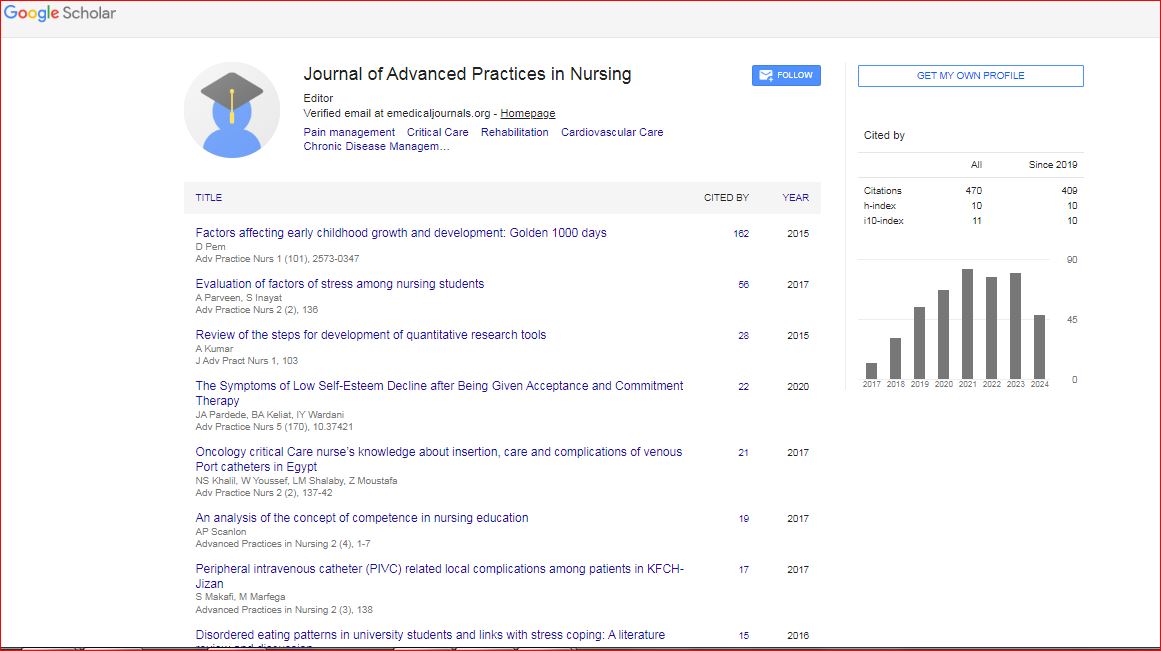
Journal of Advanced Practices in Nursing received 410 citations as per Google Scholar report