Brief Report - (2025) Volume 16, Issue 5
Received: 01-Sep-2025, Manuscript No. jpm-26-179445;
Editor assigned: 03-Sep-2025, Pre QC No. P-179445;
Reviewed: 17-Sep-2025, QC No. Q-179445;
Revised: 22-Sep-2025, Manuscript No. R-179445;
Published:
29-Sep-2025
, DOI: 10.37421/2090-0902.2025.16.551
Citation: Kovarik, Elena. ”Geometric Mechanics: Unifying Physics Through Geometry.” J Phys Math 16 (2025):551.
Copyright: © 2025 Kovarik E. This is an open-access article distributed under the terms of the Creative Commons Attribution License, which permits unrestricted use, distribution and reproduction in any medium, provided the original author and source are credited.
Geometric mechanics offers a powerful and unified framework for understanding the dynamics of physical systems by leveraging the principles of differential geometry. This approach reformulates classical mechanics in terms of sophisticated mathematical structures such as symplectic manifolds and Poisson brackets, providing elegant insights into Hamiltonian systems. The application of these geometric concepts extends to diverse fields, including celestial mechanics, fluid dynamics, and even quantum mechanics, demonstrating its broad applicability and unifying power [1].
The geometric interpretation of phase space is fundamental to both classical and quantum mechanics, with symplectic structures playing a crucial role in defining the time evolution of systems. This geometric formalism naturally expresses concepts like conserved quantities, canonical transformations, and integrability, making complex dynamical behaviors more comprehensible. The application of these ideas is particularly insightful in perturbation theory and the study of integrable systems [2].
The exploration of topological phases of matter has been significantly advanced through the lens of geometric mechanics. Specifically, the Berry curvature, a concept rooted in geometric phase, is instrumental in characterizing topological invariants in quantum systems. This geometric perspective provides a powerful means to classify and understand novel material properties, with notable examples found in condensed matter physics such as the quantum Hall effect [3].
The geometric structure of field theories, especially within general relativity and gauge theories, reveals intrinsic links between differential geometry and fundamental forces. Concepts like curvature and torsion are not merely mathematical abstractions but are deeply connected to the physical nature of spacetime and interactions. Geometric methods offer a potent means to formulate and resolve problems in theoretical physics, including force unification and spacetime dynamics [4].
A modern perspective on the geometric formulation of mechanics emphasizes its utility in understanding constrained systems and variational principles. The cotangent bundle and its associated canonical structure provide a natural and intuitive setting for Hamiltonian mechanics. This geometric approach simplifies complex problems and finds applications in areas like rigid body dynamics and celestial mechanics [5].
The study of fluid dynamics, particularly the Euler equations, benefits immensely from a geometric interpretation. The configurations of a fluid can be viewed as points on an infinite-dimensional manifold that possesses a natural geometric structure governing its flow. This geometric perspective illuminates the relationship between the geometry of the flow and its physical behavior, including vortex dynamics and turbulence [6].
Geometric methods are also invaluable for analyzing the stability of dynamical systems. Concepts such as Lyapunov functions and attractors can be understood from a geometric viewpoint, where the curvature and topology of phase space significantly influence the long-term behavior of systems. These insights are applicable to mechanical oscillators and systems exhibiting chaotic dynamics [7].
Non-holonomic mechanical systems, characterized by velocity constraints that are not integrable, present unique dynamical behaviors that are illuminated by geometric mechanics. The geometry of the configuration space and the structure of constraint forces dictate these behaviors, offering new avenues for path planning and control, as exemplified by the steering dynamics of a car [8].
The profound connections between geometric mechanics and quantum field theory are becoming increasingly apparent. The geometric formulation of classical fields, utilizing fiber bundles and connections, provides a foundational framework for quantized theories. This perspective deepens our understanding of fundamental interactions by highlighting the roles of gauge invariance and topological concepts [9].
The geometric interpretation of gravity in general relativity is a cornerstone of modern physics. Spacetime is viewed as a dynamic geometric entity whose curvature governs the motion of objects. Differential geometry provides the mathematical tools to explore Einstein's field equations and understand the geometric origins of gravitational phenomena, such as black holes and gravitational waves, underscoring the fundamental link between geometry and the universe [10].
Geometric mechanics provides a foundational approach to understanding physical systems by employing differential geometry. It reformulates classical mechanics using concepts like symplectic manifolds and Poisson brackets, offering a unified framework for Hamiltonian systems and extending its reach to celestial mechanics, fluid dynamics, and quantum mechanics [1].
Phase space in both classical and quantum mechanics is interpreted geometrically, with symplectic structures governing temporal evolution. This geometric perspective simplifies the representation of conserved quantities, canonical transformations, and integrability, with notable applications in perturbation theory and the study of integrable systems [2].
The study of topological phases of matter is significantly enhanced by geometric mechanics. The Berry curvature, a key concept in geometric phase theory, is crucial for defining topological invariants in quantum systems. This geometric insight aids in classifying and understanding new material properties, with prominent examples in condensed matter physics such as the quantum Hall effect [3].
Differential geometry plays a pivotal role in describing the structure of field theories, particularly in general relativity and gauge theories. Concepts such as curvature and torsion are intrinsically linked to fundamental forces and spacetime dynamics. Geometric methods offer a powerful means to formulate and solve complex problems in theoretical physics, including the unification of forces [4].
A contemporary view of geometric mechanics highlights its application to constrained systems and variational principles. The cotangent bundle and its canonical structure naturally accommodate Hamiltonian mechanics, simplifying intricate problems and finding utility in the dynamics of rigid bodies and celestial bodies [5].
Fluid dynamics, specifically the Euler equations, is illuminated by a geometric interpretation where fluid configurations reside on an infinite-dimensional manifold with inherent geometric properties governing flow. This geometric framework reveals connections between flow geometry and physical phenomena like vortex dynamics and turbulence [6].
Stability analysis in dynamical systems is effectively addressed through geometric methods. Concepts like Lyapunov functions and attractors are viewed geometrically, with phase space curvature and topology influencing system behavior. This approach is applicable to mechanical oscillators and systems exhibiting chaotic dynamics [7].
Non-holonomic mechanical systems, defined by non-integrable velocity constraints, exhibit distinct dynamical characteristics that are explained by geometric mechanics. The geometry of the configuration space and the nature of constraint forces lead to unique behaviors, offering insights for path planning and control, particularly in systems like automobiles [8].
The synergy between geometric mechanics and quantum field theory is increasingly recognized. The geometric formulation of classical fields, utilizing fiber bundles and connections, provides a basis for quantized theories, enhancing the understanding of fundamental interactions through gauge invariance and topological concepts [9].
General relativity's geometric interpretation of gravity posits spacetime as a dynamic geometric entity whose curvature dictates motion. Differential geometry is essential for analyzing Einstein's field equations and understanding the geometric origins of gravitational phenomena like black holes and gravitational waves, solidifying the link between geometry and the universe's fundamental nature [10].
This collection of works explores the profound intersection of differential geometry and mechanics, presenting a unified framework for understanding physical systems. Geometric mechanics reformulates classical dynamics using concepts like symplectic manifolds and phase space structures, offering elegant solutions for complex problems in areas such as celestial mechanics, fluid dynamics, and quantum mechanics. The geometric perspective is also applied to topological phases of matter, field theories, stability analysis, and non-holonomic systems. Notably, it provides a deep understanding of gravity within general relativity, viewing spacetime as a dynamic geometric entity. The overarching theme is the power of geometric principles to provide a cohesive and insightful understanding of fundamental physics.
None
None
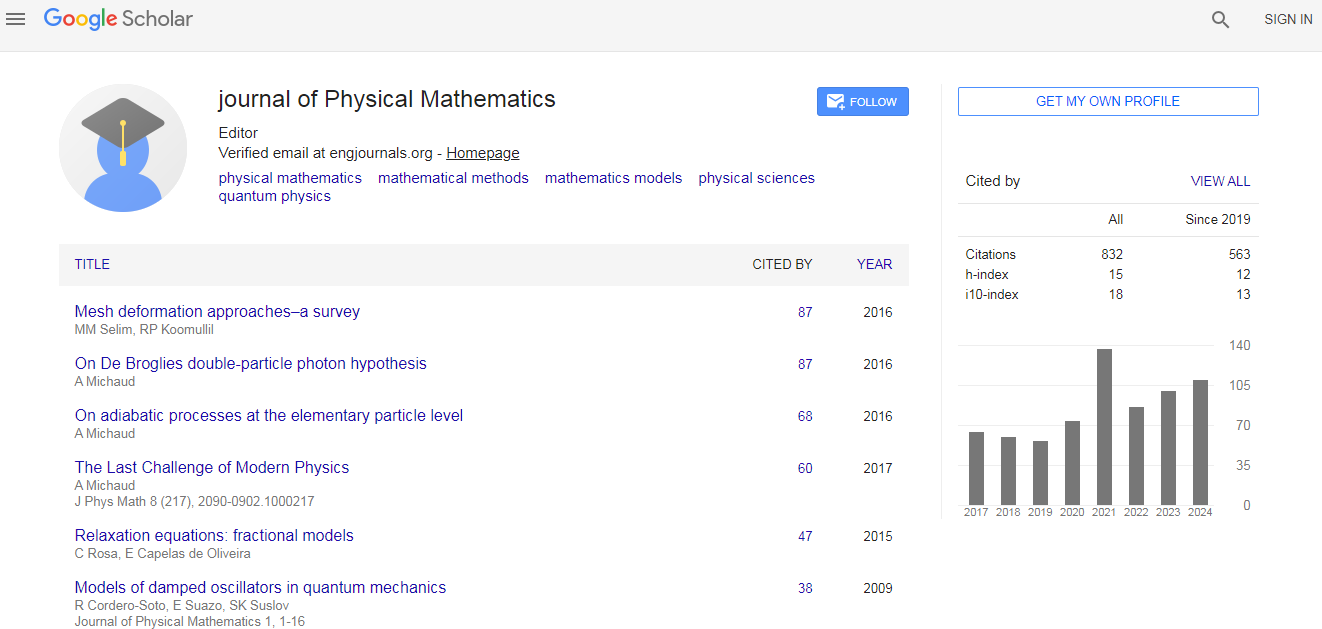
Physical Mathematics received 686 citations as per Google Scholar report