Commentary - (2025) Volume 16, Issue 3
Received: 01-May-2025, Manuscript No. jpm-26-179416;
Editor assigned: 05-May-2025, Pre QC No. P-179416;
Reviewed: 19-May-2025, QC No. Q-179416;
Revised: 22-May-2025, Manuscript No. R-179416;
Published:
29-May-2025
, DOI: 10.37421/2090-0902.2025.16.538
Citation: Reed, Samuel. ”Geometric Foundations of Classical Mechanics Mathematics.” J Phys Math 16 (2025):538.
Copyright: © 2025 Reed S. This is an open-access article distributed under the terms of the Creative Commons Attribution License, which permits unrestricted use, distribution and reproduction in any medium, provided the original author and source are credited.
This body of work delves into the profound mathematical structures that form the bedrock of classical mechanics, offering a comprehensive exploration of its theoretical underpinnings. The research highlights how advanced mathematical formalisms, such as Lagrangian and Hamiltonian approaches, serve as exceptionally powerful and elegant instruments for dissecting the complexities of physical systems. A significant emphasis is placed on the geometric interpretation of these formalisms, revealing deep and often subtle connections to the fields of differential geometry and the calculus of variations. These abstract structures are shown to substantially simplify the analysis of intricate dynamics, including the identification of conserved quantities and the understanding of canonical transformations [1].
The investigation into the role of symmetry within classical mechanics is a critical theme, demonstrating how Noether's theorem, a fundamental principle in theoretical physics, arises organically from the inherent mathematical architecture of the theory. The work examines the profound impact of continuous symmetries, illustrating their direct link to conserved quantities and establishing a crucial connection between a system's symmetries and its physical invariants. This exploration is further enriched by examining various examples across different mechanical systems [2].
Furthermore, the application of symplectic geometry to the study of Hamiltonian mechanics is thoroughly investigated. This research underscores how phase space, when endowed with a symplectic structure, provides an intrinsically natural geometric framework for comprehending canonical transformations and the temporal evolution of dynamical systems. The implications of this geometric perspective for the study of integrability and perturbation theory are discussed in detail [3].
A variational perspective is adopted to explore the foundational principles of classical mechanics, with a particular focus on the celebrated principle of least action. The research elucidates the derivation of the Euler-Lagrange equations, showing how they emerge from the minimization of a path integral. The universality of this fundamental principle across diverse physical domains is also a key point of discussion, with the mathematical rigor of the calculus of variations being central to this analysis [4].
The transition from the domain of classical mechanics to the realm of quantum mechanics is examined through the lens of their underlying mathematical structures. This research explores how established quantization procedures, such as canonical quantization, are deeply rooted in the phase-space formulation of classical systems. A significant contribution of this work is its ability to bridge the conceptual gap between the continuous nature of classical descriptions and the discrete, probabilistic characteristics of quantum phenomena [5].
The integral role of Lie groups and Lie algebras in the comprehension of symmetries within classical mechanical systems is explored. The research illustrates how these sophisticated abstract mathematical structures offer a unified and powerful framework for characterizing conserved quantities and the dynamics of systems exhibiting rotational and translational symmetries. The connections of these symmetries to fundamental forces are also considered [6].
The mathematical analysis of integrable systems within classical mechanics is a central focus. This investigation delves into the necessary conditions for integrability, the existence and properties of action-angle variables, and the strategic use of Poisson brackets to accurately describe the evolution of these systems. The study highlights the profound mathematical structures that facilitate a simplified description of non-chaotic dynamics [7].
An in-depth examination of the phase space formulation of classical mechanics is presented, with a strong emphasis on its inherent geometric underpinnings. The research discusses the fundamental properties of Poisson manifolds and elucidates their critical role in defining the dynamics of conservative systems. The profound concept of canonical transformations is thoroughly explored through the insightful lens of symplectic geometry [8].
The mathematical intricacies of constrained classical systems, particularly those described by the Diracâ??Bergmann theory, are rigorously investigated. The research explores the application of Lagrange multipliers and elucidates the significant implications of both first- and second-class constraints on the phase space and the resulting dynamics. This paper provides a robust and formal approach to effectively handling such complex systems [9].
Finally, the concept of canonical transformations within the framework of classical mechanics is explored, with a particular emphasis on their geometric interpretation within phase space. The research demonstrates how these transformations meticulously preserve the symplectic structure and are indispensable for both solving complex problems and gaining a deeper understanding of the evolution of Hamiltonian systems. The vital connection between canonical transformations and conserved quantities is also a key aspect of this analysis [10].
The mathematical formalisms underpinning classical mechanics are intricately explored, with a particular focus on how Lagrangian and Hamiltonian formulations provide elegant and powerful analytical tools for physical systems. The research emphasizes the geometric interpretation of these formalisms, revealing deep connections to differential geometry and the calculus of variations. It is highlighted how these abstract structures simplify the treatment of complex dynamics, including conserved quantities and canonical transformations [1].
The role of symmetry in classical mechanics is investigated, demonstrating how Noether's theorem naturally emerges from the mathematical structure of the theory. The article examines how continuous symmetries lead to conserved quantities, providing a fundamental link between the symmetries of a system and its physical invariants. The discussion is extended to various examples of mechanical systems [2].
The application of symplectic geometry to the study of Hamiltonian mechanics is a key theme, highlighting how phase space, endowed with a symplectic structure, offers a natural geometric framework for understanding canonical transformations and the evolution of dynamical systems. The implications for integrability and perturbation theory are discussed [3].
The foundations of classical mechanics are explored from a variational perspective, focusing on the principle of least action. The research elucidates how the Euler-Lagrange equations arise from minimizing a path integral and discusses the universality of this principle across different physical domains. The mathematical rigor of the calculus of variations is central to this analysis [4].
This research examines the transition from classical mechanics to quantum mechanics through the lens of mathematical structures. It explores how quantization procedures, such as canonical quantization, are rooted in the phase-space formulation of classical systems. The paper bridges the gap between the continuous nature of classical descriptions and the discrete, probabilistic nature of quantum phenomena [5].
The article delves into the role of Lie groups and Lie algebras in understanding the symmetries of classical mechanical systems. It illustrates how these abstract mathematical structures provide a unified framework for describing conserved quantities and the dynamics of systems with rotational and translational symmetries. The connection to fundamental forces is also discussed [6].
The mathematical analysis of integrable systems within classical mechanics is explored. This includes an examination of the conditions for integrability, the existence of action-angle variables, and the use of Poisson brackets to characterize the evolution of these systems. The study highlights the deep mathematical structures that simplify the description of non-chaotic dynamics [7].
An in-depth examination of the phase space formulation of classical mechanics is presented, emphasizing its geometric underpinnings. The properties of Poisson manifolds and their role in defining the dynamics of conservative systems are discussed. The concept of canonical transformations is explored through the lens of symplectic geometry [8].
This work investigates the mathematical structure of constrained classical systems, such as those described by the Diracâ??Bergmann theory. It explores the use of Lagrange multipliers and the implications of first and second-class constraints on the phase space and the resulting dynamics. The paper offers a rigorous approach to handling such systems [9].
The concept of canonical transformations within classical mechanics is explored, emphasizing their geometric interpretation in phase space. The research demonstrates how these transformations preserve the symplectic structure and are crucial for solving problems and understanding the evolution of Hamiltonian systems. The connection to conserved quantities is also examined [10].
This collection of research explores the intricate mathematical foundations of classical mechanics. Key areas of focus include the geometric interpretations of Lagrangian and Hamiltonian formalisms, the fundamental role of symmetry and Noether's theorem in generating conserved quantities, and the application of symplectic geometry to Hamiltonian dynamics. Variational principles, particularly the principle of least action, are examined for their foundational significance. The research also bridges the gap between classical and quantum mechanics through mathematical structures and delves into the use of Lie groups and algebras for understanding symmetries. Furthermore, the analysis extends to integrable systems, the geometric properties of phase space and Poisson structures, the mathematical framework of constrained classical systems, and the geometric viewpoint of canonical transformations in phase space. These studies collectively emphasize the elegance and power of mathematical structures in describing and understanding the behavior of physical systems.
None
None
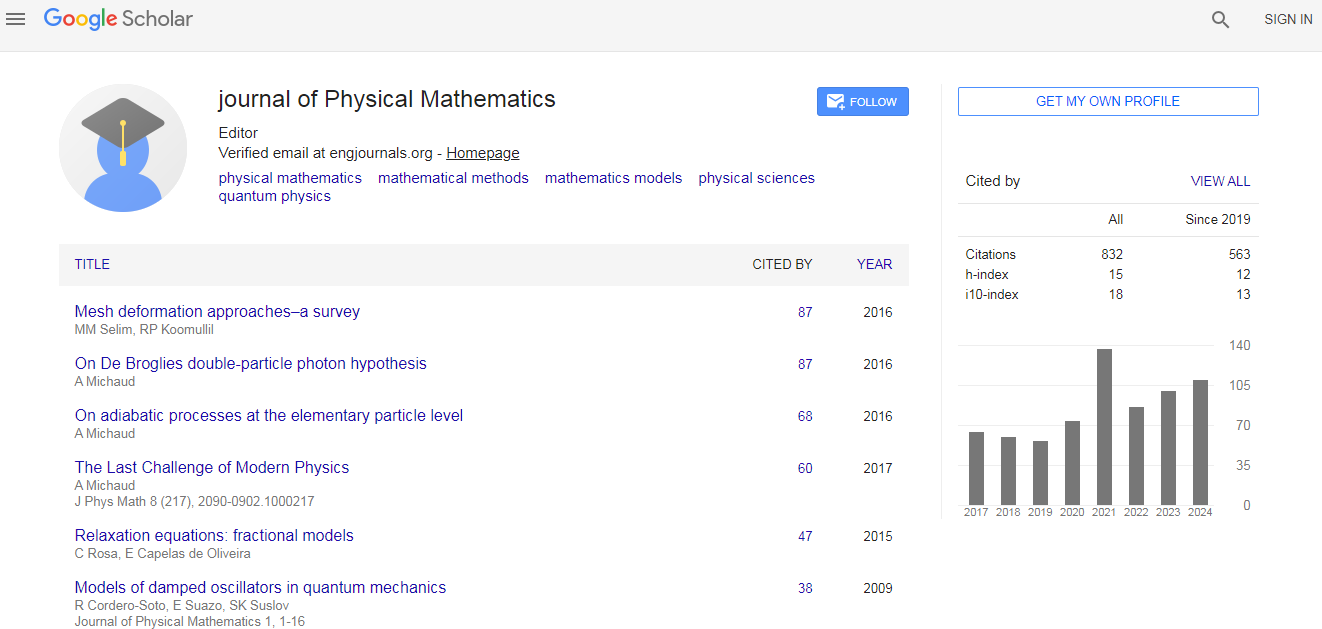
Physical Mathematics received 686 citations as per Google Scholar report