Opinion - (2025) Volume 13, Issue 4
Received: 01-Aug-2025, Manuscript No. JCMG-26-185548;
Editor assigned: 03-Aug-2025, Pre QC No. P-185548;
Reviewed: 17-Aug-2025, QC No. Q-185548;
Revised: 23-Aug-2025, Manuscript No. R-185548;
Published:
30-Aug-2025
, DOI: 10.37421/2472-128X.2025.13.351
Citation: Gallagher, Liam. ”Genomics Revolutionizes Personalized Healthcare: A New Era.” J Clin Med Genomics 13 (2025):351.
Copyright: © 2025 Gallagher L. This is an open-access article distributed under the terms of the Creative Commons Attribution License, which permits unrestricted use, distribution and reproduction in any medium, provided the original author and source are credited.
Population genomics is fundamentally reshaping the landscape of personalized healthcare by offering an unprecedented understanding of genetic variations across diverse human populations. This deep insight into genetic diversity is instrumental in identifying individual predispositions to various diseases, understanding variations in drug responses, and pinpointing potential therapeutic targets. The ultimate goal is to move beyond a generalized approach to medicine and establish tailored medical interventions and preventative strategies that are specific to an individual's genetic makeup and that of their ancestral groups. By enabling the analysis of large-scale genomic data, clinicians are empowered to make more informed and precise decisions regarding patient care. This shift signifies a departure from the traditional one-size-fits-all model, ushering in an era where medical treatments and preventative measures are customized to the unique genetic profile of each patient, thereby enhancing efficacy and minimizing adverse effects. The practical application of population genomic data within clinical settings is proving invaluable for predicting adverse drug reactions and optimizing pharmacotherapy. A thorough understanding of how genetic differences influence drug metabolism and the efficacy of treatments across various ethnic groups is critical for minimizing the risk of side effects and maximizing the therapeutic benefits of medications. This personalized approach to prescribing medications holds the promise of significantly improving patient outcomes and contributing to a reduction in overall healthcare costs. By tailoring drug regimens based on an individual's genetic profile, healthcare providers can ensure that patients receive the most effective treatment with the fewest possible complications. Furthermore, the strategic utilization of population genomics in healthcare facilitates the identification of individuals who are at a higher risk for developing specific diseases. This includes a wide spectrum of conditions such as various forms of cancer, cardiovascular diseases, and rare genetic disorders, allowing for proactive management. This proactive approach enables the implementation of targeted screening programs, promotes early detection of diseases, and supports the deployment of preventative interventions. It represents a significant paradigm shift in healthcare, moving the focus from reactive treatment of established illnesses to proactive management and prevention. Genomic databases that accurately represent the genetic diversity of various populations are indispensable for the development of robust polygenic risk scores. These scores offer a more nuanced assessment of an individual's susceptibility to complex diseases than traditional single-gene testing methods. These polygenic risk scores are increasingly being integrated into clinical decision-making processes, particularly for guiding preventative care strategies. Their development and application are critical for refining risk prediction and tailoring preventative health measures to individual needs. The ethical, legal, and social implications (ELSI) surrounding the widespread use of population genomics in personalized healthcare are substantial and require careful consideration. Key issues such as data privacy, the potential for genetic discrimination, and ensuring equitable access to advanced genomic technologies are paramount. Addressing these ELSI concerns is crucial for the responsible and effective implementation of genomic medicine, ensuring that its benefits are accessible to all and that it does not inadvertently widen existing health disparities among different demographic groups. C001 Population genomics is transforming personalized healthcare by enabling a deeper understanding of genetic variation within diverse populations. This knowledge facilitates the identification of disease predispositions, drug response variations, and potential therapeutic targets, paving the way for tailored medical interventions and preventative strategies. By analyzing large-scale genomic data, clinicians can make more informed decisions about patient care, moving beyond a one-size-fits-all approach. C002 The application of population genomic data in clinical settings allows for the prediction of adverse drug reactions and the optimization of pharmacotherapy. Understanding how genetic differences influence drug metabolism and efficacy among various ethnic groups is crucial for minimizing side effects and maximizing treatment benefits. This personalized approach to prescribing can significantly improve patient outcomes and reduce healthcare costs. C003 Leveraging population genomics in healthcare allows for the identification of individuals at higher risk for specific diseases, such as cancer, cardiovascular conditions, and rare genetic disorders. This proactive approach enables targeted screening, early detection, and preventative interventions, fundamentally shifting healthcare from reactive treatment to proactive management. C004 The ethical, legal, and social implications (ELSI) of population genomics in personalized healthcare are significant. Issues surrounding data privacy, genetic discrimination, and equitable access to genomic technologies must be addressed to ensure responsible implementation and prevent widening health disparities. C005 Genomic databases representing diverse populations are essential for building robust polygenic risk scores. These scores can predict an individual's susceptibility to complex diseases, offering a more nuanced risk assessment than single-gene testing, and are increasingly integrated into clinical decision-making for preventative care. C006 The integration of population genomic data into electronic health records (EHRs) is a critical step towards realizing the full potential of personalized medicine. This integration allows for real-time genomic insights to inform clinical care, from diagnosis to treatment selection and risk stratification. C007 Population genomics plays a crucial role in understanding the genetic architecture of complex diseases, providing insights into the interplay of multiple genes and environmental factors. This understanding is fundamental for developing targeted therapies and personalized prevention strategies. C008 The translation of population genomic findings into actionable clinical guidelines requires robust analytical tools and well-curated datasets. Ensuring the diversity of these datasets is paramount to avoid biases and ensure the equitable application of personalized medicine across different populations. C009 Future directions in population genomics for personalized healthcare include the development of more sophisticated predictive models, the expansion of genomic screening programs, and the establishment of global data-sharing initiatives. These advancements promise to further refine disease prevention, diagnosis, and treatment. C010 The implementation of population genomics in clinical practice requires a skilled workforce capable of interpreting complex genomic data and communicating findings to patients. Educational initiatives and training programs are vital to support the widespread adoption of genomic medicine.
Population genomics is emerging as a foundational element for precision medicine, providing a granular view of genetic variation within diverse human groups. This detailed understanding is crucial for identifying genetic predispositions to diseases, predicting responses to pharmaceuticals, and uncovering novel therapeutic targets. The overarching aim is to facilitate the development of medical interventions and preventative strategies that are precisely tailored to individual genetic profiles, moving away from generalized treatments. The ability to analyze extensive genomic datasets empowers clinicians with enhanced capabilities for making informed patient care decisions, signifying a paradigm shift from a one-size-fits-all medical model to a personalized approach. The clinical deployment of population genomic data offers significant advantages, particularly in forecasting adverse drug reactions and optimizing pharmacotherapeutic regimens. Comprehending the influence of genetic disparities on drug metabolism and efficacy across distinct ethnic populations is imperative for minimizing adverse effects and maximizing treatment benefits. This individualized approach to medication management can lead to substantially improved patient outcomes and a notable reduction in healthcare expenditures. Furthermore, the strategic application of population genomics within healthcare systems aids in the early identification of individuals at elevated risk for a spectrum of diseases, including various cancers, cardiovascular ailments, and rare genetic conditions. This predictive capability underpins a proactive healthcare model that emphasizes targeted screening, early diagnosis, and the implementation of preventative measures, thereby transforming healthcare from a reactive to a proactive discipline. The development of sophisticated polygenic risk scores relies heavily on the availability of comprehensive genomic databases that reflect the genetic diversity of various populations. These scores provide a more refined assessment of an individual's susceptibility to complex multifactorial diseases compared to traditional single-gene analyses. These increasingly sophisticated risk scores are being progressively incorporated into clinical decision-making frameworks, especially concerning preventative care strategies. Their accurate development and validated application are essential for improving risk stratification and personalizing health interventions. A crucial advancement in the practical integration of genomic insights into routine clinical practice involves the incorporation of population genomic data into electronic health records (EHRs). This integration enables the real-time availability and utilization of genomic information to guide various aspects of patient care. This includes informing diagnostic processes, assisting in the selection of appropriate treatments, and enhancing the accuracy of patient risk stratification. The seamless flow of genomic data within EHRs is vital for unlocking the full potential of personalized medicine at the point of care. Population genomics is instrumental in elucidating the complex genetic underpinnings of diseases, offering critical insights into the intricate interactions between multiple genes and environmental influences. This fundamental understanding is a prerequisite for the design and implementation of targeted therapeutic strategies and personalized prevention plans. The successful translation of findings derived from population genomic research into practical, actionable clinical guidelines necessitates the development and utilization of advanced analytical tools alongside meticulously curated and representative datasets. Ensuring the diversity and inclusivity of these datasets is of paramount importance to mitigate potential biases. This commitment to data diversity is essential for guaranteeing the equitable application of personalized medicine across all population groups, thereby preventing the exacerbation of existing health inequities and promoting health justice. C001 Population genomics is transforming personalized healthcare by enabling a deeper understanding of genetic variation within diverse populations. This knowledge facilitates the identification of disease predispositions, drug response variations, and potential therapeutic targets, paving the way for tailored medical interventions and preventative strategies. By analyzing large-scale genomic data, clinicians can make more informed decisions about patient care, moving beyond a one-size-fits-all approach. C002 The application of population genomic data in clinical settings allows for the prediction of adverse drug reactions and the optimization of pharmacotherapy. Understanding how genetic differences influence drug metabolism and efficacy among various ethnic groups is crucial for minimizing side effects and maximizing treatment benefits. This personalized approach to prescribing can significantly improve patient outcomes and reduce healthcare costs. C003 Leveraging population genomics in healthcare allows for the identification of individuals at higher risk for specific diseases, such as cancer, cardiovascular conditions, and rare genetic disorders. This proactive approach enables targeted screening, early detection, and preventative interventions, fundamentally shifting healthcare from reactive treatment to proactive management. C004 The ethical, legal, and social implications (ELSI) of population genomics in personalized healthcare are significant. Issues surrounding data privacy, genetic discrimination, and equitable access to genomic technologies must be addressed to ensure responsible implementation and prevent widening health disparities. C005 Genomic databases representing diverse populations are essential for building robust polygenic risk scores. These scores can predict an individual's susceptibility to complex diseases, offering a more nuanced risk assessment than single-gene testing, and are increasingly integrated into clinical decision-making for preventative care. C006 The integration of population genomic data into electronic health records (EHRs) is a critical step towards realizing the full potential of personalized medicine. This integration allows for real-time genomic insights to inform clinical care, from diagnosis to treatment selection and risk stratification. C007 Population genomics plays a crucial role in understanding the genetic architecture of complex diseases, providing insights into the interplay of multiple genes and environmental factors. This understanding is fundamental for developing targeted therapies and personalized prevention strategies. C008 The translation of population genomic findings into actionable clinical guidelines requires robust analytical tools and well-curated datasets. Ensuring the diversity of these datasets is paramount to avoid biases and ensure the equitable application of personalized medicine across different populations. C009 Future directions in population genomics for personalized healthcare include the development of more sophisticated predictive models, the expansion of genomic screening programs, and the establishment of global data-sharing initiatives. These advancements promise to further refine disease prevention, diagnosis, and treatment. C010 The implementation of population genomics in clinical practice requires a skilled workforce capable of interpreting complex genomic data and communicating findings to patients. Educational initiatives and training programs are vital to support the widespread adoption of genomic medicine.
Population genomics is revolutionizing personalized healthcare by understanding genetic variations across diverse populations. This enables identification of disease predispositions, prediction of drug responses, and discovery of therapeutic targets for tailored medical interventions. Integration into clinical practice allows for improved patient care through informed decisions, optimized pharmacotherapy, and early risk identification for proactive management of conditions like cancer and cardiovascular diseases. The development of polygenic risk scores and their incorporation into clinical decision-making for preventative care are key advancements. Ethical considerations such as data privacy and equitable access are critical for responsible implementation. Future directions involve sophisticated predictive models, expanded screening, and global data sharing to enhance disease prevention, diagnosis, and treatment. A skilled workforce trained in genomic interpretation and communication is essential for widespread adoption.
None
None
None
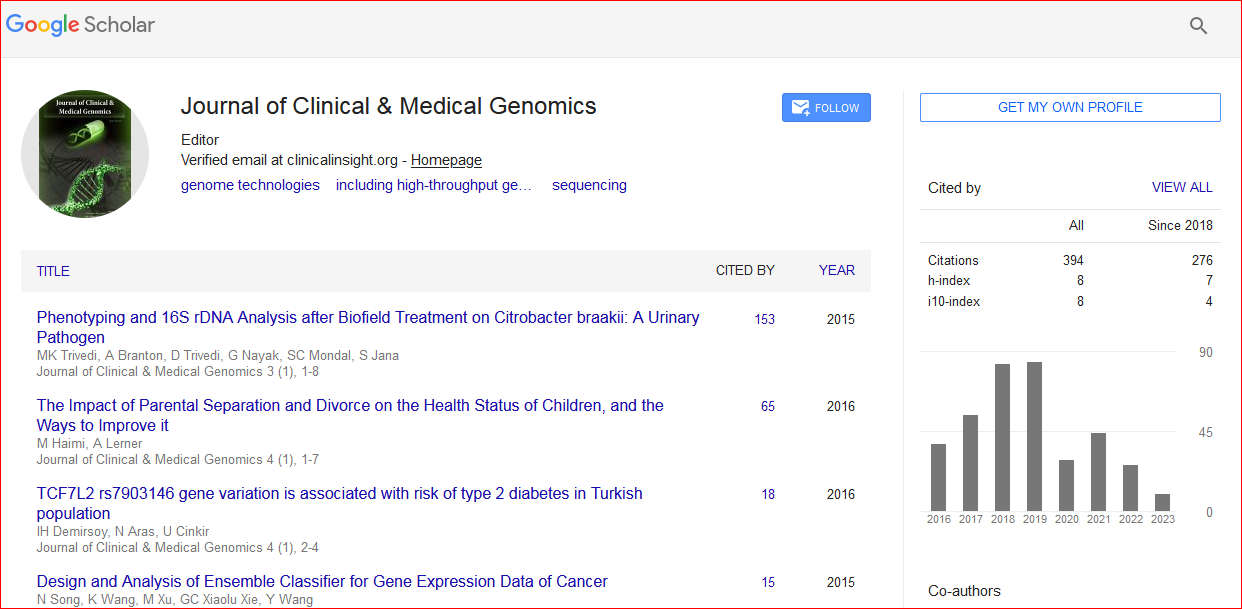
Journal of Clinical & Medical Genomics received 391 citations as per Google Scholar report