Brief Report - (2025) Volume 13, Issue 4
Received: 01-Aug-2025, Manuscript No. JCMG-26-185552;
Editor assigned: 03-Aug-2025, Pre QC No. P-185552;
Reviewed: 18-Aug-2025, QC No. Q-185552;
Revised: 22-Aug-2025, Manuscript No. R-185552;
Published:
29-Aug-2025
, DOI: 10.37421/2472-128X.2025.13.355
Citation: Kim, Hana. ”Genomics Revolutionizes Cardiovascular Disease Risk Prediction.” J Clin Med Genomics 13 (2025):355.
Copyright: © 2025 Kim H. This is an open-access article distributed under the terms of the Creative Commons Attribution License, which permits unrestricted use, distribution and reproduction in any medium, provided the original author and source are credited.
Genomic insights are fundamentally transforming the landscape of cardiovascular disease (CVD) risk prediction. By delving into an individual's unique DNA, it is now possible to pinpoint genetic predispositions. When these genetic markers are considered alongside established clinical factors, a significantly more precise assessment of CVD risk emerges than what traditional methods alone can provide. This advanced precision allows for the implementation of earlier interventions and the development of highly personalized preventive strategies, marking a substantial shift. This paradigm shift moves healthcare from a predominantly reactive treatment model towards a proactive approach centered on maintaining health and preventing disease manifestation. This evolution is further underscored by the significant advancements in polygenic risk scores (PRS). PRS offer a powerful way to quantify an individual's inherited susceptibility to CVD by aggregating the effects of numerous common genetic variants. The integration of these scores with lifestyle factors and relevant biomarkers provides a robust tool for identifying individuals who stand to benefit most from intensive preventive measures. This capability is critical for tailoring interventions to those at highest risk. Furthermore, the role of rare genetic variants in specific cardiovascular conditions, such as familial hypercholesterolemia, is increasingly being recognized. Sophisticated sequencing technologies are now capable of detecting these rare variants, which is crucial for establishing definitive diagnoses. This diagnostic capability then enables cascade screening within affected families, a targeted approach vital for early intervention and the prevention of premature cardiovascular events. Pharmacogenomics is another rapidly developing area, offering personalized drug selection and precise dosing strategies for managing CVD. By understanding how an individual's genetic makeup influences drug metabolism and response, clinicians can optimize therapeutic efficacy while simultaneously minimizing the risk of adverse drug reactions. This leads to the development of safer and more effective treatment plans tailored to the individual. The integration of multi-omics data, encompassing genomics, transcriptomics, and proteomics, is providing an unprecedented holistic view of the molecular underpinnings of CVD. This comprehensive approach has the potential to uncover novel biomarkers and previously unrecognized pathways involved in disease development. Such discoveries pave the way for the identification of new diagnostic tools and therapeutic targets. Beyond DNA sequences, epigenetic modifications, such as DNA methylation, are also playing a recognized role in CVD pathogenesis. These modifications are influenced by a complex interplay of both genetic and environmental factors. Studying these epigenetic changes in conjunction with genomic data can yield deeper insights into disease mechanisms. This understanding can, in turn, identify potential targets for novel epigenetic therapies. The ethical implications arising from the widespread use of genomic testing for CVD risk assessment are of paramount importance and require careful consideration. Key aspects include robust genetic counseling, ensuring informed consent, safeguarding data privacy, and mitigating the potential for genetic discrimination. These considerations are essential for the responsible and equitable implementation of genomic insights within clinical practice. Computational approaches, particularly machine learning and artificial intelligence, are becoming indispensable tools for analyzing the vast and complex genomic datasets now available for CVD risk prediction. These methods excel at identifying intricate patterns and interactions within the data that might elude traditional statistical analysis. Consequently, they enhance the overall accuracy and predictive power of risk assessment models. Crucially, the development of population-specific genomic databases is essential for achieving accurate CVD risk prediction. This necessity arises because allele frequencies and the genetic associations with disease can vary significantly across different ethnic and ancestral groups. Tailoring predictive models to reflect these population-specific genetic variations ensures that genomic medicine can be applied equitably and effectively across diverse populations. Advancements in long-read sequencing technologies are significantly improving our ability to detect complex structural variations within the genome. These variations, which can include large deletions, insertions, and rearrangements, are increasingly recognized as contributors to CVD. Such technological improvements facilitate a more comprehensive understanding of the genetic architecture underlying various cardiovascular conditions.
Genomic insights are revolutionizing cardiovascular disease (CVD) risk prediction by enabling the identification of genetic predispositions that, when combined with clinical factors, offer a more precise assessment than traditional methods. This precision approach facilitates earlier interventions and personalized preventive strategies, shifting the paradigm towards proactive health management. The analysis of an individual's DNA allows for a deeper understanding of their unique susceptibility to CVD. The integration of this genetic information with other clinical data points creates a more holistic and accurate risk profile, paving the way for more effective preventative care and early detection strategies, ultimately aiming to reduce the burden of cardiovascular disease. Polygenic risk scores (PRS) represent a significant leap forward in genomic risk prediction for CVD. These scores effectively aggregate the effects of many common genetic variants, providing a comprehensive measure of inherited susceptibility to the disease. By integrating PRS with lifestyle factors and relevant biomarkers, clinicians gain a powerful tool for identifying individuals at high risk who could benefit significantly from intensified preventive measures. This approach allows for the stratification of risk within a population and the targeted application of resources and interventions to those most likely to develop CVD. The quantitative nature of PRS provides a tangible metric for risk assessment and patient counseling. Rare genetic variants play a crucial role in the etiology of specific cardiovascular conditions, such as familial hypercholesterolemia. Advanced sequencing technologies have made it possible to detect these variants with increasing accuracy, leading to definitive diagnoses and enabling cascade screening of affected families. This targeted approach is vital for early intervention and the prevention of premature cardiovascular events. Identifying these rare but impactful variants is critical for managing inherited cardiovascular disorders and preventing adverse outcomes in affected individuals and their relatives. Pharmacogenomics is emerging as a key discipline in the personalized management of CVD. It offers tailored drug selection and precise dosing strategies based on an individual's genetic makeup. Understanding how genetic variations influence drug metabolism and response is critical for optimizing therapeutic efficacy and minimizing the likelihood of adverse drug reactions. This leads to the development of safer, more effective, and individualized treatment plans for patients with cardiovascular conditions, enhancing patient outcomes and reducing healthcare costs associated with ineffective treatments or side effects. The integration of multi-omics data, including genomics, transcriptomics, and proteomics, is providing a holistic and comprehensive view of the molecular underpinnings of CVD. This multi-faceted approach allows for the discovery of novel biomarkers and the elucidation of complex pathways involved in disease development. Such insights are crucial for identifying new diagnostic targets and developing innovative therapeutic strategies aimed at preventing or treating CVD more effectively. This systems biology approach promises to unlock a deeper understanding of disease complexity. Epigenetic modifications, such as DNA methylation, are recognized to be influenced by both genetic and environmental factors and play a significant role in the pathogenesis of CVD. Studying these dynamic changes alongside genomic data can provide deeper insights into the intricate mechanisms of disease development. Identifying potential targets for epigenetic therapies represents a promising avenue for novel treatment strategies. Understanding how environmental exposures interact with genetic susceptibility through epigenetic mechanisms is key to developing comprehensive prevention and treatment approaches. The ethical implications of genomic testing for CVD risk are of paramount importance and necessitate careful consideration to ensure responsible implementation. This includes providing adequate genetic counseling, obtaining informed consent, ensuring robust data privacy, and actively preventing potential genetic discrimination. Upholding ethical principles is essential for building trust and ensuring that the benefits of genomic medicine are realized without compromising individual rights or societal equity. Responsible stewardship of genetic information is critical for its effective clinical application. Machine learning and artificial intelligence (AI) are increasingly being employed to analyze complex genomic datasets and enhance CVD risk prediction. These advanced computational approaches are adept at identifying intricate patterns and interactions within the data that may not be readily apparent through traditional statistical methods. This capability significantly improves the accuracy and predictive power of risk assessment models, leading to more reliable identification of individuals at risk. The development and utilization of population-specific genomic databases are crucial for accurate CVD risk prediction. This is because allele frequencies and the genetic associations with disease can vary substantially across different ethnic and ancestral groups. Tailoring predictive models to account for these population-specific genetic variations is essential for ensuring the equitable and effective application of genomic medicine across diverse populations worldwide. Ensuring representation in genomic databases is vital for global health equity. Long-read sequencing technologies are significantly enhancing our ability to detect complex structural variations in the genome that contribute to CVD. These technological advancements enable a more comprehensive understanding of the genetic architecture of cardiovascular conditions, including those involving large deletions, insertions, and rearrangements. This detailed genetic information can lead to improved diagnostic capabilities and a more nuanced understanding of disease mechanisms.
Genomic insights are revolutionizing cardiovascular disease (CVD) risk prediction by identifying genetic predispositions and integrating them with clinical factors for more precise assessments. Polygenic risk scores (PRS) quantify inherited susceptibility, while rare variants and epigenetic modifications offer insights into specific conditions and disease mechanisms. Pharmacogenomics enables personalized drug selection and dosing. Multi-omics data provides a holistic view, and advancements in sequencing, like long-read technology, improve the detection of complex variations. Machine learning and AI are enhancing predictive models, but the development of population-specific genomic databases is crucial for equitable risk prediction. Ethical considerations regarding genetic counseling, privacy, and discrimination are paramount for responsible implementation.
None
None
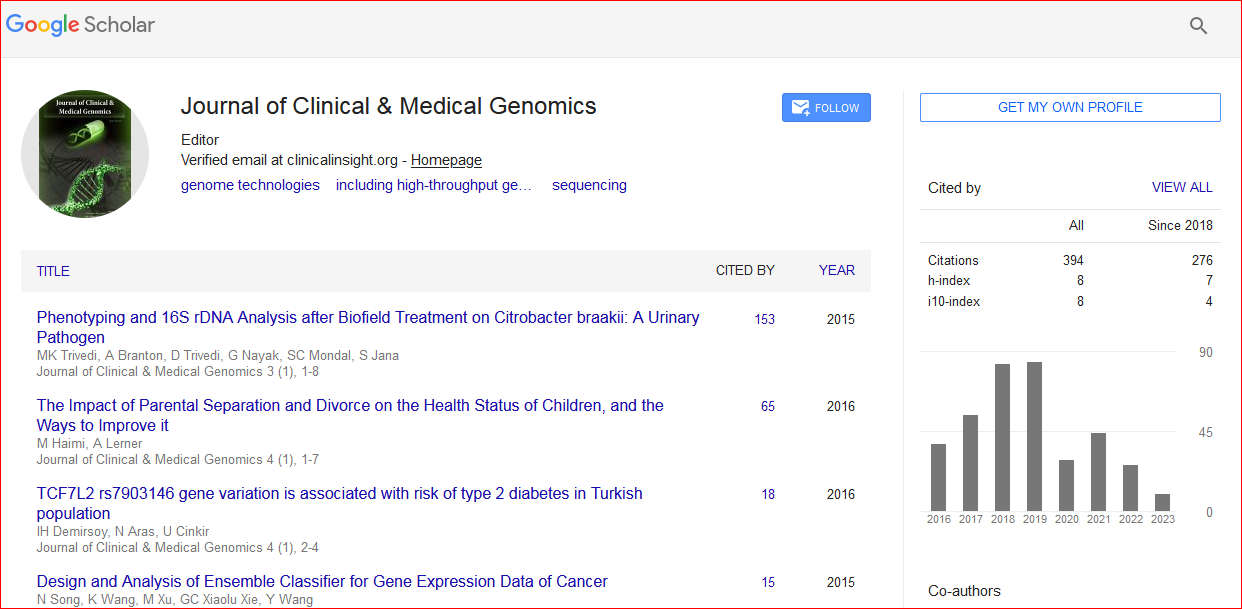
Journal of Clinical & Medical Genomics received 391 citations as per Google Scholar report