Brief Report - (2025) Volume 18, Issue 4
Received: 30-Jun-2025, Manuscript No. jcsb-25-176416;
Editor assigned: 02-Jul-2025, Pre QC No. P-176416;
Reviewed: 16-Jul-2025, QC No. Q-176416;
Revised: 23-Jul-2025, Manuscript No. R-176416;
Published:
30-Jul-2025
, DOI: 10.37421/0974-7230.2025.18.600
Citation: Jensen, Hannah. ”Genomics: Evolving Computation, Data, AI, and Privacy.” J Comput Sci Syst Biol 18 (2025):600.
Copyright: © 2025 Jensen H. This is an open-access article distributed under the terms of the Creative Commons Attribution License, which permits unrestricted use, distribution and reproduction in any medium, provided the original author and source are credited.
The landscape of genomics and bioinformatics is rapidly expanding, bringing with it both unprecedented opportunities and significant computational challenges across various domains. Effectively integrating diverse single-cell multi-omics data presents considerable computational hurdles. These include managing data harmonization, performing dimension reduction, and conducting joint analysis to truly reveal complex biological insights derived from cellular heterogeneity. The need for sophisticated computational tools is paramount to fully leverage these multi-modal single-cell datasets, setting a clear path for future advancements in the field [1].
Artificial Intelligence (AI) has emerged as a transformative force in genomics, offering a comprehensive suite of applications from precise variant calling to robust disease prediction. This realm explores a variety of machine learning models, detailing their inherent strengths and limitations, while underscoring AI's vast potential to accelerate both discovery and clinical translation within genomic medicine. Acknowledging key challenges such as data interpretability and inherent biases is vital for its responsible deployment [2].
Advanced computational methods are indispensable for processing and accurately interpreting the rich data generated by long-read sequencing technologies. This area covers essential algorithms for base calling, sequence alignment, variant detection, and comprehensive genome assembly. These methods are designed to overcome the unique challenges associated with longer reads, enabling the discovery of complex genomic structures and variants that short-read platforms previously could not detect [3].
Recent innovations in statistical and computational methods are continually enhancing genome-wide association studies (GWAS). These advancements are crucial for fine-mapping causal variants with greater precision, effectively integrating diverse multi-omic data, and analyzing rare variants. The collective goal is to significantly boost the power and resolution of GWAS, ultimately uncovering stronger genetic associations with complex traits and diseases [4].
Identifying structural variants (SVs) within cancer genomes demands specialized computational techniques. This involves navigating the complexities of detecting rearrangements like copy number variations and translocations across various sequencing data types. Evaluating the performance of existing tools is crucial, as they are fundamental for understanding the progression of cancer evolution and for developing highly targeted therapies [5].
The protection of genomic data privacy stands as a critical computational challenge. Researchers are actively exploring and implementing various privacy-preserving techniques, including homomorphic encryption, secure multi-party computation, and differential privacy. These methods are designed to facilitate essential genomic research while rigorously safeguarding sensitive personal information, requiring careful consideration of their respective trade-offs and charting future research directions [6].
Analyzing complex metagenomic datasets introduces its own set of computational hurdles and calls for innovative solutions. This area encompasses methods for precise taxonomic profiling, functional annotation, and the assembly of microbial genomes from diverse environmental samples. The necessity of advanced algorithms is highlighted here, as they are key to extracting meaningful biological insights from the vast and varied microbial communities we encounter [7].
Computational tools are increasingly vital for deciphering the intricate three-dimensional organization of chromatin within the cell nucleus. This involves methodologies for analyzing Hi-C and other chromatin conformation capture data, including sophisticated techniques for identifying topologically associating domains (TADs), chromatin loops, and distinct compartmentalization. Such insights are fundamental for understanding complex gene regulation and overall nuclear function [8].
Computational strategies are also being refined for interpreting pharmacogenomic variants and accurately predicting drug response. These approaches integrate clinical data, comprehensive genomic information, and detailed functional annotations to pinpoint genetic markers that significantly influence drug efficacy and potential toxicity. This work is instrumental in advancing personalized medicine and optimizing individual drug therapies [9].
Finally, analyzing large-scale human population genomics data presents distinct computational challenges. These include issues related to efficient data storage, processing capabilities, imputation accuracy, and the inference of demographic history and natural selection. There is a clear and ongoing need for efficient algorithms and robust infrastructure to effectively leverage these immense datasets, thereby deepening our understanding of human genetic diversity and evolutionary processes [10].
The rapidly advancing landscape of genomics and bioinformatics relies heavily on sophisticated computational methods to tackle complex biological data. For example, integrating diverse single-cell multi-omics data poses significant challenges that demand advanced computational approaches for data harmonization, dimension reduction, and joint analysis. These methods are crucial for uncovering subtle biological insights hidden within cellular heterogeneity, emphasizing the continuous need for better tools to fully utilize multi-modal single-cell datasets [1]. These computational foundations are essential to move past mere data collection towards profound biological understanding.
Artificial Intelligence (AI) plays a pivotal role across various genomic applications, from refining variant calling techniques to enhancing disease prediction models. AI frameworks, including diverse machine learning models, offer immense potential to accelerate both scientific discovery and clinical translation in genomic medicine. However, it is also important to consider inherent challenges like data interpretability and potential biases in these models [2]. Parallel to this, the advent of long-read sequencing technologies has necessitated an entirely new generation of computational methods. These are vital for accurate base calling, precise alignment, robust variant detection, and comprehensive genome assembly. These innovative methods enable researchers to overcome the limitations of shorter reads, bringing to light complex genomic structures and variants that were previously undetectable [3].
In the realm of disease research, statistical and computational methods are continually refined to improve genome-wide association studies (GWAS). Recent advancements focus on more accurately fine-mapping causal variants, seamlessly integrating multi-omic data, and meticulously analyzing rare variants. The ultimate goal here is to enhance the power and resolution of GWAS, allowing for a clearer identification of genetic associations with complex traits and diseases [4]. Moreover, identifying structural variants (SVs) in cancer genomes requires highly specialized computational techniques. Detecting intricate rearrangements, such as copy number variations and translocations, across different sequencing data types is challenging. Evaluating the efficacy of existing tools is therefore critical, as these are fundamental for comprehending cancer evolution and for developing effective, targeted therapies [5]. Furthermore, pharmacogenogenomics benefits significantly from computational strategies designed to interpret genetic variants and predict individual drug responses. These approaches combine clinical data, genomic information, and functional annotations to pinpoint genetic markers influencing drug efficacy and toxicity, thereby advancing personalized medicine and optimizing therapeutic outcomes for patients [9].
Protecting the privacy of genomic data is another pressing computational challenge. The development and deployment of privacy-preserving techniques, such as homomorphic encryption, secure multi-party computation, and differential privacy, are essential. These methods allow genomic research to progress while rigorously safeguarding sensitive personal information, though their implementation often involves carefully weighing various trade-offs and considering future directions [6]. This careful balance ensures that scientific progress does not compromise individual privacy.
The analysis of complex metagenomic datasets also presents substantial computational hurdles, leading to ongoing development of innovative solutions. Methods for accurate taxonomic profiling, functional annotation, and assembly of microbial genomes from diverse environmental samples are continuously being improved. The need for advanced algorithms in this area is clear, as they are key to extracting meaningful biological insights from vast and often diverse microbial communities [7]. These efforts allow us to understand intricate ecological systems and their impact on health and environment.
Finally, computational tools are indispensable for deciphering the three-dimensional organization of chromatin within the cell nucleus. Analyzing Hi-C and other chromatin conformation capture data through techniques like identifying topologically associating domains (TADs), loops, and distinct compartmentalization is crucial for understanding fundamental gene regulation and nuclear function [8]. In parallel, large-scale human population genomics faces its own computational demands, particularly concerning efficient data storage, processing, accurate imputation, and the inference of demographic history and natural selection. There is an enduring need for powerful algorithms and robust infrastructure to effectively utilize these massive datasets, enhancing our grasp of human genetic diversity and evolutionary processes [10].
The field of genomics and bioinformatics is undergoing rapid evolution, driven by the demand for sophisticated computational approaches to process, interpret, and protect vast biological datasets. This collection of research highlights significant advancements and ongoing challenges across various sub-disciplines. One key area involves the intricate integration of single-cell multi-omics data, where computational hurdles in harmonization, dimension reduction, and joint analysis are being addressed to unlock deeper biological insights from cellular heterogeneity. Artificial Intelligence (AI) is transforming genomics, offering powerful tools for tasks ranging from variant calling to disease prediction. Machine learning models are proving instrumental, though their interpretability and potential biases remain critical considerations. The advent of long-read sequencing technologies has necessitated advanced computational methods for accurate base calling, alignment, variant detection, and genome assembly, enabling the discovery of complex genomic structures previously beyond reach. Genome-wide association studies (GWAS) are seeing improvements through new statistical and computational methods. These innovations allow for more precise fine-mapping of causal variants, better integration of multi-omic data, and effective analysis of rare variants, ultimately strengthening our understanding of genetic associations with complex traits. Similarly, identifying structural variants in cancer genomes requires specialized computational techniques to detect copy number variations and translocations, informing cancer evolution and therapeutic strategies. Beyond analysis, data privacy in genomics is a paramount concern. Researchers are exploring privacy-preserving techniques such as homomorphic encryption and secure multi-party computation to balance research advancement with safeguarding sensitive personal information. Complex metagenomic datasets also present unique analytical challenges, driving the development of algorithms for taxonomic profiling, functional annotation, and microbial genome assembly. Furthermore, computational methods are crucial for deciphering the three-dimensional organization of chromatin, uncovering its role in gene regulation. The interpretation of pharmacogenomic variants for predicting drug response is another critical application, paving the way for personalized medicine. Lastly, large-scale human population genomics necessitates efficient algorithms and infrastructure for data storage, processing, and inference to understand human genetic diversity and evolution.
None
None
Timothy S, Rahul S, Sam LM. "Single-cell multi-omics integration: computational challenges and solutions".Nat Rev Genet 24 (2023):685-702.
Indexed at, Google Scholar, Crossref
Michael WL, William SN, Anna TPG. "Artificial intelligence in genomics: a review".Nat Rev Genet 24 (2023):733-752.
Indexed at, Google Scholar, Crossref
Tobias R, Jan OK, Melanie RG. "Computational approaches for analyzing long-read sequencing data".Nat Methods 20 (2023):469-480.
Indexed at, Google Scholar, Crossref
Dandan L, Chaichan C, Yu-Hsun C. "Recent advances in statistical methods for genome-wide association studies".Front Genet 14 (2023):1107530.
Indexed at, Google Scholar, Crossref
Peter E, Roland E, Marc Z. "Computational methods for detecting structural variants in cancer genomes".Genome Biol 24 (2023):128.
Indexed at, Google Scholar, Crossref
Xin Z, Yi L, Qiankun M. "Computational privacy for genomic data: a review".Brief Bioinform 23 (2022):bbac484.
Indexed at, Google Scholar, Crossref
Duy TT, Peer B, Lucas S. "Computational challenges and opportunities in metagenomic data analysis".Nat Rev Microbiol 19 (2021):653-668.
Indexed at, Google Scholar, Crossref
Shuai M, Zhiping Z, Yu Z. "Computational methods for chromatin 3D architecture analysis".Nat Struct Mol Biol 28 (2021):531-542.
Indexed at, Google Scholar, Crossref
Jing S, Wei-Qi W, Rui Z. "Computational strategies for pharmacogenomic variant interpretation".Trends Pharmacol Sci 42 (2021):372-386.
Indexed at, Google Scholar, Crossref
Simon G, John N, Peter R. "Computational challenges in large-scale human population genomics".Nat Rev Genet 21 (2020):407-422.
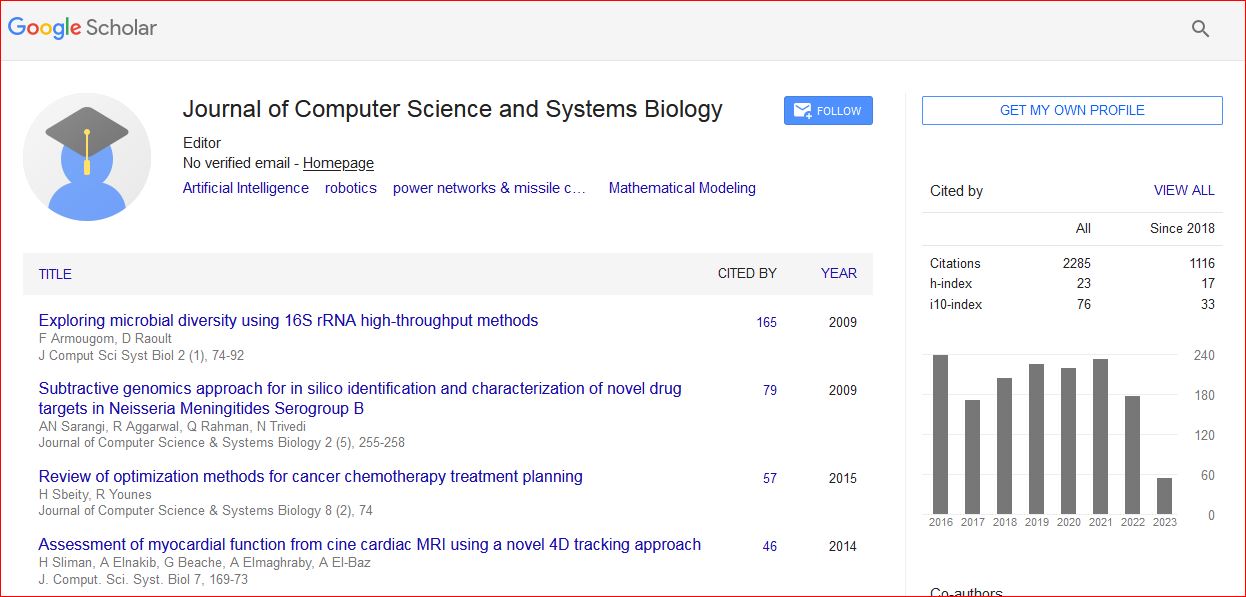
Journal of Computer Science & Systems Biology received 2279 citations as per Google Scholar report