Short Communication - (2025) Volume 15, Issue 5
Received: 02-Oct-2025, Manuscript No. jbbs-25-174261;
Editor assigned: 06-Oct-2025, Pre QC No. P-174261;
Reviewed: 20-Oct-2025, QC No. Q-174261;
Revised: 23-Oct-2025, Manuscript No. R-174261;
Published:
30-Oct-2025
, DOI: 10.37421/2155-9538.2025.15.504
Citation: Robinson, Olivia. ”Genomic Transformation: Precision and Personalized Healthcare.” J Bioengineer & Biomedical Sci 15 (2025):504.
Copyright: © 2025 Robinson O. This is an open-access article distributed under the terms of the Creative Commons Attribution License, which permits unrestricted use,distribution and reproduction in any medium, provided the original author and source are credited.
This review delves into the significant advancements and diverse applications of CRISPR-Cas genome editing technology. It covers its utility in creating disease models, understanding genetic mechanisms, and its potential for therapeutic interventions across various human diseases, highlighting the current state and future prospects of gene editing in medicine [1].
Polygenic risk scores (PRS) offer a comprehensive overview of disease susceptibility, explaining their development, statistical methodologies for evaluation, and their burgeoning applications in personalized medicine. This approach critically examines factors influencing PRS accuracy and their potential for clinical translation [2].
Single-cell genomics is actively revolutionizing precision oncology, highlighting its ability to dissect tumor heterogeneity, characterize immune microenvironments, and identify mechanisms of drug resistance at an unprecedented resolution. The clinical implications for personalized cancer treatment strategies are emphasized [3].
Integrating pharmacogenomics into routine clinical practice is explored, discussing the current status and future trajectory. The article outlines challenges and opportunities in using an individual's genetic profile to optimize drug selection and dosing, aiming to improve therapeutic efficacy and minimize adverse drug reactions [4].
Significant progress in epigenomics and its growing relevance to understanding complex diseases is detailed. This includes various epigenetic mechanisms like Deoxyribonucleic Acid (DNA) methylation, histone modifications, and non-coding Ribonucleic Acid (RNAs), illustrating how their dysregulation contributes to disease pathology and how they offer new avenues for diagnosis and therapeutic intervention [5].
Human population genomics provides a crucial roadmap for identifying genetic factors that influence disease susceptibility and response to treatment. It discusses methodologies and challenges in leveraging genomic diversity across populations to improve our understanding of disease etiology and to guide precision medicine initiatives [6].
Clinical gene editing technologies are experiencing rapid development, with updates on their progress and inherent challenges. Tools like CRISPR-Cas systems are being applied to correct genetic mutations responsible for various diseases, prompting discussions on ethical considerations and the path forward for broader clinical implementation [7].
Applying Machine Learning (ML) in clinical genomics presents significant opportunities and potential pitfalls. Artificial Intelligence (AI) can enhance genomic data interpretation for diagnosis, prognosis, and therapeutic guidance, though caution is advised regarding challenges such as data bias, model interpretability, and ethical implications [8].
The transition of tumor genomics into precision oncology is explored, detailing how sequencing and profiling of cancer genomes enable tailored treatment strategies. The clinical utility of identifying actionable mutations and biomarkers to guide targeted therapies and immunotherapies is emphasized, moving towards more effective and less toxic treatments for cancer patients [9].
Non-coding Ribonucleic Acid (ncRNA) is emerging as a new paradigm in clinical diagnostics and therapeutics. It highlights the diverse roles of various ncRNA classes, such as microRNAs, long non-coding RNAs, and circular RNAs, in regulating gene expression and their potential as biomarkers and therapeutic targets for a wide range of human diseases [10].
The landscape of genomic medicine is rapidly evolving, driven by groundbreaking advancements across multiple fields. CRISPR-Cas genome editing technology, for instance, has demonstrated significant utility in creating robust disease models, deciphering intricate genetic mechanisms, and holds immense potential for therapeutic interventions in human diseases. This gene editing approach is actively shaping the future prospects of medicine [1]. Complementary to this, clinical gene editing technologies are seeing rapid development, with tools like CRISPR-Cas systems being applied to correct genetic mutations across various diseases. This progress naturally brings forth ethical considerations and outlines a clear path for broader clinical implementation [7].
Understanding disease susceptibility is significantly enhanced by Polygenic Risk Scores (PRS). These scores provide a comprehensive overview, from their development and statistical evaluation to their applications in personalized medicine. Crucially, they allow for a critical examination of factors influencing PRS accuracy and clinical translation [2]. Building on this, human population genomics acts as an essential roadmap, aiding in the identification of genetic factors influencing both disease susceptibility and treatment response. It involves complex methodologies and addresses challenges in leveraging diverse genomic data to improve our understanding of disease etiology and to guide precision medicine initiatives [6].
In the realm of cancer treatment, single-cell genomics is revolutionizing precision oncology by dissecting tumor heterogeneity and characterizing immune microenvironments. It offers unprecedented resolution for identifying mechanisms of drug resistance, thereby informing personalized cancer treatment strategies [3]. Similarly, tumor genomics is transitioning directly into precision oncology, using sequencing and profiling of cancer genomes to enable tailored treatment strategies. This emphasizes the critical clinical utility of identifying actionable mutations and biomarkers, which in turn guides targeted therapies and immunotherapies for more effective and less toxic cancer treatments [9].
Further advancements are evident in pharmacogenomics, where its integration into routine clinical practice is actively being explored. This involves discussing the opportunities and challenges of using an individual's genetic profile to optimize drug selection and dosing, aiming for improved therapeutic efficacy and minimized adverse drug reactions [4]. Epigenomics also shows significant progress, proving increasingly relevant to understanding complex diseases. It covers mechanisms like Deoxyribonucleic Acid (DNA) methylation, histone modifications, and non-coding Ribonucleic Acid (RNAs), illustrating how their dysregulation contributes to disease pathology and offering new avenues for diagnosis and therapeutic intervention [5]. Concurrently, Non-coding Ribonucleic Acid (ncRNA) is emerging as a critical paradigm in clinical diagnostics and therapeutics. Diverse classes of ncRNA, including microRNAs, long non-coding RNAs, and circular RNAs, regulate gene expression and hold immense potential as biomarkers and therapeutic targets for a wide range of human diseases [10].
Finally, the application of Machine Learning (ML) in clinical genomics presents both substantial opportunities and inherent pitfalls. Artificial Intelligence (AI) can significantly enhance genomic data interpretation, assisting in diagnosis, prognosis, and therapeutic guidance. However, it is vital to approach this with caution, considering potential challenges such as data bias, model interpretability, and ethical implications [8].
Genomic medicine is currently experiencing a profound transformation, driven by significant advancements in gene editing, risk stratification, and personalized therapeutic approaches. Key technologies such as CRISPR-Cas are pushing the boundaries of gene editing, enabling sophisticated disease modeling and offering promising avenues for therapeutic interventions across various human diseases. Alongside these developments, the clinical application of gene editing technologies is rapidly progressing, with discussions around ethical implications and the pathway for broader implementation. Our understanding of disease susceptibility is substantially enhanced by Polygenic Risk Scores (PRS) and comprehensive human population genomics. These tools are crucial for identifying genetic factors that influence disease onset and an individual's response to treatment, ultimately guiding precision medicine initiatives. In oncology, precision approaches are being revolutionized by single-cell genomics and advanced tumor genomics. These methods provide unprecedented insights into tumor heterogeneity and actionable mutations, leading to more tailored and effective cancer therapies, including targeted treatments and immunotherapies. Furthermore, the integration of pharmacogenomics into routine clinical practice is optimizing drug selection and dosing based on individual genetic profiles, aiming to improve efficacy and reduce adverse reactions. Epigenomics and the study of non-coding Ribonucleic Acid (ncRNA) are concurrently revealing new diagnostic and therapeutic targets by elucidating complex gene regulation and disease pathology. Finally, Machine Learning (ML) and Artificial Intelligence (AI) are poised to significantly enhance genomic data interpretation for diagnosis, prognosis, and therapeutic guidance, though careful consideration of data bias, model interpretability, and ethical challenges remains paramount. These interwoven advancements collectively underscore a clear trajectory towards more precise, personalized, and ultimately more effective healthcare solutions.
None
None
1. Armin G, Hamed M, Mojtaba S. "CRISPR-Cas genome editing in disease modeling and therapy: a systematic review".J Cell Physiol 238 (2023):477-495.
Indexed at, Google Scholar, Crossref
2. Naomi RW, Ting L, Sang HL. "Polygenic risk scores: an overview of their development, statistical evaluation, and applications".Annu Rev Genomics Hum Genet 22 (2021):331-346.
Indexed at, Google Scholar, Crossref
3. Suman P, Neda L, Daniel P. "Single-cell genomics for precision oncology".Nat Rev Clin Oncol 20 (2023):541-558.
Indexed at, Google Scholar, Crossref
4. Mary VR, Michelle W, Charles JA. "Implementing Pharmacogenomics Into Routine Clinical Practice: Current Status and Future Directions".Annu Rev Med 75 (2024):101-115.
Indexed at, Google Scholar, Crossref
5. Yao M, Ling Z, Maoli M. "Advances in Epigenomics and Their Application to Complex Diseases".Cells 11 (2022):1489.
Indexed at, Google Scholar, Crossref
6. Ayelet B, Noah Z, Yaniv E. "Human population genomics: A roadmap to understanding disease susceptibility and treatment response".Trends Genet 38 (2022):285-299.
Indexed at, Google Scholar, Crossref
7. Andrew VA, David TS, David RL. "Clinical gene editing: current progress and future challenges".Trends Genet 40 (2024):16-32.
Indexed at, Google Scholar, Crossref
8. John MW, Brian SG, Taras O. "Machine learning in clinical genomics: a guide to opportunities and pitfalls".Nat Rev Genet 24 (2023):669-688.
Indexed at, Google Scholar, Crossref
9. Chiara G, Lucia P, Giuseppe R. "Precision oncology: translating tumor genomics into clinical practice".Ther Adv Med Oncol 14 (2022):17588359221104648.
Indexed at, Google Scholar, Crossref
10. Eugenia A, Leo SJ, Frank JS. "Non-coding RNA: A new paradigm in clinical diagnostics and therapeutics".EMBO Rep 22 (2021):e52391.
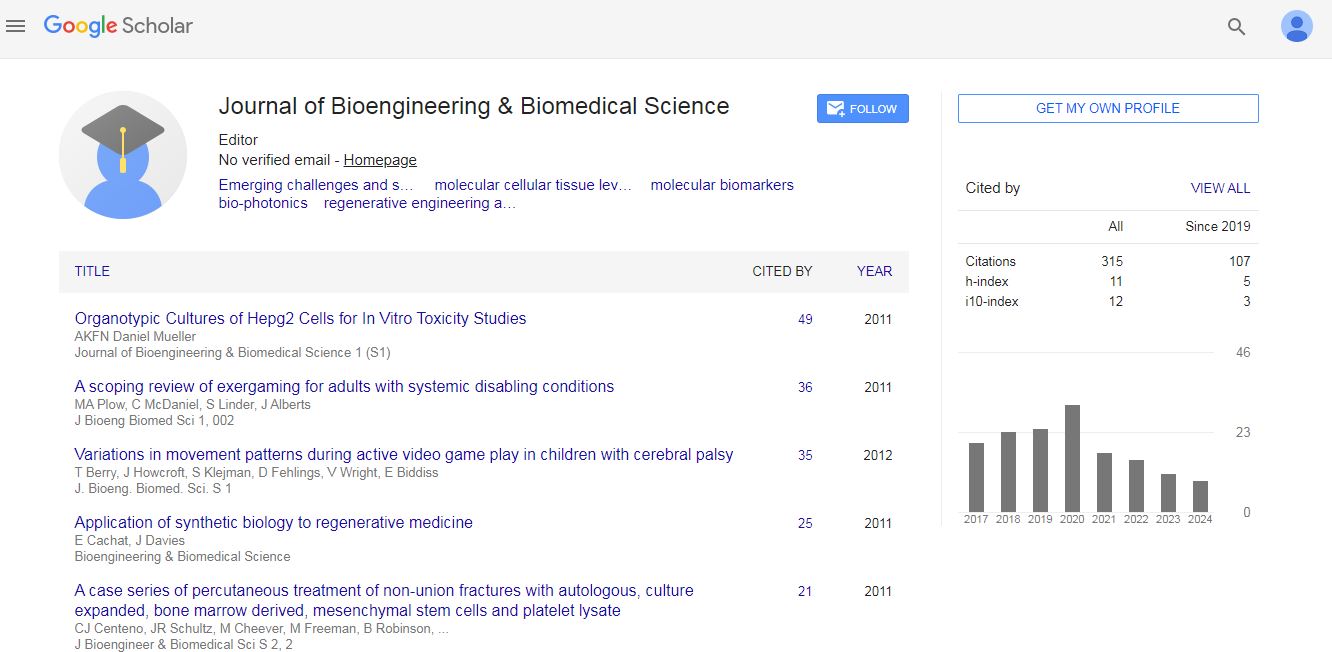
Journal of Bioengineering & Biomedical Science received 307 citations as per Google Scholar report