Opinion - (2025) Volume 9, Issue 6
Received: 13-Sep-2024, Manuscript No. JGGE-24-147940;
Editor assigned: 16-Sep-2024, Pre QC No. JGGE-24-147940 (PQ);
Reviewed: 01-Oct-2024, QC No. JGGE-24-147940;
Revised: 14-Dec-2025, Manuscript No. JGGE-24-147940 (R);
Published:
21-Dec-2025
, DOI: 10.37421/2684-4567.2025.9.202
Citation: Evans, Barbara. "Genomic Sequencing and Its Role in Personalized Medicine: Current Developments and Future Directions." J Genet Genom 9 (2025): 161.
Copyright: © 2025 Evans B. This is an open-access article distributed under the terms of the creative commons attribution license which permits unrestricted
use, distribution and reproduction in any medium, provided the original author and source are credited.
Genomic sequencing has emerged as a transformative force in modern medicine, offering unprecedented insights into the genetic underpinnings of health and disease. By decoding the complete genetic blueprint of individuals, genomic sequencing enables a deeper understanding of genetic variations that contribute to disease susceptibility, drug response, and overall health. This capability is the cornerstone of personalized medicine, a field dedicated to tailoring medical care to the unique genetic profile of each patient. Recent advancements in sequencing technologies have made it possible to analyze entire genomes rapidly and cost-effectively, paving the way for more precise and individualized approaches to diagnosis, treatment, and prevention. As we explore the current developments in genomic sequencing and its integration into clinical practice, it is also crucial to consider future directions that could further enhance personalized medicine. This journey promises not only to refine our understanding of human genetics but also to redefine the future of healthcare with greater accuracy and personalization.
Genomic sequencing has become a cornerstone of personalized medicine, offering profound insights into individual genetic makeup that can tailor healthcare strategies to each person’s unique biological profile. By decoding an individual's complete DNA sequence, genomic sequencing enables the identification of genetic variations that influence susceptibility to diseases, response to treatments, and overall health risks. In personalized medicine, genomic sequencing facilitates targeted interventions by pinpointing the specific genetic factors contributing to a patient’s condition. This approach allows for more precise diagnostics, the development of tailored therapies, and the optimization of treatment plans based on an individual’s genetic predispositions. For example, in oncology, genomic sequencing can identify mutations that drive cancer growth, guiding the selection of targeted therapies and improving outcomes. Moreover, genomic sequencing contributes to preventive medicine by identifying genetic predispositions to various diseases, enabling early intervention and lifestyle modifications to mitigate risks. The integration of genomic data with other health information, such as lifestyle and environmental factors, further enhances the ability to personalize healthcare strategies.
As genomic sequencing technology continues to advance, it holds the potential to transform medical practice by making treatments more effective, reducing adverse drug reactions, and shifting the focus from reactive to proactive healthcare. However, its widespread application also necessitates careful consideration of ethical issues, including privacy concerns and the potential for genetic discrimination. Balancing these considerations with the promise of personalized medicine is crucial as we move towards a future where genomic sequencing becomes an integral part of individualized healthcare. Genomic sequencing has revolutionized the field of medicine by providing comprehensive insights into an individual’s genetic makeup. Advances in sequencing technologies have dramatically reduced the cost and time required to sequence entire genomes, making it a practical tool for personalized medicine. The development of NGS technologies has been a game-changer, enabling high-throughput sequencing of DNA and RNA. This allows for the rapid analysis of genetic variants across the entire genome, exome, or specific gene panels, providing a detailed view of genetic information relevant to health and disease.
Genomic sequencing is increasingly being integrated into clinical settings to guide diagnosis, treatment, and management of diseases. For instance, in oncology, sequencing can identify specific genetic mutations in tumors, helping to tailor targeted therapies that are more effective and have fewer side effects compared to traditional treatments. Sequencing technologies are enhancing our understanding of how genetic variations affect drug metabolism and response. This enables the development of personalized drug regimens, reducing adverse drug reactions and improving therapeutic efficacy. Large-scale genomic studies and biobanks are providing valuable data on the genetic basis of complex diseases, leading to more precise risk assessments and the identification of potential therapeutic targets.
Future advancements aim to enhance the accuracy of genomic sequencing and further reduce costs, making this technology more accessible to a broader population. Efforts are focused on developing portable sequencing devices and improving data analysis algorithms. Combining genomic data with other types of omics data (e.g., proteomics, metabolomics) will provide a more holistic understanding of individual health and disease mechanisms. This integrative approach can lead to more comprehensive personalized treatment plans. As genomic sequencing becomes more prevalent, ensuring the ethical use of genetic data and protecting patient privacy will be paramount. Developing robust frameworks for data sharing, consent, and security will be essential to address these concerns. The future of genomic sequencing in personalized medicine will likely involve a greater focus on preventive care. By identifying genetic predispositions early, personalized strategies for disease prevention and lifestyle modification can be developed, potentially improving overall public health outcomes. In summary, genomic sequencing is at the forefront of personalized medicine, offering unprecedented opportunities for tailored healthcare. Continued advancements in technology and data integration, coupled with careful attention to ethical issues, will drive the future of personalized medicine and enhance its impact on individual and public health.
Genomic sequencing stands at the forefront of a new era in personalized medicine, offering transformative potential for tailoring healthcare to the unique genetic profiles of individuals. The advancements in sequencing technologies have significantly enhanced our ability to decode complex genetic information with remarkable speed and precision. This progress has already begun to revolutionize clinical practice by enabling more accurate diagnoses, optimizing treatment plans, and paving the way for preventive strategies based on genetic risk assessments. As we look to the future, continued innovations in sequencing technology and data integration promise to further personalize and refine medical care. Integrating genomic data with other omics disciplines, improving accessibility, and addressing ethical and privacy concerns will be critical in advancing the field. By embracing these future directions, we can unlock even greater potential for genomic sequencing to improve health outcomes, enhance the effectiveness of treatments, and prevent diseases before they arise. Ultimately, the journey of genomic sequencing in personalized medicine underscores a broader vision: A healthcare system that is not only reactive but also proactive and tailored to the individual. As we navigate these developments, the promise of personalized medicine holds the potential to make healthcare more precise, effective, and equitable for all.
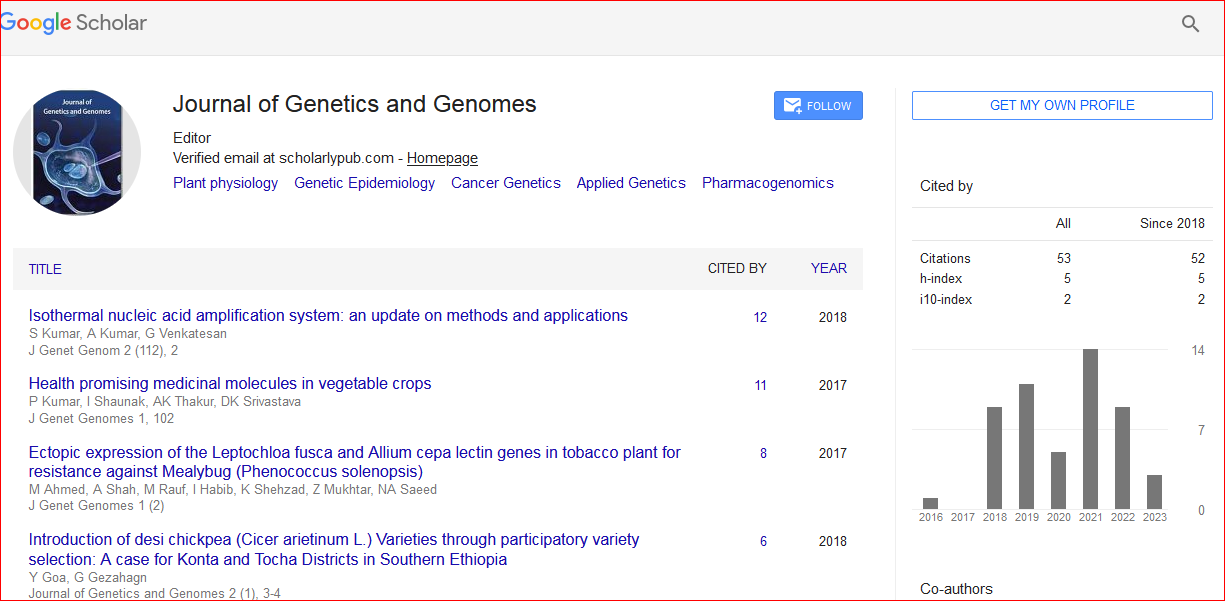
Journal of Genetics and Genomes received 65 citations as per Google Scholar report