Brief Report - (2025) Volume 13, Issue 5
Received: 01-Jan-2025, Manuscript No. JCMG-26-185564;
Editor assigned: 03-Oct-2025, Pre QC No. P-185564;
Reviewed: 17-Oct-2025, QC No. Q-185564;
Revised: 22-Oct-2025, Manuscript No. R-185564;
Published:
29-Oct-2025
, DOI: 10.37421/2472-128X.2025.13.358
Citation: Muller, Thomas. ”Genomic Medicine: Revolutionizing Metabolic Disorder Treatment.” J Clin Med Genomics 13 (2025):358.
Copyright: © 2025 Muller T. This is an open-access article distributed under the terms of the Creative Commons Attribution License, which permits unrestricted use, distribution and reproduction in any medium, provided the original author and source are credited.
Metabolic disorder genomics is revolutionizing treatment by enabling personalized strategies. By analyzing an individual's genetic makeup, clinicians can identify specific predispositions to metabolic conditions, predict disease progression, and tailor interventions for optimal efficacy and minimal side effects. This approach moves beyond one-size-fits-all therapies, focusing on precise molecular targets and lifestyle modifications informed by genetic insights.[1] The integration of advanced genomic sequencing technologies, such as whole-genome and whole-exome sequencing, allows for the comprehensive identification of genetic variants associated with complex metabolic traits and diseases like type 2 diabetes, obesity, and dyslipidemia. Understanding these genetic underpinnings is crucial for developing targeted diagnostic tools and therapeutic agents.[2] Pharmacogenomics plays a vital role in personalizing metabolic disorder treatment by predicting how an individual will respond to specific medications. Genetic variations in drug-metabolizing enzymes, transporters, and drug targets can significantly alter drug efficacy and toxicity. This knowledge guides the selection of the most appropriate drug and dosage, thereby enhancing treatment outcomes and patient safety.[3] The field is also exploring the application of polygenic risk scores (PRS) to stratify individuals based on their cumulative genetic risk for developing common metabolic diseases. PRS can help identify at-risk populations for early intervention and personalized prevention strategies, complementing traditional risk factors.[4] The development of novel therapeutic targets for metabolic disorders is being accelerated by genomic research. By pinpointing specific genes and pathways involved in metabolic dysregulation, researchers can design highly targeted therapies, including gene editing and small molecule inhibitors, that address the root causes of these conditions.[5] Epigenetic modifications, such as DNA methylation and histone modifications, are increasingly recognized as crucial players in metabolic health and disease. Genomic and epigenomic profiling can reveal how environmental factors interact with an individual's genetic background to influence metabolic phenotypes, paving the way for interventions targeting epigenetic regulation.[6] Nutrigenomics, the study of how diet interacts with genes, offers a powerful avenue for personalized metabolic health. By understanding an individual's genetic predispositions to nutrient metabolism and response, tailored dietary recommendations can be formulated to prevent, manage, or ameliorate metabolic disorders.[7] The implementation of genomic testing in clinical practice for metabolic disorders faces challenges, including data interpretation, ethical considerations, and cost-effectiveness. However, ongoing advancements in bioinformatics and clinical guidelines are steadily addressing these barriers, facilitating wider adoption of personalized genomic medicine.[8] The concept of a 'metabolic signature' derived from genomic and multi-omic data is emerging as a powerful tool for early disease detection and prognosis. This signature can integrate genetic predisposition with molecular phenotypes to provide a holistic view of an individual's metabolic health status.[9] Future directions in metabolic disorder genomics include the application of artificial intelligence and machine learning to analyze large-scale genomic datasets, predict disease risk more accurately, and identify novel therapeutic targets. This computational approach will further refine personalized treatment strategies.[10]
Metabolic disorder genomics is fundamentally transforming therapeutic approaches by enabling the development of personalized treatment strategies. Through the detailed analysis of an individual's genetic makeup, healthcare professionals can precisely identify specific predispositions to metabolic conditions, forecast disease progression trajectories, and customize interventions to maximize efficacy while minimizing adverse effects. This paradigm shift moves away from generalized treatment protocols towards a focus on molecular targets and lifestyle adjustments informed by deep genetic insights.[1] Advanced genomic sequencing technologies, including whole-genome and whole-exome sequencing, are instrumental in identifying genetic variations linked to complex metabolic traits and conditions such as type 2 diabetes, obesity, and dyslipidemia. A thorough understanding of these genetic foundations is paramount for the creation of specialized diagnostic tools and innovative therapeutic agents.[2] Pharmacogenomics is a critical component in tailoring metabolic disorder treatments by predicting an individual's response to specific medications. Variations in genes encoding drug-metabolizing enzymes, transporters, and drug targets can profoundly influence both the effectiveness and toxicity of therapeutic agents. This genetic information aids in selecting optimal drugs and dosages, thereby improving treatment outcomes and ensuring patient safety.[3] Furthermore, the field is actively investigating the utility of polygenic risk scores (PRS) for classifying individuals based on their aggregate genetic susceptibility to common metabolic diseases. PRS can serve as a valuable tool for identifying high-risk populations, enabling early interventions and personalized prevention strategies that complement conventional risk assessment methods.[4] The discovery of novel therapeutic targets for metabolic disorders is being significantly propelled by genomic research. By pinpointing the specific genes and biological pathways implicated in metabolic dysregulation, researchers are empowered to design highly precise therapies, encompassing gene editing and small molecule inhibitors, that address the underlying causes of these conditions.[5] Epigenetic modifications, such as DNA methylation and alterations in histone structure, are increasingly acknowledged for their pivotal roles in metabolic health and disease development. Genomic and epigenomic profiling techniques offer insights into how environmental exposures interact with an individual's genetic background to shape metabolic phenotypes, opening avenues for interventions that target epigenetic regulation mechanisms.[6] Nutrigenomics, which explores the intricate relationship between diet and an individual's genes, presents a potent pathway toward achieving personalized metabolic health. By elucidating an individual's genetic predispositions related to nutrient metabolism and response, customized dietary recommendations can be formulated to effectively prevent, manage, or mitigate metabolic disorders.[7] The integration of genomic testing into routine clinical practice for managing metabolic disorders presents certain hurdles, including the complexities of data interpretation, ethical considerations, and the economic feasibility of such tests. Nevertheless, continuous progress in bioinformatics and the development of standardized clinical guidelines are progressively resolving these challenges, thereby fostering broader adoption of personalized genomic medicine.[8] The emerging concept of a 'metabolic signature,' derived from the integration of genomic and multi-omic data, is proving to be a formidable tool for the early detection of diseases and the assessment of prognosis. This signature consolidates genetic predisposition with molecular phenotypes, offering a comprehensive overview of an individual's metabolic health status.[9] Looking ahead, the future of metabolic disorder genomics involves leveraging artificial intelligence and machine learning for the analysis of extensive genomic datasets. These advanced computational methods will enhance disease risk prediction accuracy and facilitate the identification of novel therapeutic targets, ultimately refining personalized treatment strategies.[10]
Genomic insights are revolutionizing metabolic disorder treatment through personalization, enabling tailored interventions based on an individual's genetic makeup. Advanced sequencing technologies like whole-genome sequencing identify genetic variants linked to metabolic diseases, crucial for developing targeted diagnostics and therapies. Pharmacogenomics predicts drug responses, optimizing medication selection and dosage for improved outcomes and safety. Polygenic risk scores stratify individuals by genetic risk, facilitating early intervention and prevention. Genomic research accelerates the discovery of novel therapeutic targets, leading to precise treatments. Epigenetic modifications and nutrigenomics also offer personalized approaches by examining gene-environment interactions and diet-gene relationships. Despite challenges in implementation such as data interpretation and cost, advancements in bioinformatics and AI are paving the way for wider adoption of genomic medicine. The concept of metabolic signatures derived from multi-omic data aids in early disease detection and prognosis. Future directions focus on AI and machine learning for enhanced risk prediction and target identification.
None
None
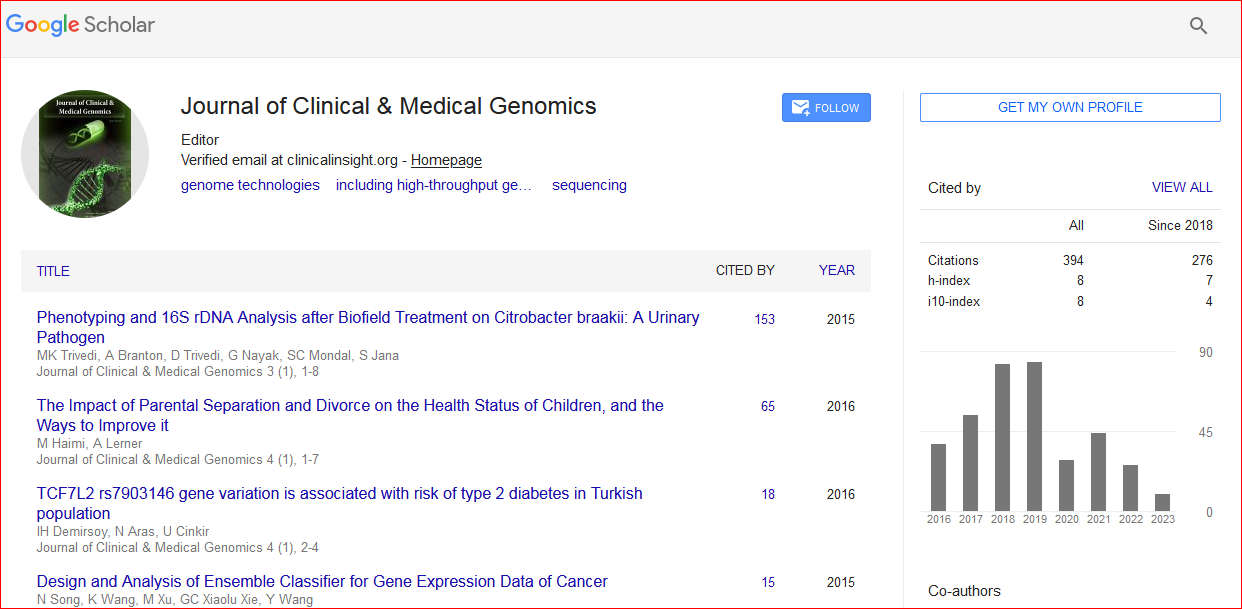
Journal of Clinical & Medical Genomics received 391 citations as per Google Scholar report