Brief Report - (2025) Volume 10, Issue 3
Received: 02-Jun-2025, Manuscript No. jcct-26-183210;
Editor assigned: 04-Jun-2025, Pre QC No. P-183210;
Reviewed: 18-Jun-2025, QC No. Q-183210;
Revised: 23-Jun-2025, Manuscript No. R-183210;
Published:
30-Jun-2025
, DOI: 10.37421/2577-0535.2025.9.308
Citation: El-Sayed, Ahmed. ”Genomic Data Revolutionizes Cancer Clinical Trials.” J Cancer Clin Trials 10 (2025):308.
Copyright: © 2025 El-Sayed A. This is an open-access article distributed under the terms of the Creative Commons Attribution License, which permits unrestricted use, distribution and reproduction in any medium, provided the original author and source are credited.
The integration of genomic data into cancer clinical trials has become a cornerstone of modern oncology research and practice, fundamentally altering the landscape of patient care and drug development. This advanced approach allows for a more nuanced understanding of tumor biology, leading to more precise patient stratification and the development of highly targeted therapies that address specific molecular alterations within a patient's cancer [1].
The incorporation of comprehensive genomic profiling into the early phases of cancer clinical trials is not merely an advancement but an essential step for the rapid identification of actionable mutations. This enables the acceleration of precision oncology initiatives by directly linking genetic findings to therapeutic strategies [2].
Biomarker-driven clinical trials, meticulously guided by detailed genomic data, are actively transforming the trajectory of cancer research. This paradigm shift facilitates more efficient drug development processes and the creation of truly personalized treatment strategies tailored to the individual patient's genetic makeup [3].
The ever-increasing availability and sophistication of next-generation sequencing (NGS) technologies have profoundly revolutionized the capacity to effectively integrate genomic information into the intricate design of cancer clinical trials. This capability is crucial for identifying novel drug targets and developing companion diagnostics that precisely select appropriate patient populations for specific treatments [4].
Master protocols, a class of innovative clinical trial designs such as basket and umbrella trials, are progressively becoming more common. Their utility lies in efficiently evaluating multiple drugs and diverse molecular targets across a broad spectrum of cancer patient populations, a development largely propelled by profound genomic insights [5].
Beyond the scientific and therapeutic implications, the ethical considerations that surround the use of genomic data within the context of cancer clinical trials are of paramount importance and require careful navigation. These complex issues encompass data privacy, informed consent, the management of incidental findings, and ensuring equitable access to both advanced genomic testing and the resultant targeted therapies [6].
Real-world evidence (RWE) that is meticulously derived from genomic data, often collected during routine clinical practice, offers invaluable and pragmatic insights that can significantly refine the design and execution of cancer clinical trials. RWE helps in identifying critical unmet needs, informing patient selection criteria, and rigorously evaluating the real-world effectiveness of treatments outside the highly controlled environments of traditional clinical trials [7].
The integration of cutting-edge artificial intelligence (AI) and sophisticated machine learning (ML) techniques with vast genomic datasets is poised to dramatically enhance the design and optimization of cancer clinical trials. AI and ML algorithms can significantly accelerate the identification of predictive biomarkers, streamline trial simulations, and enable highly personalized treatment selections [8].
Decentralized clinical trials (DCTs) are rapidly emerging as a promising modality to substantially improve patient access and participation in research studies. The strategic integration of genomic data can further augment the effectiveness of DCTs, allowing for comprehensive data collection through remote monitoring and digital tools, thus enabling broader patient recruitment and diverse trial populations [9].
The implementation of tumor mutational burden (TMB) as a predictive biomarker in clinical trials has demonstrated considerable promise in accurately forecasting patient response to immunotherapies. Nevertheless, the standardization of TMB assessment methodologies and its optimal integration into trial design remain dynamic and actively researched areas within the field [10].
Genomic data is increasingly recognized as an indispensable component in the design and execution of cancer clinical trials, facilitating a more precise stratification of patients and accelerating the development of novel targeted therapies. This integration allows for the construction of biomarker-driven trial designs, which serve to enhance treatment efficacy and reduce the overall number of patients required for statistically significant success. Furthermore, the incorporation of real-world data coupled with advanced analytical techniques provides further refinement in trial execution and the interpretation of outcomes [1].
The seamless incorporation of genomic profiling into the critical early phases of cancer clinical trials is absolutely essential for the timely identification of actionable mutations and the accelerated development of precision oncology strategies. Adaptive trial designs, which are dynamically informed by genomic information, possess the unique capability to efficiently identify specific patient subgroups that are most likely to derive substantial benefit from particular investigational treatments [2].
Biomarker-driven clinical trials, consistently guided by comprehensive genomic data analysis, are actively engaged in transforming the landscape of cancer research. This transformative approach empowers more efficient drug development pathways and the establishment of personalized treatment strategies that are meticulously tailored to individual patient profiles. The successful implementation of this strategy necessitates robust infrastructure for genomic testing and data analysis, alongside flexible and adaptive trial designs [3].
The escalating availability of advanced next-generation sequencing (NGS) technologies has unequivocally revolutionized the capacity to integrate detailed genomic information into the design of cancer clinical trials. This technological leap enables the identification of previously unknown drug targets and the development of sophisticated companion diagnostics, which are crucial for selecting the most appropriate patient populations for therapeutic interventions [4].
Master protocols, including innovative designs such as basket and umbrella trials, are becoming increasingly prevalent in oncology research. Their growing adoption is driven by the need to efficiently evaluate multiple investigational drugs and molecular targets across diverse cancer patient populations, a trend significantly influenced by advancements in genomic understanding. These designs optimize the allocation of resources and accelerate the overall drug development process [5].
The ethical dimensions associated with the utilization of genomic data in cancer clinical trials are of paramount concern and demand careful consideration. Key ethical issues include the safeguarding of patient data privacy, the nuances of informed consent, the management of incidental findings that may arise from genomic analysis, and ensuring equitable access to both sophisticated genomic testing and the life-saving targeted therapies that result from such research [6].
Real-world evidence (RWE), meticulously collected from real-world genomic data generated in routine clinical practice, offers invaluable and practical insights that can substantially inform and refine the design of cancer clinical trials. RWE plays a critical role in identifying unmet clinical needs, shaping patient selection criteria for trials, and evaluating the genuine effectiveness of treatments in broader patient populations outside the controlled settings of traditional trials [7].
The synergistic integration of artificial intelligence (AI) and machine learning (ML) with extensive genomic data holds immense potential to significantly enhance the design and efficiency of cancer clinical trials. AI and ML algorithms can dramatically accelerate the process of identifying predictive biomarkers, optimize trial simulations for better forecasting, and facilitate highly personalized treatment selection strategies for individual patients [8].
Decentralized clinical trials (DCTs) represent an emerging and transformative approach aimed at improving patient access and increasing participation rates in oncology research. The strategic integration of genomic data can further amplify the effectiveness of DCTs by leveraging remote monitoring and digital tools to collect comprehensive genomic and clinical data, thereby enabling broader patient recruitment and greater diversity within trial cohorts [9].
The clinical utility of tumor mutational burden (TMB) as a biomarker in cancer clinical trials has shown considerable promise, particularly in predicting patient responses to immunotherapy. However, the critical need for standardization in TMB assessment methodologies and the determination of its optimal application within various trial designs remain active and important areas of ongoing research and development [10].
Genomic data is revolutionizing cancer clinical trials by enabling precise patient stratification and the development of targeted therapies. This approach facilitates biomarker-driven designs, improving efficacy and efficiency. Next-generation sequencing (NGS) technologies are key to integrating genomic information, identifying new drug targets, and developing companion diagnostics. Master protocols, such as basket and umbrella trials, efficiently evaluate multiple drugs and targets across diverse populations, driven by genomic insights. Ethical considerations regarding data privacy, consent, and equitable access are paramount. Real-world evidence from genomic data refines trial designs by identifying unmet needs and informing patient selection. Artificial intelligence and machine learning are enhancing trial design through biomarker identification and personalized treatment selection. Decentralized clinical trials, augmented by genomic data, improve patient access and broaden recruitment. Tumor mutational burden shows promise as a biomarker for immunotherapy response, though standardization remains a research focus.
None
None
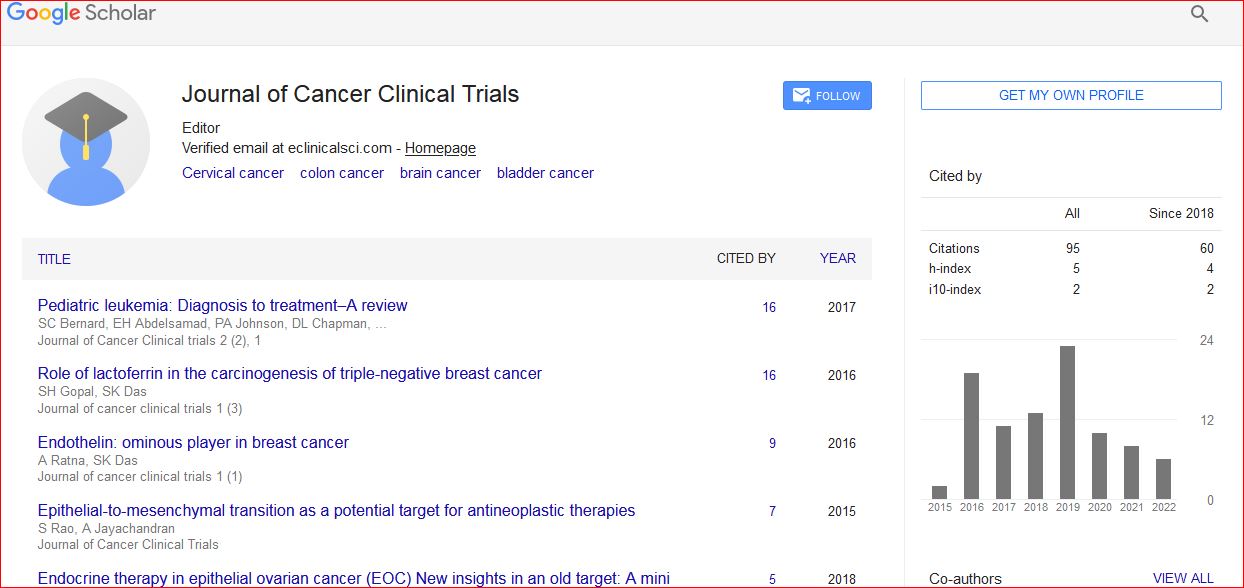
Journal of Cancer Clinical Trials received 95 citations as per Google Scholar report