Commentary - (2025) Volume 16, Issue 6
Received: 01-Dec-2025, Manuscript No. jmbd-26-179548;
Editor assigned: 03-Dec-2025, Pre QC No. P-179548;
Reviewed: 15-Dec-2025, QC No. Q-179548;
Revised: 22-Dec-2025, Manuscript No. R-179548;
Published:
29-Dec-2025
, DOI: 10.37421/2155-9929.2025.16.736
Citation: Aisyah, Siti. ”Genomic Biomarkers Revolutionizing Disease Diagnosis and Medicine.” J Mol Biomark Diagn 16 (2025):736.
Copyright: © 2025 Aisyah S. This is an open-access article distributed under the terms of the Creative Commons Attribution License, which permits unrestricted use,
distribution and reproduction in any medium, provided the original author and source are credited.
The landscape of disease diagnosis is undergoing a profound transformation, driven by the burgeoning field of genomic biomarkers. These molecular indicators are revolutionizing our ability to detect and understand illness with unprecedented precision, paving the way for earlier interventions and more targeted therapies [1].
Among the most significant advancements is the integration of circulating tumor DNA (ctDNA) analysis into clinical practice. This 'liquid biopsy' approach allows for the detection and monitoring of cancer through simple blood tests, offering a less invasive alternative to traditional tissue biopsies and enabling real-time assessment of treatment efficacy [2].
Beyond DNA, epigenetic modifications are emerging as powerful indicators of disease states. Alterations in DNA methylation patterns, for instance, can signal the presence or progression of various conditions, particularly in the realms of oncology and neurology, offering a glimpse into the regulatory mechanisms of gene expression [3].
Complementing these are RNA-based biomarkers, such as messenger RNA (mRNA) and microRNA (miRNA). Their dynamic nature reflects cellular activity and disease progression, making them valuable for diagnosing infectious diseases and inflammatory disorders, as well as for understanding the complex molecular responses to illness [4].
The synergy between cutting-edge technologies like next-generation sequencing (NGS) and sophisticated bioinformatics is accelerating the discovery and validation of these biomarkers. This technological convergence is crucial for identifying the subtle genetic signatures associated with a wide spectrum of diseases, from common ailments to rare genetic disorders [1].
Furthermore, the application of artificial intelligence (AI) and machine learning to vast genomic datasets is proving instrumental in uncovering complex patterns that elude traditional analytical methods. AI algorithms can process immense amounts of information to pinpoint disease indicators with remarkable accuracy, significantly enhancing early diagnostic capabilities [5].
Metabolomics offers a complementary window into an individual's biochemical state, providing insights into physiological and pathological changes. Metabolite profiles can serve as early warning signs for metabolic disorders and chronic diseases, offering a metabolic snapshot of health [6].
The development of polygenic risk scores (PRS) represents a significant stride in assessing an individual's inherited susceptibility to complex, multifactorial diseases. By considering the cumulative effect of numerous genetic variants, PRS can stratify individuals based on their risk for conditions like cardiovascular disease and type 2 diabetes, enabling proactive health management [7].
Proteomics, the study of the complete set of proteins produced by an organism, provides a dynamic view of cellular function and disease states. Protein biomarkers can exhibit high specificity and sensitivity, aiding in the detection of a broad range of conditions, including autoimmune and neurodegenerative diseases [8].
However, the successful translation of these promising biomarkers into routine clinical practice is contingent upon addressing critical translational challenges. This includes rigorous validation, standardization of assays, and navigating the ethical, legal, and societal implications to ensure equitable and responsible implementation [9, 10].
Genomic biomarkers are at the forefront of a diagnostic revolution, offering unparalleled precision and enabling the early detection of diseases. Advances in next-generation sequencing (NGS) coupled with powerful bioinformatics tools allow for the identification of genetic signatures linked to various conditions, from cancers to rare inherited diseases, thereby facilitating personalized treatment strategies and proactive disease management [1].
A significant leap in cancer diagnostics is the integration of circulating tumor DNA (ctDNA) analysis into clinical settings. ctDNA, released from tumors into the bloodstream, can be detected and analyzed to identify specific mutations, monitor treatment response, and even detect minimal residual disease before it becomes apparent through imaging [2].
Epigenetic modifications, such as alterations in DNA methylation, are recognized as potent biomarkers for a diverse range of diseases. Changes in these methylation patterns can often precede or coincide with disease onset, making them invaluable for early diagnosis and prognosis, especially in the contexts of cancer and neurological disorders [3].
RNA-based biomarkers, encompassing messenger RNA (mRNA) and microRNA (miRNA), are increasingly recognized as critical tools in disease diagnosis. Their dynamic nature allows them to accurately reflect cellular states and disease progression, providing a distinct advantage in the detection of conditions like infectious diseases and inflammatory disorders [4].
The synergy between advanced sequencing technologies and computational biology is accelerating the discovery and validation of novel biomarkers. This convergence is essential for uncovering the complex genetic profiles associated with numerous health conditions, moving medicine towards a more personalized approach [1].
Artificial intelligence (AI) and machine learning are transforming the analysis of genomic data, enabling the identification of intricate patterns indicative of disease that might otherwise be missed. These advanced algorithms contribute to more accurate and earlier diagnoses by processing vast datasets efficiently [5].
Metabolomics provides a complementary perspective by offering insights into an individual's biochemical makeup. Metabolite profiles can serve as biomarkers, reflecting physiological and pathological changes, and are particularly useful for identifying metabolic disorders and early signs of chronic diseases [6].
Polygenic risk scores (PRS) are reshaping the assessment of genetic predisposition to complex diseases. By aggregating the influence of numerous common genetic variants, PRS can identify individuals at heightened risk for conditions such as heart disease and type 2 diabetes, thereby enabling tailored preventive strategies [7].
Proteomics, the comprehensive study of proteins, offers a dynamic view of cellular functions and disease states. Protein biomarkers are valuable for detecting a wide array of diseases with high specificity and sensitivity, ranging from autoimmune disorders to neurodegenerative conditions [8].
However, the journey from discovery to clinical application involves substantial translational challenges. This includes rigorous validation of biomarker assays, standardization of protocols, and careful consideration of ethical, legal, and societal implications to ensure responsible and equitable implementation of genomic diagnostics [9, 10].
Genomic biomarkers, including ctDNA, epigenetic modifications, and RNA-based molecules, are revolutionizing disease diagnosis and personalized medicine. Advances in next-generation sequencing, bioinformatics, and AI are accelerating the discovery and validation of these biomarkers. Metabolomics and proteomics offer complementary insights into disease states. Polygenic risk scores are enhancing the prediction of complex diseases. While the potential is immense, translational challenges, including assay validation, standardization, and ethical considerations, must be addressed for widespread clinical implementation.
None
None
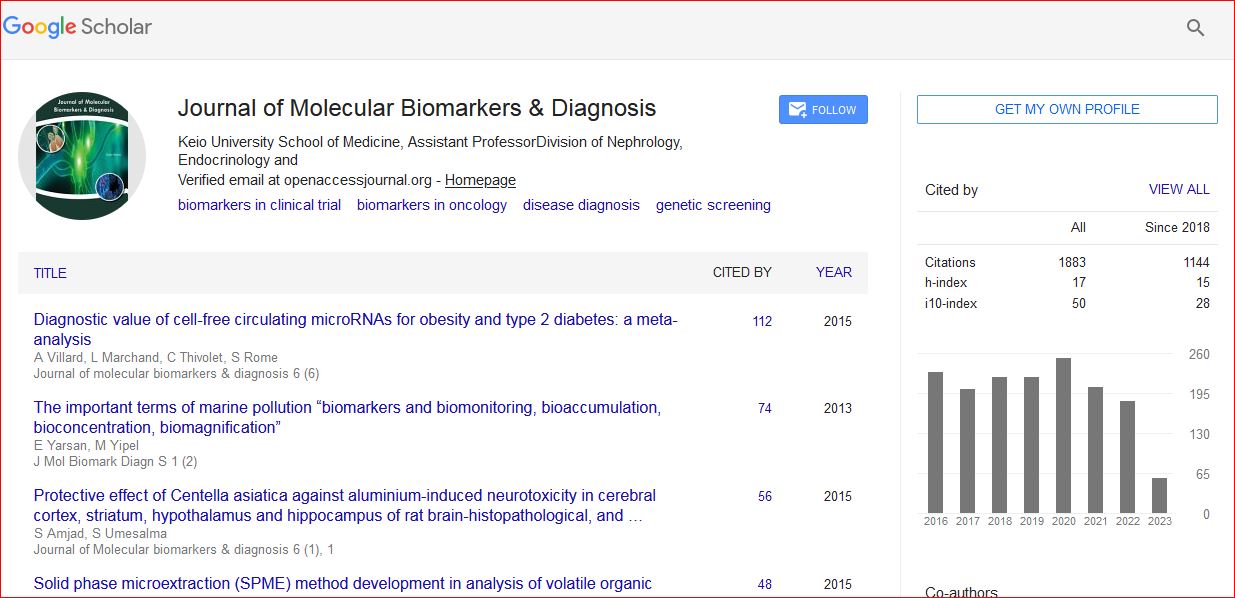
Journal of Molecular Biomarkers & Diagnosis received 2054 citations as per Google Scholar report