Brief Report - (2025) Volume 16, Issue 2
Received: 01-Apr-2025, Manuscript No. jmbd-26-179366;
Editor assigned: 03-Apr-2025, Pre QC No. P-179366;
Reviewed: 14-Apr-2025, QC No. Q-179366;
Revised: 22-Apr-2025, Manuscript No. R-179366;
Published:
29-Apr-2025
, DOI: 10.37421/2155-9929.2025.16.691
Citation: Sayed, Ahmed. ”Genomic and Epigenetic Biomarkers for Early Disease Detection.” J Mol Biomark Diagn 16 (2025):691.
Copyright: © 2025 Sayed A. This is an open-access article distributed under the terms of the Creative Commons Attribution License, which permits unrestricted use, distribution and reproduction in any medium, provided the original author and source are credited.
The landscape of medical diagnostics is undergoing a profound transformation, driven by the identification and application of novel biomarkers that promise earlier and more accurate disease detection. Emerging genetic and epigenetic biomarkers are at the forefront of this revolution, offering the potential to identify pathological conditions long before overt clinical symptoms appear. Advancements in high-throughput sequencing technologies and sophisticated computational analyses are instrumental in uncovering these subtle molecular signatures, paving the way for a paradigm shift towards proactive and personalized healthcare strategies. This proactive approach aims to enable timely interventions, ultimately leading to improved patient outcomes and a more efficient healthcare system [1]. The intricate regulatory mechanisms governed by microRNAs (miRNAs) have positioned them as potent epigenetic biomarkers with significant implications for early disease diagnosis. Their altered expression profiles in the nascent stages of various cancers, such as non-small cell lung cancer (NSCLC), offer a less invasive diagnostic avenue. The concept of miRNA-based liquid biopsies represents a promising development, enhancing screening efficacy and providing valuable guidance for therapeutic decisions, thereby revolutionizing early cancer detection. C002 Investigating the role of DNA methylation patterns has revealed their critical importance in the early detection of prevalent cancers like colorectal cancer (CRC). Specific CpG island hypermethylation events in genes such as MLH1 and CDH1 are strongly associated with precancerous lesions and early-stage tumors. The feasibility of utilizing methylation-based markers, detectable in readily accessible biofluids like stool or blood, underscores the potential for widespread, non-invasive CRC screening [2]. Circulating tumor DNA (ctDNA) analysis, a cornerstone of liquid biopsy techniques, is increasingly recognized for its potential in the early detection and subsequent monitoring of a broad spectrum of cancers [3]. Despite challenges in detecting minute amounts of ctDNA in early-stage disease, ongoing technological advancements are enhancing sensitivity. Insights from ctDNA analysis suggest its capability to serve as a highly sensitive marker for minimal residual disease and the early detection of recurrence, providing crucial information for patient management [4]. Long non-coding RNAs (lncRNAs) are emerging as significant epigenetic regulators and promising biomarkers for the early detection of complex diseases, particularly neurodegenerative disorders. Aberrant lncRNA expression is increasingly understood to contribute to disease pathogenesis, and the detectability of specific lncRNAs in biofluids opens avenues for early diagnosis. The promise of lncRNAs lies in their capacity to offer a more nuanced understanding of early disease states, enabling earlier interventions [5]. The integration of genomic and epigenomic data offers a powerful approach for the early detection of complex autoimmune diseases. Multi-omic strategies can identify intricate disease signatures, revealing subtle molecular alterations that precede the manifestation of overt clinical symptoms. The potential for these integrated biomarkers to accurately predict disease onset and progression is a key area of focus, promising improved diagnostic capabilities [6]. Histone modifications are gaining recognition as potential epigenetic biomarkers for early cancer detection. Aberrant patterns of histone acetylation and methylation can profoundly alter gene expression, contributing to the intricate processes of tumorigenesis. Understanding these early molecular events provides critical insights, and the development of assays capable of detecting these markers presents both challenges and significant opportunities for early cancer diagnosis [7]. Extracellular vesicles (EVs), along with their rich cargo of genetic and epigenetic material, are being investigated for their diagnostic potential in early disease detection. EVs released by diseased cells can encapsulate specific molecular signatures, rendering them valuable non-invasive biomarkers. The review of EV analysis across various diseases highlights its considerable promise for facilitating early and accurate diagnosis [8]. The utility of circulating cell-free DNA (cfDNA) mutations and epigenetic alterations is being explored for the early detection and surveillance of hepatocellular carcinoma (HCC). Analyzing cfDNA in blood samples can effectively reveal early carcinogenic events, potentially enabling therapeutic intervention before the development of advanced disease. These findings strongly underscore the profound power of liquid biopsies in the field of oncology for early detection [9]. DNA methylation biomarkers are showing considerable promise for the early diagnosis of neurodegenerative conditions such as Alzheimer's disease (AD). Specific methylation patterns in genes critical for neuronal function and inflammatory responses are found to be altered in the early stages of AD. The potential for developing blood-based methylation tests to facilitate early diagnosis and inform intervention strategies for AD represents a significant advancement in patient care [10].
The critical role of emerging genetic and epigenetic biomarkers in revolutionizing early disease detection is highlighted, emphasizing how advancements in sequencing and computational analysis are uncovering novel molecular signatures indicative of various pathological conditions before clinical symptoms manifest. The potential for these biomarkers to shift diagnostic paradigms towards proactive and personalized healthcare, enabling timely interventions and improving patient outcomes, is a key focus. MicroRNAs (miRNAs) are identified as potent epigenetic biomarkers with significant utility in the early diagnosis of non-small cell lung cancer (NSCLC). This work presents a comprehensive review of circulating miRNAs exhibiting altered expression profiles in early-stage NSCLC, offering a less invasive diagnostic approach. The potential for miRNA-based liquid biopsies to enhance screening efficacy and guide therapeutic decisions is a crucial takeaway. The study investigates DNA methylation patterns for the early detection of colorectal cancer (CRC), pinpointing specific CpG island hypermethylation events in genes like MLH1 and CDH1 that are associated with precancerous lesions and early-stage tumors. The research underscores the feasibility of using methylation-based markers in accessible biofluids for non-invasive CRC screening. The potential of circulating tumor DNA (ctDNA) analysis, a liquid biopsy method, for the early detection and monitoring of various cancers is explored. The authors discuss technological advancements enabling the detection of minute ctDNA amounts and the challenges in its application for early-stage disease, suggesting ctDNA could serve as a sensitive marker for minimal residual disease and recurrence. This review focuses on the application of long non-coding RNAs (lncRNAs) as epigenetic regulators and potential biomarkers for early disease detection, particularly in neurodegenerative disorders. Aberrant lncRNA expression contributes to disease pathogenesis, and specific lncRNAs detectable in biofluids offer insights into early molecular events. The promise of lncRNAs for a nuanced understanding of early disease states is emphasized. The integration of genomic and epigenomic data for the early detection of autoimmune diseases is discussed, highlighting how multi-omic approaches identify complex disease signatures revealing subtle molecular changes that precede overt clinical symptoms. The potential for these integrated biomarkers to predict disease onset and progression is a key area of focus. Histone modifications are explored as potential epigenetic biomarkers for early cancer detection, detailing how aberrant patterns of histone acetylation and methylation can alter gene expression and contribute to tumorigenesis. The authors discuss the challenges and opportunities in developing assays for these early molecular event markers. The diagnostic potential of extracellular vesicles (EVs) and their cargo, including genetic and epigenetic material, for early disease detection is investigated. This paper highlights how EVs released by diseased cells carry specific molecular signatures, making them valuable non-invasive biomarkers, and covers various diseases where EV analysis shows promise for early diagnosis. The utility of circulating cell-free DNA (cfDNA) mutations and epigenetic alterations for the early detection and surveillance of hepatocellular carcinoma (HCC) is examined. The study demonstrates how analyzing cfDNA in blood can reveal early carcinogenic events, potentially allowing for intervention before advanced disease develops, underscoring the power of liquid biopsies in oncology. The role of DNA methylation biomarkers in the early diagnosis of Alzheimer's disease (AD) is explored, identifying specific methylation patterns in genes associated with neuronal function and inflammation that are altered in early AD stages. The potential for blood-based methylation tests to facilitate early diagnosis and intervention strategies for AD is a significant implication.
This collection of research highlights the significant advancements in using genetic and epigenetic biomarkers for early disease detection across various conditions. Studies explore the potential of microRNAs (miRNAs) for early lung cancer diagnosis, DNA methylation patterns for colorectal cancer and Alzheimer's disease detection, and circulating tumor DNA (ctDNA) and cell-free DNA (cfDNA) for early cancer detection and monitoring. Long non-coding RNAs (lncRNAs) are identified as key epigenetic regulators for neurodegenerative disorders, while histone modifications offer insights into early cancer development. The integration of multi-omic data, including genomic and epigenomic information, is crucial for understanding complex autoimmune diseases. Extracellular vesicles (EVs) are also recognized as promising non-invasive biomarkers. These collective findings underscore a growing trend towards proactive, personalized healthcare driven by sophisticated molecular diagnostics, enabling earlier interventions and improved patient outcomes.
None
None
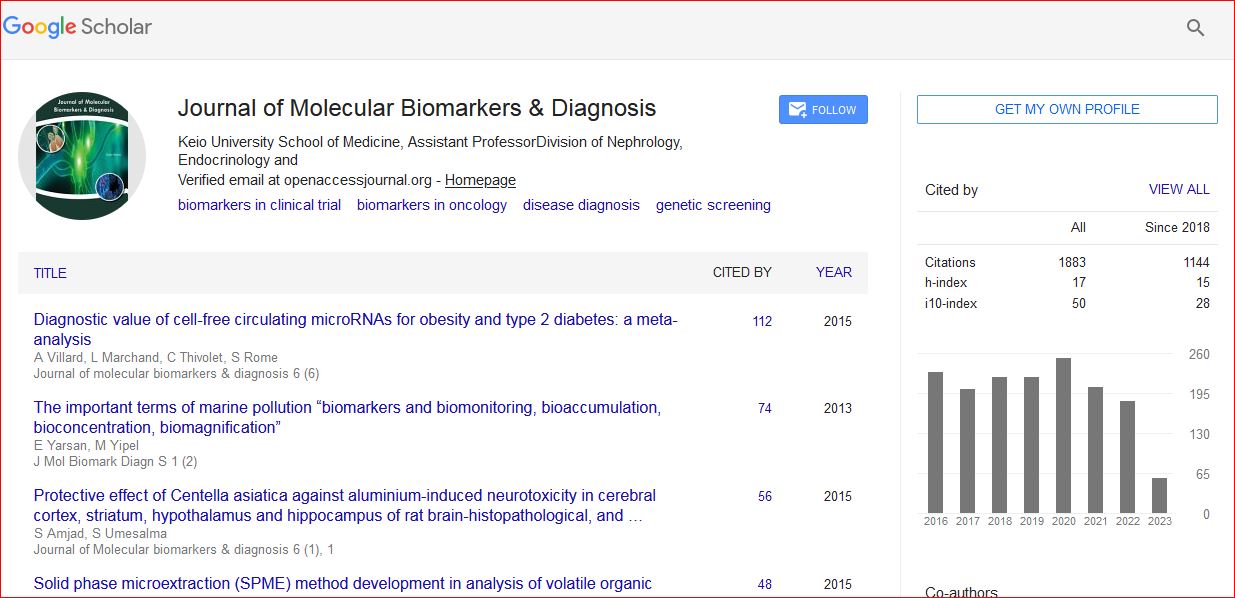
Journal of Molecular Biomarkers & Diagnosis received 2054 citations as per Google Scholar report