Perspective - (2025) Volume 19, Issue 2
Received: 01-Apr-2025, Manuscript No. jmgm-26-185641;
Editor assigned: 03-Apr-2025, Pre QC No. P-185641;
Reviewed: 17-Apr-2025, QC No. Q-185641;
Revised: 22-Apr-2025, Manuscript No. R-185641;
Published:
29-Apr-2025
, DOI: 10.37421/1747-0862.2025.19.717
Citation: Moreau, Isabelle. ”Genomic Advances Revolutionize Rare Genetic Disorder Diagnosis.” J Mol Genet Med 19 (2025):717.
Copyright: © 2025 Moreau I. This is an open-access article distributed under the terms of the Creative Commons Attribution License, which permits unrestricted use, distribution and reproduction in any medium, provided the original author and source are credited.
Recent breakthroughs in genomic technologies have significantly enhanced the diagnosis of rare genetic disorders. Advances in next-generation sequencing (NGS), including whole-genome sequencing (WGS) and whole-exome sequencing (WES), enable comprehensive genetic profiling, leading to faster and more accurate identification of causative variants. These high-throughput methods are transforming the diagnostic odyssey for many patients [1].
CRISPR-Cas9 gene editing holds immense promise for treating a range of rare genetic disorders at their root cause. Initial clinical trials are demonstrating the potential of this technology to correct specific gene mutations, offering hope for previously untreatable conditions. However, challenges related to delivery, off-target effects, and long-term safety remain active areas of research [2].
The development of personalized medicine approaches, particularly through gene therapy and small molecule drugs, is revolutionizing the treatment landscape for rare genetic disorders. Tailoring treatments to an individual's specific genetic makeup allows for more targeted and effective interventions, moving beyond symptomatic management [3].
Liquid biopsies, employing cell-free DNA (cfDNA) and circulating tumor DNA (ctDNA), are emerging as non-invasive tools for early diagnosis and monitoring of certain genetic conditions, including some rare disorders. This approach offers a less burdensome alternative to traditional tissue biopsies [4].
The integration of artificial intelligence (AI) and machine learning (ML) is accelerating the interpretation of complex genomic data, aiding in the identification of novel disease-causing genes and predicting treatment responses for rare genetic disorders. These computational tools are essential for navigating the vastness of genomic information [5].
The increasing availability of multi-omics data, combining genomics, transcriptomics, proteomics, and metabolomics, provides a more holistic understanding of rare genetic disorders. This integrated approach allows for the identification of intricate molecular pathways and potential therapeutic targets [6].
Ex vivo gene therapy, where cells are modified outside the body before reinfusion, is proving effective for certain blood disorders and immunological conditions caused by genetic defects. This method allows for precise genetic manipulation and quality control [7].
Advances in CRISPR-based diagnostics, such as SHERLOCK and DETECTR, offer rapid, sensitive, and field-deployable methods for detecting specific genetic mutations associated with rare diseases. These tools complement traditional sequencing-based diagnostics [8].
The increasing understanding of gene-environment interactions is crucial for a complete picture of rare genetic disorders. While genetics plays a primary role, environmental factors can modulate disease onset and severity, opening avenues for novel therapeutic strategies [9].
The implementation of newborn screening programs utilizing advanced genetic and biochemical techniques is expanding to include a wider range of rare genetic disorders. Early detection through these programs is critical for timely intervention and improved outcomes [10].
Recent advancements in genomic technologies are revolutionizing the diagnosis of rare genetic disorders. Techniques such as next-generation sequencing (NGS), including whole-genome sequencing (WGS) and whole-exome sequencing (WES), provide comprehensive genetic profiling. This enables faster and more accurate identification of causative variants, significantly shortening the diagnostic journey for patients [1].
CRISPR-Cas9 gene editing represents a powerful therapeutic strategy for addressing the root cause of numerous rare genetic disorders. Early clinical trials have shown promising results in correcting specific gene mutations, offering hope for conditions previously considered untreatable. However, ongoing research addresses critical challenges such as efficient delivery, minimizing off-target effects, and ensuring long-term safety [2].
Personalized medicine, especially gene therapy and targeted small molecule drugs, is transforming the treatment of rare genetic disorders. By tailoring interventions to an individual's unique genetic profile, these approaches move beyond managing symptoms towards more effective and precise treatments [3].
Liquid biopsies, utilizing cell-free DNA (cfDNA) and circulating tumor DNA (ctDNA), are emerging as valuable non-invasive tools for the early detection and monitoring of various genetic conditions, including rare disorders. This method offers a less invasive alternative to conventional tissue biopsies [4].
Artificial intelligence (AI) and machine learning (ML) are playing an increasingly vital role in interpreting complex genomic data. These computational tools facilitate the identification of novel disease-causing genes and help predict patient responses to therapies for rare genetic disorders, aiding in the navigation of vast genomic datasets [5].
The integration of multi-omics data, encompassing genomics, transcriptomics, proteomics, and metabolomics, offers a more comprehensive understanding of rare genetic disorders. This holistic approach helps unravel complex molecular pathways and identify potential therapeutic targets [6].
Ex vivo gene therapy, a process involving the genetic modification of cells outside the body followed by reinfusion, has demonstrated efficacy for specific blood and immunological disorders stemming from genetic defects. This technique allows for precise genetic manipulation and rigorous quality control of the modified cells [7].
CRISPR-based diagnostic tools, such as SHERLOCK and DETECTR, are enabling rapid, sensitive, and field-deployable detection of specific genetic mutations linked to rare diseases. These innovative diagnostics complement traditional sequencing methods [8].
Understanding gene-environment interactions is becoming increasingly important for a complete picture of rare genetic disorders. While genetic factors are primary, environmental influences can significantly modulate disease onset and severity, presenting opportunities for developing novel therapeutic strategies [9].
Newborn screening programs are being expanded to encompass a broader spectrum of rare genetic disorders through the application of advanced genetic and biochemical techniques. Early detection via these programs is paramount for initiating timely interventions and improving long-term patient outcomes [10].
Recent advancements in genomic technologies, including next-generation sequencing and CRISPR-based diagnostics, are revolutionizing the diagnosis and treatment of rare genetic disorders. Personalized medicine approaches like gene therapy and targeted drugs offer tailored interventions. Liquid biopsies provide a non-invasive diagnostic tool. Artificial intelligence and machine learning are crucial for interpreting complex genomic data, while multi-omics data offers a holistic understanding. Ex vivo gene therapy shows promise for specific conditions, and gene-environment interactions are gaining importance. Expanded newborn screening programs are critical for early detection and improved outcomes.
None
None
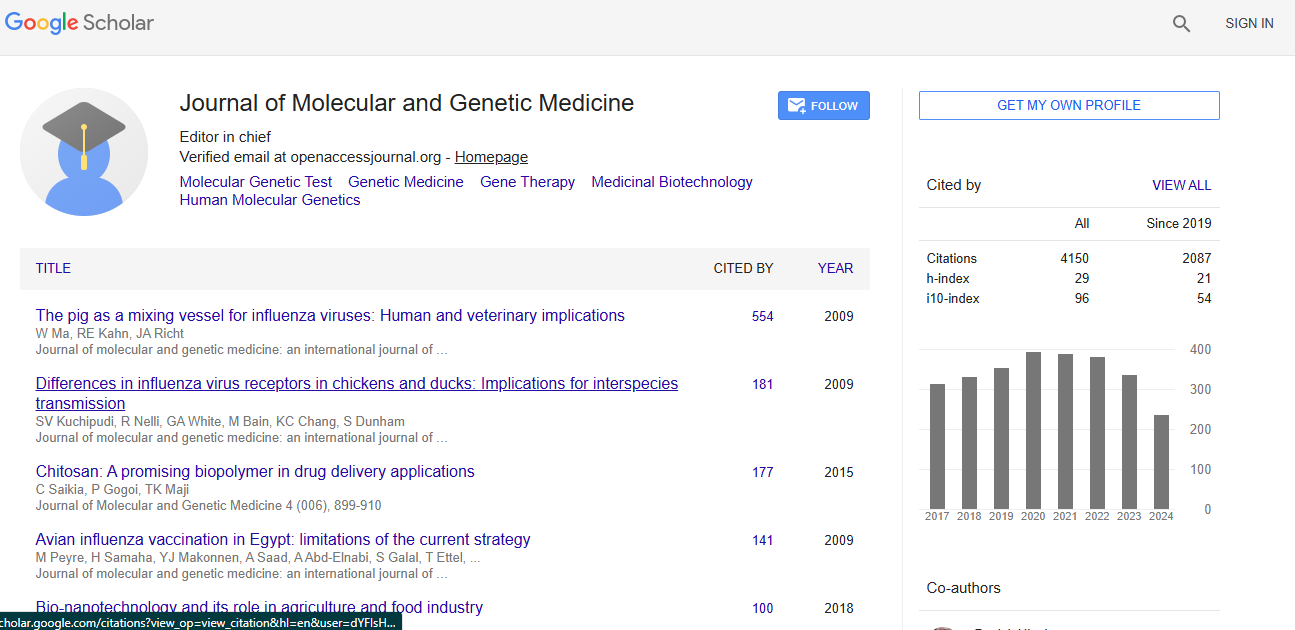
Molecular and Genetic Medicine received 3919 citations as per Google Scholar report