Short Communication - (2025) Volume 9, Issue 5
Received: 01-Sep-2025, Manuscript No. jchd-26-185713;
Editor assigned: 03-Sep-2025, Pre QC No. P-185713;
Reviewed: 17-Sep-2025, QC No. Q-185713;
Revised: 22-Sep-2025, Manuscript No. R-185713;
Published:
29-Sep-2025
, DOI: 10.37421/2684-6020.2024.9.269
Citation: Pires, David. ”Genetics of Coronary Heart Disease:
Risk and Prevention.” J Coron Heart Dis 09 (2025):269.
Copyright: © 2025 Pires D. This is an open-access article distributed under the terms of the Creative Commons Attribution License, which permits unrestricted use, distribution
and reproduction in any medium, provided the original author and source are credited.
Coronary heart disease (CHD) is a complex condition with a multifactorial etiology, where genetic predisposition plays a significant role in its development and progression. Understanding the intricate genetic architecture underlying CHD is crucial for advancing personalized risk assessment and therapeutic strategies. Research has increasingly focused on identifying key genes and pathways that contribute to an individual's susceptibility, offering new avenues for early detection and intervention. This includes examining variations in genes that regulate lipid metabolism, inflammation, and vascular function, which are central to the pathogenesis of atherosclerosis and subsequent cardiovascular events.
Polygenic risk scores (PRS) have emerged as a powerful tool for predicting CHD risk, demonstrating utility even in individuals lacking traditional risk factors. These scores aggregate the effects of numerous genetic variants, providing a more comprehensive assessment of genetic liability. Their integration with clinical data can refine risk stratification, enabling the identification of high-risk individuals who may benefit from intensified preventive measures. The ongoing development and validation of PRS promise to enhance the precision of CHD risk prediction. The interplay between an individual's genetic makeup and environmental factors, such as lifestyle choices, is another critical area of investigation in CHD. Specific genetic variants can modulate the impact of diet, exercise, and smoking, influencing an individual's overall risk. This gene-environment interaction highlights the necessity of personalized lifestyle recommendations tailored to an individual's genetic profile for optimal disease prevention. Familial hypercholesterolemia (FH) stands out as a significant genetic contributor to premature coronary heart disease, characterized by markedly elevated levels of low-density lipoprotein cholesterol. Research in this area has focused on identifying novel gene variants responsible for FH and elucidating their functional consequences. Early diagnosis and effective management of FH are paramount to averting potentially life-threatening cardiovascular events, with gene-based therapies showing promise for future treatment. Investigating the genetic architecture of coronary artery disease (CAD) across diverse populations is essential for a comprehensive understanding of its global impact. Such studies reveal both common and population-specific genetic risk factors, underscoring the importance of inclusivity in genetic research to ensure equitable advancements. Genetic diversity significantly influences disease susceptibility and the response to treatments, necessitating a broad perspective in genetic studies. The genetic determinants of inflammation within the context of atherosclerosis, a cornerstone of CHD, are also a key focus of research. Identifying genetic targets that can modulate inflammatory responses offers potential therapeutic strategies for preventing or treating CHD. This research highlights the intricate link between genetic predisposition and the inflammatory cascade that leads to the development of atherosclerotic plaques. Myocardial infarction (MI), a critical manifestation of CHD, is also being studied through the lens of genetics. Genome-wide association studies (GWAS) have identified novel loci associated with an increased risk of MI, providing deeper insights into its complex genetic etiology. These findings contribute to the development of more accurate risk prediction models for heart attacks. Beyond direct DNA sequence variations, epigenetics represents a novel frontier in understanding the genetic basis of CHD. This field examines heritable changes in gene expression that are not caused by alterations in the DNA sequence itself. Environmental factors can influence epigenetic modifications, thereby impacting CHD risk and adding another layer of complexity to its genetic etiology. Genetic factors influencing lipid metabolism are intrinsically linked to CHD risk. Research has identified specific genetic variants that affect levels of LDL cholesterol, HDL cholesterol, and triglycerides, elucidating how these variations contribute to cardiovascular disease. Understanding the genetic basis of dyslipidemia is vital for effective prevention and management strategies. Finally, the pharmacogenomics of statin therapy, a mainstay in CHD treatment, is an area of active investigation. Genetic variations can influence statin efficacy and the risk of adverse effects, paving the way for personalized treatment approaches. This field holds significant potential for optimizing cardiovascular drug therapy by tailoring it to an individual's genetic profile.The genetic underpinnings of coronary heart disease (CHD) are multifaceted, involving numerous genes and pathways that influence an individual's risk. Key genetic factors implicated in CHD development relate to lipid metabolism, inflammation, and vascular function, with variations in these genes contributing to disease susceptibility. The emphasis on understanding these genetic elements is driving the development of personalized risk assessment tools and targeted therapeutic interventions to mitigate CHD [1].
Polygenic risk scores (PRS) represent a significant advancement in predicting CHD risk, offering valuable insights even in the absence of traditional risk factors. These scores, derived from the cumulative effect of many genetic variants, can identify individuals with a higher genetic predisposition. Integrating PRS with clinical data enhances risk stratification and supports early preventive strategies, positioning PRS as a promising approach for personalized CHD prevention [2].
The intricate relationship between genetic predisposition and lifestyle factors is pivotal in the pathogenesis of coronary heart disease. Certain genetic variants can modify the influence of lifestyle choices such as diet, exercise, and smoking on an individual's CHD risk. This underscores the importance of personalized lifestyle modifications that consider an individual's genetic makeup for more effective disease prevention [3].
Familial hypercholesterolemia (FH), a significant contributor to premature coronary heart disease, is characterized by its genetic basis. Research has identified novel gene variants associated with FH and their functional impacts, highlighting the critical need for early diagnosis and management to prevent cardiovascular events. The exploration of gene-based therapies offers a new avenue for treating this severe genetic disorder [4].
Examining the genetic architecture of coronary artery disease (CAD) across diverse populations is crucial for a comprehensive understanding of its global prevalence and genetic basis. These studies reveal both shared and population-specific genetic risk factors, emphasizing the importance of including underrepresented groups to ensure equitable advancements in research and treatment. Genetic diversity impacts disease susceptibility and therapeutic responses globally [5].
The role of specific gene variants in modulating the inflammatory pathways involved in atherosclerosis is a critical area of research for CHD. Identifying genetic targets that can regulate inflammatory responses suggests potential therapeutic avenues for preventing and treating CHD. This highlights the complex interplay between genetic susceptibility and the inflammatory processes leading to plaque formation [6].
Genome-wide association studies (GWAS) have been instrumental in dissecting the genetic factors contributing to myocardial infarction (MI), a severe manifestation of CHD. These studies have identified novel genetic loci associated with increased MI risk and explored their underlying biological mechanisms, providing deeper insights into the genetic etiology of heart attacks and informing risk prediction models [7].
Epigenetics offers a novel perspective on the genetic factors influencing CHD by examining heritable changes in gene expression that do not involve alterations in the DNA sequence. Environmental factors can induce epigenetic modifications that affect CHD risk, revealing an additional layer of complexity in the genetic etiology of heart disease and opening up new avenues for research [8].
Genetic factors that influence lipid metabolism are strongly associated with coronary heart disease risk. Studies have identified variants affecting LDL cholesterol, HDL cholesterol, and triglyceride levels and their impact on CHD. Understanding the genetic basis of dyslipidemia is essential for the effective prevention and management of cardiovascular disease [9].
The pharmacogenomics of statin therapy for patients with coronary heart disease is a rapidly evolving field. Genetic variations can influence statin efficacy and the likelihood of experiencing side effects, enabling the development of personalized statin treatment strategies. This research is vital for optimizing cardiovascular drug therapy through genetic insights [10].
Coronary heart disease (CHD) is influenced by a complex interplay of genetic factors, including variations in genes related to lipid metabolism, inflammation, and vascular function. Polygenic risk scores (PRS) are emerging as a valuable tool for predicting CHD risk, even in individuals without traditional risk factors, by aggregating the effects of multiple genetic variants. The interaction between genetics and lifestyle factors, such as diet and exercise, also plays a critical role in CHD pathogenesis, necessitating personalized preventive strategies. Familial hypercholesterolemia (FH), a genetic disorder leading to premature CHD, underscores the importance of early diagnosis and potential gene-based therapies. Genetic studies across diverse populations reveal both shared and population-specific risk factors, emphasizing the need for inclusive research. Research into the genetic determinants of inflammation in atherosclerosis and the genetic architecture of myocardial infarction (MI) provides deeper insights into CHD etiology. Epigenetic modifications, influenced by environmental factors, add another layer of complexity to CHD genetics. Understanding the genetic basis of dyslipidemia is crucial for managing CHD risk. Finally, pharmacogenomics of statin therapy aims to personalize treatment by considering individual genetic profiles for optimal efficacy and safety.
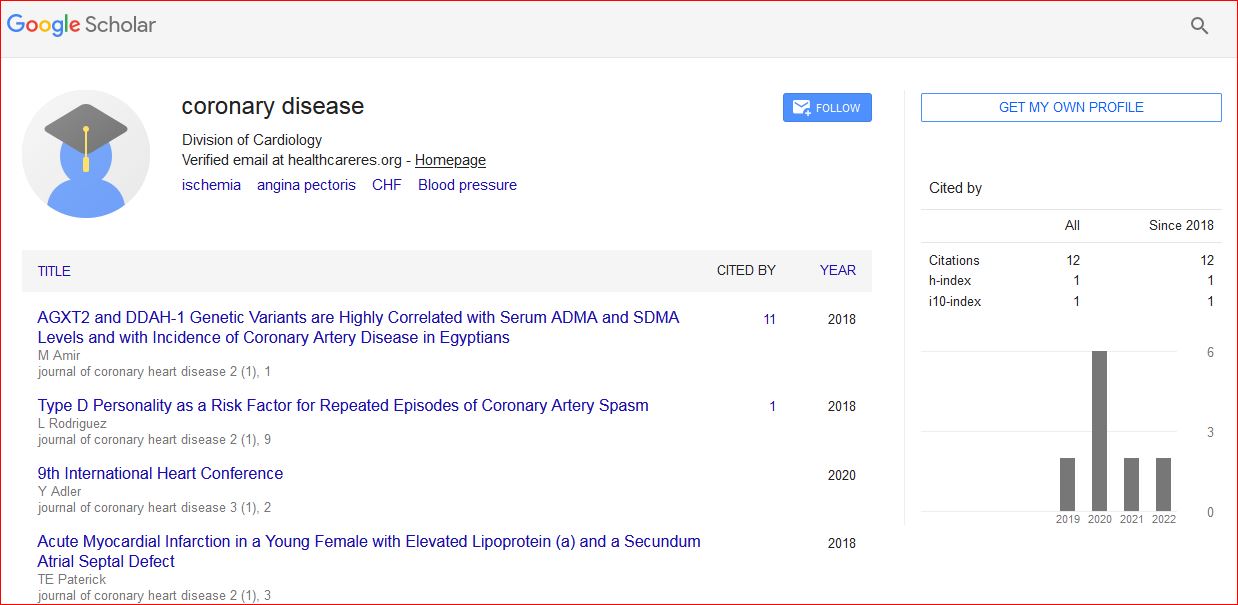
Journal of Coronary Heart Diseases received 15 citations as per Google Scholar report