Opinion - (2025) Volume 9, Issue 6
Received: 13-Sep-2024, Manuscript No. JGGE-24-147939;
Editor assigned: 16-Sep-2024, Pre QC No. JGGE-24-147939 (PQ);
Reviewed: 01-Oct-2024, QC No. JGGE-24-147939;
Revised: 14-Dec-2025, Manuscript No. JGGE-24-147939 (R);
Published:
21-Dec-2025
, DOI: 10.37421/2684-4567.2025.9.201
Citation: Munck, Lars. "Genetic Variability and Population Genomics: Implications for Human Health and Evolution." J Genet Genom 9 (2025): 201.
Copyright: © 2025 Munck L. This is an open-access article distributed under the terms of the creative commons attribution license which permits unrestricted
use, distribution and reproduction in any medium, provided the original author and source are credited.
The study of genetic variability is fundamental to understanding the diversity of life on Earth, and in humans, it offers profound insights into health, disease, and evolutionary processes. Genetic variability and population genomics: Implications for human health and evolution explores how variations in our DNA influence individual health, drive evolutionary change, and shape population dynamics. Genetic variability encompasses the differences in DNA sequences among individuals within a population. These differences are crucial for the adaptation and survival of species, providing the raw material upon which natural selection acts. In humans, genetic diversity contributes to variations in susceptibility to diseases, responses to treatments, and overall health outcomes. The advent of advanced genomic technologies has allowed us to delve deeper into these variations, offering unprecedented clarity on how genetic differences affect both individual and population-level health. This book provides a comprehensive overview of population genomics, focusing on how genetic diversity is analyzed across human populations. It discusses foundational concepts such as population structure, genetic drift, gene flow, and selection, and demonstrates how these factors interact to shape genetic variability.
By examining the latest research and methodologies, the text highlights the role of genetic diversity in understanding complex traits and diseases. In addition to its implications for health, the study of genetic variability offers crucial insights into human evolution. The book explores how genetic variation reflects historical migrations, adaptations to diverse environments, and evolutionary pressures, providing a deeper understanding of our species' history and resilience. Genetic variability and population genomics serves as an essential resource for researchers, clinicians, and students interested in the intersection of genetics, health, and evolution. It offers a detailed examination of how the study of genetic diversity informs our understanding of human biology and disease, while also shedding light on the evolutionary processes that have shaped our species. As we continue to advance our genomic knowledge, this book provides a valuable framework for appreciating the complex interplay between our genes, health, and evolutionary heritage.
Genetic variability and population genomics
Implications for human health and evolution provides an insightful exploration into the genetic diversity within and between human populations and its far-reaching implications for both health and evolutionary biology. This book delves into how genetic variability the differences in DNA sequences among individualâ??s shapes human health, contributes to disease susceptibility, and influences evolutionary processes. The text covers foundational concepts in population genomics, including the sources and types of genetic variation, population structure, and the principles of genetic drift, selection, and migration. It emphasizes the role of advanced genomic technologies and analytical methods in uncovering patterns of genetic diversity across different populations and in understanding how these patterns influence health and disease. Key topics include the impact of genetic variability on complex traits and diseases, the role of population genetics in precision medicine, and the evolutionary significance of genetic variation. The book explores how insights from population genomics can lead to a better understanding of genetic risk factors for diseases, inform strategies for personalized healthcare, and contribute to public health initiatives. Additionally, the text addresses the implications of genetic diversity for human evolution, providing a comprehensive view of how evolutionary forces shape genetic variation and how this, in turn, affects human adaptation and survival. Ideal for researchers, students, and professionals in genetics, genomics, and evolutionary biology, genetic variability and population genomics offers a thorough and accessible examination of the intricate interplay between genetic diversity and its implications for human health and evolution. By integrating current research with practical applications, this book provides a valuable resource for understanding how genetic variability influences both individual health and the broader evolutionary context.
In concluding genetic variability and population genomics implications for human health and evolution, it is clear that the study of genetic variability and population genomics provides profound insights into the intricate relationship between our genetic makeup, health, and evolutionary history. This book has explored how genetic diversity, shaped by evolutionary processes and demographic histories, plays a critical role in influencing individual health, disease susceptibility, and population-level health dynamics. We have seen how advances in genomic technologies and analytical methods have enhanced our understanding of genetic variation, allowing us to uncover patterns that inform both evolutionary theory and practical applications in medicine. From identifying genetic risk factors for complex diseases to advancing precision medicine and public health strategies, the knowledge gained from population genomics is transforming our approach to healthcare. The interplay between genetic variability and evolution reveals a dynamic picture of how human populations adapt to diverse environments and challenges. This evolving understanding underscores the importance of considering genetic diversity in research and clinical practice, highlighting the need for personalized approaches that account for individual and population-level genetic differences.
As we move forward, the continued integration of genomic data with clinical insights promises to refine our approaches to disease prevention, diagnosis, and treatment. However, challenges remain, including the need for comprehensive and representative data, ethical considerations, and the development of tools to effectively translate genomic findings into clinical benefits. In summary, 'Genetic variability and population genomics' underscores the significance of genetic diversity in shaping human health and evolution. By bridging the gap between genetic research and practical applications, this book provides a valuable foundation for understanding how genetic variability influences both our biological makeup and our responses to health and disease. As research in this field progresses, it will undoubtedly lead to further advancements in personalized medicine and a deeper appreciation of the evolutionary forces that have shaped human diversity.
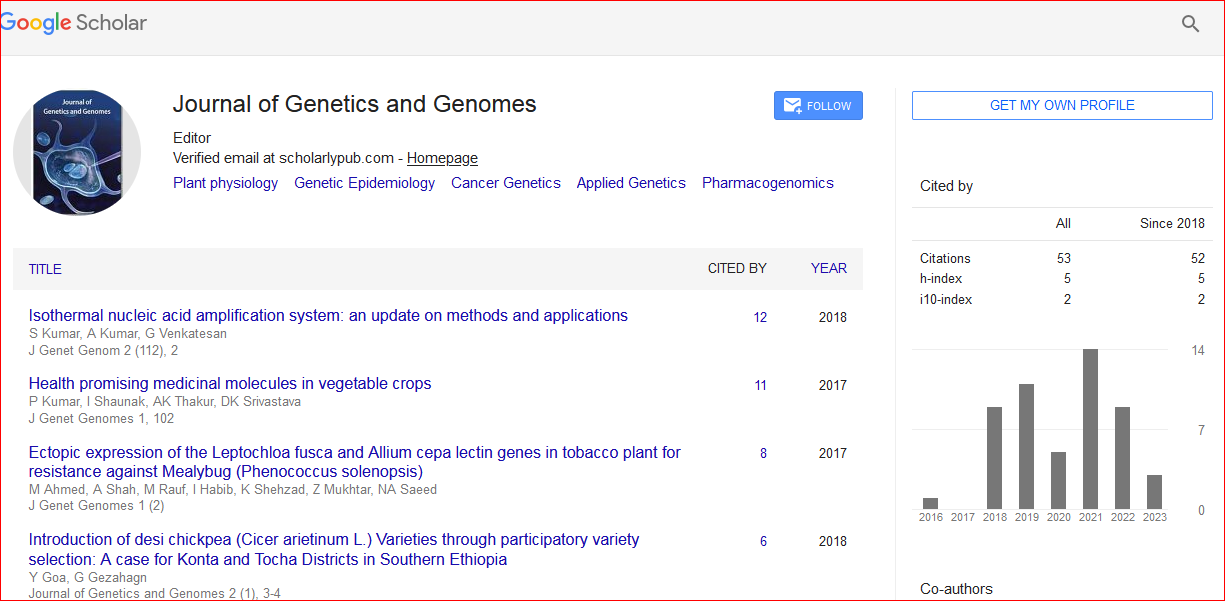
Journal of Genetics and Genomes received 65 citations as per Google Scholar report