Commentary - (2025) Volume 16, Issue 3
Received: 01-Aug-2025, Manuscript No. hgec-25-174736;
Editor assigned: 04-Aug-2025, Pre QC No. P-174736;
Reviewed: 18-Aug-2025, QC No. Q-174736;
Revised: 22-Aug-2025, Manuscript No. R-174736;
Published:
29-Aug-2025
, DOI: 10.37421/2161-0436.2025.16.290
Citation: Al-Mansouri, Noura. ”Genetic Mapping: Advancing Traits and Disease Insights.” Human Genet Embryol 16 (2025):290.
Copyright: © 2025 Al-Mansouri N. This is an open-access article distributed under the terms of the Creative Commons Attribution License, which permits unrestricted use, distribution and reproduction in any medium, provided the original author and source are credited.
This research utilized high-density genetic maps to identify quantitative trait loci (QTLs) associated with grain yield and its constituent traits in wheat, specifically under conditions of terminal heat stress. This approach offers critical targets for marker-assisted breeding programs. Such programs are essential for developing heat-tolerant wheat varieties, ultimately contributing to global food security by ensuring stable yields even under challenging environmental conditions [1].
This study employed advanced genetic mapping techniques, including high-density Single Nucleotide Polymorphism (SNP) arrays and multi-parental populations, to identify novel genetic loci influencing obesity-related traits in mice. These findings are significant because they provide critical insights into the complex genetic architecture underlying obesity. Identifying these loci suggests potential therapeutic targets and pathways, many of which may be conserved across different species, highlighting the broad relevance of this research [2].
This research applied genetic mapping to understand the genomic architecture of clubroot resistance in Brassica rapa. By pinpointing multiple Quantitative Trait Loci (QTLs) and candidate genes, this study clearly demonstrated the polygenic nature of resistance to clubroot. The markers derived from this work are incredibly valuable for breeding initiatives, helping to enhance disease resistance in important crop species like Brassica rapa [3].
This study employed genetic fine-mapping to pinpoint a critical Quantitative Trait Locus (QTL) responsible for spikelet fertility in rice under low-temperature conditions. This meticulous work successfully identified such a locus. By narrowing down the candidate region, this research significantly contributes to identifying specific genes that confer cold tolerance, thereby facilitating the creation of rice varieties that are resilient to adverse climatic conditions [4].
This review comprehensively examines the latest advances and future challenges in genetic mapping of complex human traits. It thoroughly explores methodologies such as Genome-Wide Association Studies (GWAS), Mendelian randomization, and fine-mapping, underscoring their crucial role in dissecting the intricate genetic architecture of diseases and paving the way for personalized medicine, which tailors treatments to an individual's genetic makeup [5].
This research introduces a robust statistical framework for genetic mapping of quantitative traits in outbred populations, addressing challenges such as population structure and cryptic relatedness. The statistical framework presented here for genetic mapping of quantitative traits in outbred populations effectively addresses common challenges like population structure and cryptic relatedness. This novel method substantially improves both the power and precision needed for identifying QTLs, making it highly valuable for a wide range of genetic studies in both agricultural and human populations [6].
This study successfully mapped genetic loci contributing to resistance against Fusarium head blight, a devastating disease, in durum wheat. Identifying these resistance-conferring regions opens promising avenues for the development of disease-resistant wheat cultivars. This can be achieved through marker-assisted selection, which will significantly improve crop resilience and ensure greater yield stability, especially against devastating diseases like Fusarium head blight [7].
This large-scale genetic mapping study utilized data from the UK Biobank to identify host genetic factors influencing susceptibility and severity of COVID-19. It brought to light several novel genetic loci linked to disease outcomes, offering vital mechanistic insights into SARS-CoV-2 infection and informing the development of potential therapeutic strategies [8].
This study performed genetic mapping to identify Quantitative Trait Loci (QTLs) associated with resistance to Verticillium wilt in olive trees. The results shed light on the genetic basis of resistance to Verticillium wilt. These findings provide valuable molecular markers that can be directly integrated into breeding programs, leading to the development of more resilient olive cultivars capable of withstanding this significant fungal pathogen [9].
This groundbreaking study integrates multi-omics data, including genomics, transcriptomics, and epigenomics, with genetic mapping strategies to uncover the molecular mechanisms underlying common complex diseases. This innovative research combines multi-omics data with genetic mapping techniques to reveal the molecular mechanisms underlying common complex diseases. This integrated approach is key to enhancing the identification of causal variants and disease pathways, providing a more complete and holistic understanding of disease etiology [10].
Research into genetic mapping plays a pivotal role in enhancing agricultural productivity and resilience. For example, high-density genetic maps have been used to identify quantitative trait loci (QTLs) vital for grain yield in wheat, especially under challenging terminal heat stress conditions. These QTLs are critical targets for developing heat-tolerant varieties through marker-assisted breeding, directly addressing global food security concerns [1]. Similarly, efforts have successfully mapped genetic loci for resistance to Fusarium head blight in durum wheat. Identifying these resistance-conferring regions provides excellent opportunities for creating disease-resistant wheat cultivars, thereby improving crop resilience and maintaining stable yields [7].
Beyond wheat, genetic mapping has been applied to other crucial crop species to bolster disease and stress resistance. Understanding the genomic architecture of clubroot resistance in Brassica rapa was achieved by identifying multiple QTLs and candidate genes, highlighting the polygenic nature of this resistance. This work provides valuable markers for breeding programs focused on enhancing disease resistance in this important vegetable crop [3]. Moreover, genetic fine-mapping in rice has pinpointed a crucial QTL responsible for spikelet fertility under low-temperature conditions. This focused research helps identify specific genes for cold tolerance, facilitating the development of rice varieties resilient to adverse climatic shifts [4]. Even perennial crops like olive trees benefit, with genetic mapping identifying QTLs linked to resistance against Verticillium wilt, a significant fungal pathogen. These findings offer molecular markers crucial for breeding programs aimed at developing more resilient olive cultivars [9].
The scope of genetic mapping extends significantly into human and animal health. Advanced genetic mapping techniques, including high-density Single Nucleotide Polymorphism (SNP) arrays and multi-parental populations, have been instrumental in identifying novel genetic loci influencing obesity-related traits in mice. This offers crucial insights into the complex genetic architecture of obesity, suggesting potential therapeutic targets and conserved pathways across species [2]. For humans, a comprehensive review highlights the latest advancements and ongoing challenges in mapping complex human traits. It covers essential methodologies such as Genome-Wide Association Studies (GWAS), Mendelian randomization, and fine-mapping, underscoring their role in dissecting disease genetic architecture and moving towards personalized medicine [5].
Large-scale genetic mapping studies are also shedding light on specific human diseases. Research utilizing data from the UK Biobank successfully identified host genetic factors that influence susceptibility and severity of COVID-19. This study uncovered several novel genetic loci associated with disease outcomes, providing important mechanistic insights into SARS-CoV-2 infection and guiding potential therapeutic strategies [8]. On the methodological front, new statistical frameworks have been developed for genetic mapping of quantitative traits in outbred populations. These frameworks effectively address challenges like population structure and cryptic relatedness, leading to improved power and precision in QTL identification. This innovation is highly valuable for genetic studies in both agricultural and human contexts [6].
Looking forward, a groundbreaking study demonstrates the power of integrating multi-omics data, including genomics, transcriptomics, and epigenomics, with genetic mapping strategies. This approach aims to uncover the molecular mechanisms underlying common complex diseases. This integrative method significantly enhances the identification of causal variants and disease pathways, fostering a more holistic understanding of disease etiology and guiding future research and interventions [10].
Genetic mapping research is actively advancing our understanding of various biological traits and disease resistances across diverse species. Scientists are leveraging high-density genetic maps to identify quantitative trait loci (QTLs) and specific genetic loci influencing key agricultural traits. For example, studies in wheat aim to pinpoint QTLs for grain yield under terminal heat stress and resistance to Fusarium head blight, paving the way for developing more resilient and high-yielding varieties through marker-assisted breeding programs. Beyond crops, genetic mapping extends to human and animal health. Researchers are using advanced techniques like Single Nucleotide Polymorphism (SNP) arrays and multi-parental populations to uncover novel genetic loci linked to obesity-related traits in mice, providing insights into the complex genetics of metabolic disorders. In human populations, genetic mapping is critical for dissecting complex traits and disease architectures, with methodologies like Genome-Wide Association Studies (GWAS), Mendelian randomization, and fine-mapping playing pivotal roles in personalized medicine and understanding disease etiology. Large-scale studies, such as those using UK Biobank data, have identified host genetic factors influencing COVID-19 susceptibility and severity, offering crucial mechanistic insights and informing therapeutic strategies. The field also sees methodological advancements, including the development of robust statistical frameworks for genetic mapping in outbred populations, which better accounts for population structure and cryptic relatedness. This improves the precision and power of identifying QTLs, benefiting both agricultural and human genetic studies. Future directions involve integrating multi-omics dataâ??genomics, transcriptomics, and epigenomicsâ??with genetic mapping to uncover the molecular mechanisms of complex diseases, providing a holistic understanding of disease pathways and causal variants. Overall, genetic mapping efforts are instrumental in identifying the genetic basis of economically important traits in crops like clubroot resistance in Brassica rapa and spikelet fertility in rice under low temperatures. It also helps in improving resistance to pathogens like Verticillium wilt in olive trees. This broad application highlights genetic mapping as a cornerstone technique for enhancing global food security, improving animal and human health outcomes, and deepening our understanding of fundamental genetic principles.
None
None
Indexed at, Google Scholar, Crossref
Indexed at, Google Scholar, Crossref
Indexed at, Google Scholar, Crossref
Indexed at, Google Scholar, Crossref
Indexed at, Google Scholar, Crossref
Indexed at, Google Scholar, Crossref
Indexed at, Google Scholar, Crossref
Indexed at, Google Scholar, Crossref
Indexed at, Google Scholar, Crossref
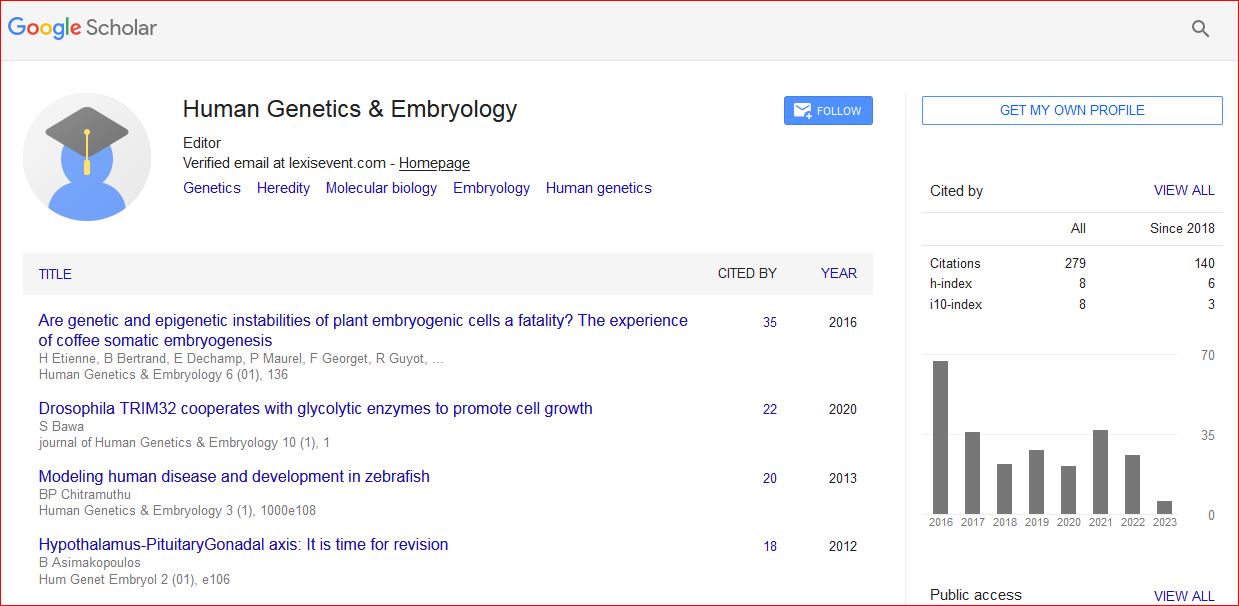
Human Genetics & Embryology received 309 citations as per Google Scholar report