Perspective - (2025) Volume 19, Issue 2
Received: 01-Apr-2025, Manuscript No. jmgm-26-185640;
Editor assigned: 03-Apr-2025, Pre QC No. P-185640;
Reviewed: 17-Apr-2025, QC No. Q-185640;
Revised: 22-Apr-2025, Manuscript No. R-185640;
Published:
29-Apr-2025
, DOI: 10.37421/1747-0862.2025.19.718
Citation: Andersen, Michael J. ”Genes, RNA, and Disease: A Molecular Perspective.” J Mol Genet Med 19 (2025):718.
Copyright: © 2025 Andersen J. Michael This is an open-access article distributed under the terms of the Creative Commons Attribution License, which permits unrestricted use, distribution and reproduction in any medium, provided the original author and source are credited.
The intricate interplay between DNA damage and RNA metabolism forms a cornerstone of modern genetic medicine, with fundamental implications for human health and disease [1].
Understanding how alterations in the DNA sequence cascade into aberrant RNA molecules and ultimately manifest as disease is of paramount importance. This comprehension necessitates exploring the diverse mechanisms governing DNA repair, the precise fidelity of transcription and splicing processes, and the critical factors influencing RNA stability and translation [1].
Somatic mutations, which arise throughout an organism's lifespan, are increasingly recognized for their significant role in a variety of diseases, most notably cancer and the aging process [2].
These mutations can originate from endogenous cellular activities or be induced by exogenous mutagens encountered in the environment. The unique patterns and frequencies of somatic mutations observed can offer profound insights into the underlying molecular mechanisms driving these cellular changes and the historical trajectory of cellular evolution [2].
RNA editing represents a sophisticated post-transcriptional modification process that actively alters the nucleotide sequence of an RNA molecule after its initial transcription [3].
This modification has the capacity to profoundly influence cellular processes by leading to changes in protein function, the regulation of gene expression, and overall cellular behavior. Dysregulation of these RNA editing events has been implicated in the pathogenesis of various neurological disorders and certain types of cancer, underscoring its critical importance in maintaining cellular homeostasis and preventing disease [3].
Non-coding RNAs (ncRNAs), a diverse class encompassing microRNAs (miRNAs) and long non-coding RNAs (lncRNAs), play indispensable roles in the intricate regulation of gene expression within cells [4].
The dysregulation of these ncRNAs has been demonstrably linked to the pathogenesis of a broad spectrum of human diseases. Consequently, elucidating the precise molecular mechanisms by which ncRNAs are controlled and understanding how their aberrant regulation impacts cellular function constitutes a key and active area of research within the field of genetic medicine [4].
The revolutionary advent of CRISPR-Cas gene editing technology has dramatically transformed the therapeutic landscape for genetic diseases [5].
By enabling the precise targeting and modification of specific DNA sequences, CRISPR-Cas systems present unprecedented opportunities for correcting disease-causing mutations directly at their source. Ongoing research endeavors are rigorously focused on enhancing the efficiency, specificity, and overall safety of these powerful gene editing systems to facilitate their successful clinical application [5].
Epigenetic modifications, such as DNA methylation and various histone modifications, represent a crucial layer of gene regulation that can alter gene expression patterns without causing any changes to the underlying DNA sequence itself [6].
These modifications are inherently dynamic and can be significantly influenced by a multitude of environmental factors. Aberrant epigenetic patterns are now increasingly recognized as significant drivers of diverse diseases, including cancer and various developmental disorders, positioning them as promising targets for novel therapeutic interventions [6].
RNA interference (RNAi) is a fundamental biological process that naturally occurs within cells to achieve gene silencing, effectively reducing the expression of specific genes [7].
The therapeutic applications derived from harnessing RNAi, particularly through the use of small interfering RNAs (siRNAs) and antisense oligonucleotides (ASOs), have emerged as remarkably powerful tools for treating diseases. These agents function by specifically targeting and degrading disease-causing messenger RNA (mRNA) molecules, thereby modulating disease progression [7].
DNA repair pathways are absolutely essential for maintaining the integrity of the genome, acting as cellular guardians against accumulating errors [8].
When errors occur within these critical DNA repair mechanisms, it can lead to the unchecked accumulation of mutations within the DNA. This accumulation of mutations can serve as a powerful driving force in the development of various diseases, with cancer being a particularly prominent example. A deep understanding of the intricate molecular mechanisms underlying DNA repair offers promising avenues for the development of innovative therapeutic strategies that judiciously exploit these natural cellular pathways [8].
Alternative splicing of RNA represents a vital molecular mechanism that significantly expands the proteomic diversity achievable from a limited number of genes by generating different mature mRNA variants from a single pre-mRNA transcript [9].
The dysregulation of this crucial alternative splicing process has been implicated in the pathogenesis of a wide array of diseases, encompassing both inherited genetic disorders and various forms of cancer. Therefore, the meticulous investigation of splicing abnormalities is paramount for advancing our understanding of disease pathogenesis and for the development of precisely targeted therapeutic interventions [9].
The comprehensive study of RNA modifications, extending beyond simple nucleotide sequence changes, is progressively revealing their profound and multifaceted impact on RNA function, stability, and cellular localization [10].
These modifications can substantially influence RNA structure, dictate its subcellular localization, and mediate its interactions with specific proteins, thereby exerting significant control over gene expression and overall cellular processes. As our knowledge expands, understanding these RNA modifications is becoming increasingly critical in the context of unraveling the complexities of genetic diseases and developing effective therapeutic strategies [10].
The fundamental role of DNA mutations and RNA dysregulation in genetic medicine cannot be overstated, highlighting their direct link to human health and disease [1].
A thorough understanding of how alterations in the DNA sequence lead to the production of aberrant RNA molecules, and consequently to disease, is crucial. This includes detailed exploration of the complex mechanisms involved in DNA repair, the stringent fidelity required during transcription and splicing, and the regulatory processes governing RNA stability and translation [1].
Somatic mutations, which are acquired during an individual's lifetime, play a significant and often detrimental role in various diseases, particularly in the context of cancer development and the aging process [2].
These mutations can arise from both intrinsic cellular processes and external environmental mutagens. The specific patterns and frequencies of somatic mutations observed can provide valuable insights into the underlying molecular mechanisms at play and the evolutionary history of affected cells [2].
RNA editing is a key post-transcriptional modification process that actively alters the sequence of an RNA molecule after its initial transcription [3].
This process can lead to significant changes in protein function, gene expression levels, and various cellular processes. The dysregulation of RNA editing has been linked to the pathogenesis of neurological disorders and cancer, emphasizing its importance in maintaining cellular homeostasis and preventing disease [3].
Non-coding RNAs, such as microRNAs and long non-coding RNAs, are critical regulators of gene expression [4].
Their dysregulation is increasingly implicated in the pathogenesis of a wide range of human diseases. Therefore, understanding the precise mechanisms controlling ncRNA expression and how their aberrant regulation impacts cellular function is a central focus of current research in genetic medicine [4].
The advent of CRISPR-Cas gene editing technology has revolutionized the potential for treating genetic diseases [5].
This technology offers unprecedented opportunities for correcting disease-causing mutations by precisely targeting and modifying specific DNA sequences. Current research efforts are dedicated to improving the efficiency, specificity, and safety of these gene editing systems for eventual clinical applications [5].
Epigenetic modifications, including DNA methylation and histone modifications, alter gene expression without changing the underlying DNA sequence [6].
These modifications are dynamic and responsive to environmental influences. Aberrant epigenetic patterns are increasingly recognized as drivers of diseases such as cancer and developmental disorders, making them promising targets for therapeutic intervention [6].
RNA interference (RNAi) is a natural cellular process that silences gene expression [7].
Therapeutic applications of RNAi, employing agents like small interfering RNAs (siRNAs) and antisense oligonucleotides (ASOs), have emerged as potent tools for treating diseases by specifically targeting disease-causing mRNAs [7].
DNA repair pathways are essential for maintaining genomic integrity, and errors in these pathways can lead to the accumulation of mutations that drive disease development, particularly cancer [8].
Understanding the intricate mechanisms of DNA repair offers potential avenues for developing novel therapeutic strategies that leverage these pathways for treatment [8].
Alternative splicing of RNA is a critical mechanism for generating protein diversity from a limited number of genes [9].
Dysregulation of alternative splicing contributes to a wide range of diseases, including genetic disorders and cancer. Investigating splicing abnormalities is key to understanding disease pathogenesis and developing targeted therapies [9].
The study of RNA modifications, beyond sequence alterations, is revealing their profound impact on RNA function and stability [10].
These modifications influence RNA structure, localization, and protein interactions, thereby affecting gene expression and cellular processes. Understanding these modifications is crucial in the context of genetic diseases [10].
Genetic medicine fundamentally relies on understanding the links between DNA mutations and RNA dysregulation, which are crucial for disease development. Somatic mutations acquired during life are significant in cancer and aging. RNA editing and non-coding RNAs (miRNAs, lncRNAs) play critical roles in gene regulation and disease pathogenesis. The CRISPR-Cas system offers revolutionary potential for treating genetic diseases by precise DNA editing. Epigenetic modifications, which alter gene expression without changing DNA sequence, are also implicated in disease and represent therapeutic targets. RNA interference (RNAi) provides therapeutic strategies by silencing gene expression. DNA repair pathways are vital for genomic integrity, and their defects can lead to mutations driving diseases like cancer. Alternative splicing diversifies protein products, and its dysregulation contributes to various disorders. Finally, RNA modifications beyond sequence changes significantly impact RNA function and are increasingly important in understanding genetic diseases.
None
None
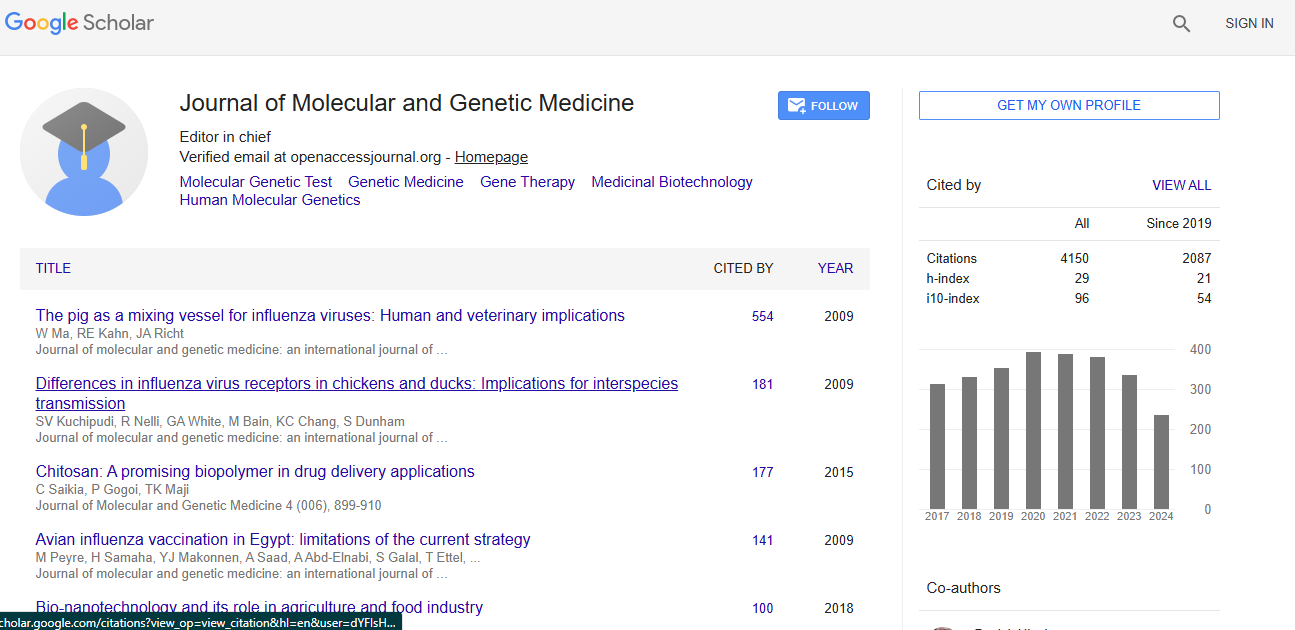
Molecular and Genetic Medicine received 3919 citations as per Google Scholar report