Opinion - (2025) Volume 11, Issue 6
Received: 03-Nov-2025, Manuscript No. OHCR-25-167875;
Editor assigned: 05-Nov-2025, Pre QC No. P-167875;
Reviewed: 17-Nov-2025, QC No. Q-167875;
Revised: 22-Nov-2025, Manuscript No. R-167875;
Published:
29-Nov-2025
, DOI: 10.37421/2471-8726.2025.11.216
Citation: Ekuni, Hassell. “Gender and Aesthetic Expectations in Gum Disease Treatment.” Oral Health Case Rep 11 (2025): 216.
Copyright: © 2025 Ekuni H. This is an open-access article distributed under the terms of the Creative Commons Attribution License, which permits unrestricted use, distribution and reproduction in any medium, provided the original author and source are credited.
Gum disease treatment has traditionally focused on halting disease progression and restoring periodontal health. However, with increasing emphasis on aesthetics in modern dentistry, patient expectations have evolved often shaped by gender-specific perceptions of beauty and oral appearance. Men and women may approach periodontal therapy with differing priorities, particularly when treatment affects the visibility of the smile. While both genders value healthy gums, women are often more concerned with the color, contour, and symmetry of gingival tissues, especially in the anterior region. Conversely, men may prioritize functionality and long-term health outcomes. These differences influence not only treatment choices but also patient satisfaction and compliance. Understanding the role of gender in aesthetic expectations is essential for tailoring periodontal treatment plans that address both clinical needs and the personal goals of diverse patients [1].
Aesthetic outcomes in gum disease treatment are increasingly important in patient-centered care, especially as cosmetic dentistry intersects with periodontology. Gender plays a significant role in shaping what patients consider a desirable result. Cultural norms and societal expectations often place greater aesthetic pressure on women, making them more likely to express dissatisfaction with post-treatment gingival irregularities or recession. This difference affects how clinicians approach surgical techniques, flap design, and regenerative procedures. Men may be more tolerant of minor cosmetic changes but equally value treatment success and durability. As such, periodontal therapy must evolve beyond a standardized approach to one that considers gender-based expectations, lifestyle factors, and emotional responses to treatment. Customizing periodontal care to meet these nuanced demands enhances communication, optimizes results, and ensures ethical, empathetic clinical practice in an increasingly diverse patient population [2].
Gender differences in aesthetic perception influence both the expectations and outcomes of gum disease treatment. Women are generally more attuned to subtle gingival details, including tissue color, margin scalloping, and interdental papilla preservation. Studies have shown that female patients are more likely to report dissatisfaction with black triangles, gingival recession, or asymmetry following periodontal therapy, even when clinical success is achieved. This sensitivity often prompts a preference for minimally invasive procedures that prioritize soft tissue preservation and natural contours. For men, although aesthetics remain important, function, longevity, and convenience may hold greater weight in decision-making. These tendencies influence patient preferences regarding surgical versus non-surgical interventions, recovery time, and acceptance of minor imperfections. Clinicians must be adept at recognizing and managing these expectations during consultation and treatment planning. Thorough pre-treatment discussions that include visual simulations and case examples can help align expectations with achievable outcomes. Additionally, gender-specific communication styles may impact how patients interpret information and consent to procedures, necessitating a tailored approach to dialogue and education. While individual variation always exists, acknowledging common gender trends in aesthetic sensitivity allows for more empathetic and successful periodontal care. Incorporating these insights into clinical protocols ensures that both male and female patients feel seen, heard, and satisfied with their periodontal treatment journey [3].
Aesthetic considerations in periodontal treatment vary by gender and can influence the selection of clinical techniques. For example, in female patients with high smile lines, even slight gingival recession or scarring may be immediately noticeable and impact overall appearance. As a result, clinicians often adopt microsurgical methods, utilize connective tissue grafts, or employ collagen matrices to enhance soft tissue outcomes in aesthetically sensitive zones. Women may also be more receptive to regenerative treatments, such as enamel matrix derivatives or growth factors, which promise not just disease control but also aesthetic improvement. In contrast, male patients, who may have lower smile lines or less concern for minor contour discrepancies, often prefer efficient, low-maintenance treatments. These differing preferences require periodontal therapies that are both clinically effective and adaptable to individual cosmetic goals. Understanding such distinctions enables clinicians to present treatment options in a way that resonates with the patientâ??s values and priorities. It also helps in setting realistic expectations, particularly in cases where disease severity limits aesthetic enhancement. By integrating gender-aware strategies into periodontal planning such as modifying flap design or emphasizing tissue blending clinicians improve both the visual and emotional outcomes of therapy. Ultimately, aesthetic success is not solely a technical result but a subjective experience shaped by personal, often gendered, perceptions of beauty [4].
Communication is a critical aspect of managing aesthetic expectations in periodontal therapy and is often shaped by gendered preferences and behavior. Female patients tend to engage more actively in treatment planning, ask detailed questions, and seek visual proof of outcomes through images or mock-ups. They may express heightened concern about the visibility of surgical sites, post-treatment smile changes, or potential cosmetic trade-offs. Addressing these concerns requires a proactive approach, with clinicians offering clear, empathetic explanations and visual aids that illustrate both procedural steps and likely results. Male patients, on the other hand, may prefer concise, outcome-driven discussions that focus on efficiency, durability, and function. They may be less inclined to voice aesthetic concerns but can still feel dissatisfied if cosmetic outcomes are not addressed preemptively. For both groups, the failure to acknowledge and manage aesthetic expectations can lead to miscommunication, treatment regret, or lack of compliance. Ethical care involves not only treating disease but also validating the patientâ??s vision of success. This is particularly important in chronic periodontal conditions, where long-term changes to the smile and gumline are possible. By tailoring communication strategies and incorporating gender-informed dialogue, clinicians can build stronger rapport, foster trust, and ensure that both the functional and aesthetic dimensions of periodontal health are respected and achieved [5].
Google Scholar Cross Ref Indexed at
Google Scholar Cross Ref Indexed at
Google Scholar Cross Ref Indexed at
Google Scholar Cross Ref Indexed at
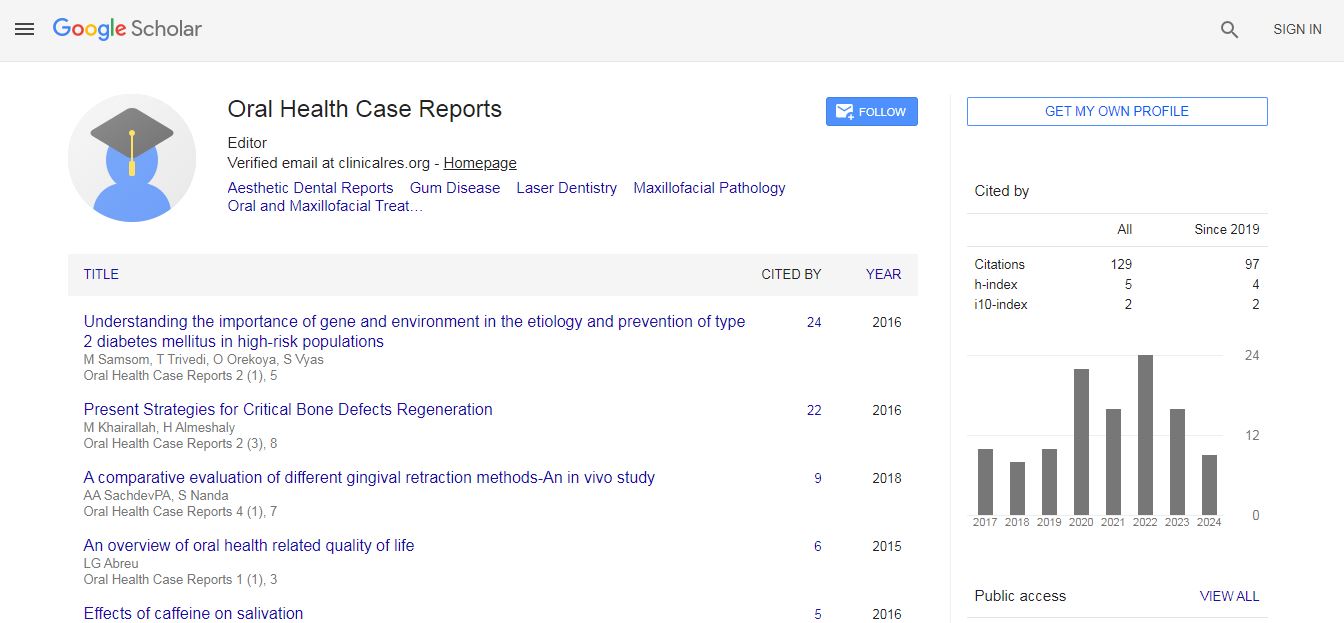
Oral Health Case Reports received 120 citations as per Google Scholar report