Opinion - (2025) Volume 14, Issue 3
Received: 02-Jun-2025, Manuscript No. jeom-26-188172;
Editor assigned: 04-Jun-2025, Pre QC No. P-188172;
Reviewed: 18-Jun-2025, QC No. Q-188172;
Revised: 23-Jun-2025, Manuscript No. R-188172;
Published:
30-Jun-2025
, DOI: 10.37421/2169-026X.2025.14.535
Citation: Sato, Rina. ”Future-Ready Leadership: Adapt, Engage, and Lead Ethically.” J Entrepren Organiz Manag 14 (2025):535.
Copyright: © 2025 Sato R. This is an open-access article distributed under the terms of the Creative Commons Attribution License, which permits unrestricted use, distribution and reproduction in any medium, provided the original author and source are credited.
Effective leadership development in modern organizations is undergoing a significant transformation, driven by the need for adaptive capabilities, emotional intelligence, and a robust ethical framework. [1] Organizations are increasingly moving towards distributed leadership models, emphasizing continuous learning and agile skill acquisition to navigate the complexities of today's business environments. [1] The primary focus is on cultivating leaders who can inspire, empower teams, and drive innovation, rather than solely relying on traditional hierarchical structures. [1] This necessitates the creation of inclusive cultures that actively encourage diverse perspectives and establish ongoing feedback mechanisms crucial for individual and organizational growth. [1] Concurrently, the integration of digital technologies, such as artificial intelligence and big data analytics, is revolutionizing leadership development by enabling highly personalized learning paths and providing data-driven performance insights. [2] Leaders are being equipped with essential digital literacy and the critical ability to leverage technology for strategic decision-making and enhanced team collaboration. [2] This evolving landscape demands a continuous re-evaluation of leadership competencies to ensure their relevance in an increasingly digitized global business context. [2] Building inclusive leadership is paramount for organizations aiming to foster diverse and equitable workplaces, requiring leaders to champion diversity, equity, and inclusion (DEI) principles. [3] This involves cultivating environments where all employees feel genuinely valued and respected, achieved through initiatives like unconscious bias training and inclusive communication strategies. [3] The rise of remote and hybrid work models further complicates leadership, demanding new approaches focused on trust, autonomy, and exceptionally effective communication to manage dispersed teams. [4]
The evolution of leadership development is strongly influenced by the imperative to foster adaptive capabilities, emotional intelligence, and a clear ethical compass within modern organizations. [1] This involves a strategic shift towards more distributed leadership paradigms, underscoring the importance of continuous learning and the agile acquisition of skills necessary for navigating complex organizational terrains. [1] The objective is to nurture leaders capable of inspiring and empowering their teams, thereby driving innovation, moving beyond the constraints of purely hierarchical authority. [1] A critical component of this development is the cultivation of inclusive cultures that embrace diverse viewpoints and implement robust feedback mechanisms for sustained growth. [1] Furthermore, the profound impact of digital technologies, including AI and big data analytics, is reshaping leadership development by facilitating personalized learning journeys and offering data-driven insights into performance. [2] Leaders are now tasked with developing strong digital literacy and mastering the art of leveraging technology for informed strategic decision-making and effective team collaboration. [2] This technological integration necessitates a constant recalibration of leadership competencies to maintain their currency in a rapidly digitizing business world. [2] The development of inclusive leadership is a non-negotiable aspect for organizations striving for diversity, equity, and inclusion (DEI) within their workforces. [3] This entails equipping leaders with the understanding and commitment to champion DEI principles, creating environments where every employee feels recognized and respected. [3] The proliferation of remote and hybrid work models has introduced a unique set of challenges, compelling leaders to adopt new strategies centered on building trust, granting autonomy, and ensuring clear, consistent communication across geographically dispersed teams. [4]
None
None
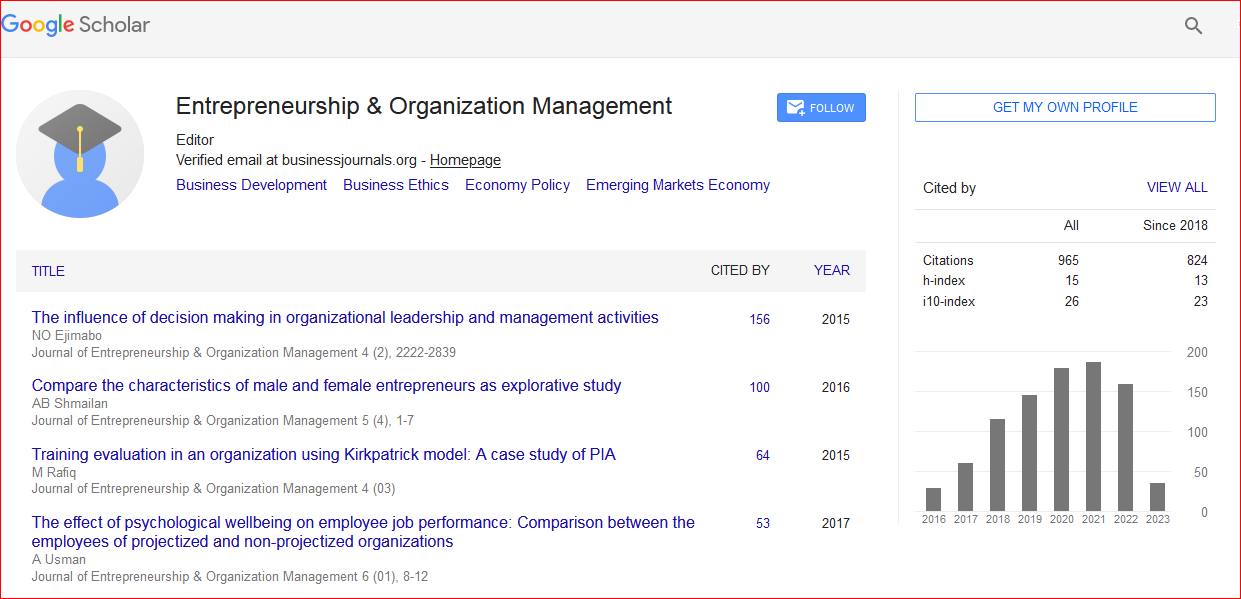
Entrepreneurship & Organization Management received 1115 citations as per Google Scholar report