Perspective - (2025) Volume 14, Issue 6
Received: 01-Dec-2025, Manuscript No. jeom-26-188201;
Editor assigned: 03-Dec-2025, Pre QC No. P-188201;
Reviewed: 17-Dec-2025, QC No. Q-188201;
Revised: 22-Dec-2025, Manuscript No. R-188201;
Published:
29-Dec-2025
, DOI: 10.37421/2169-026X.2025.14.561
Citation: Ramirez, Victor Hugo. ”Future Entrepreneurship: Digital, Sustainable, Purpose-Driven Innovation.” J Entrepren Organiz Manag 14 (2025):561.
Copyright: © 2025 Ramirez H. Victor This is an open-access article distributed under the terms of the Creative Commons Attribution License, which permits unrestricted use, distribution and reproduction in any medium, provided the original author and source are credited.
The future of entrepreneurship is undergoing a profound transformation, driven by several interconnected forces that are reshaping how businesses are conceived, launched, and sustained. Digital transformation stands as a central pillar, with emerging trends indicating a significant rise in entrepreneurial ecosystems that actively foster innovation through collaboration and the open sharing of data. Organizations are increasingly expected to cultivate agility, embrace adaptive leadership styles, and uphold a robust ethical framework to effectively navigate the complexities of the global landscape [1].
The pervasive influence of digital platforms and e-commerce has established them as primary avenues for entrepreneurial ventures, thereby democratizing access to markets on an unprecedented scale. This fundamental shift mandates a deep and nuanced understanding of digital marketing strategies, customer analytics, and the critical importance of cybersecurity. Concurrently, businesses are actively exploring decentralized organizational structures and embracing the gig economy to enhance operational flexibility and broaden their talent acquisition capabilities, with a strong emphasis on creating value through comprehensive digital integration and building resilient business operations [2].
Sustainability has evolved from a peripheral concern to a core strategic imperative for organizations charting a course for the future. Entrepreneurs are increasingly guided by a triple-bottom-line approach, diligently balancing the pursuit of profit with a profound commitment to social and environmental impact. The adoption of circular economy models and the responsible management of resources are gaining considerable traction, necessitating innovative solutions for waste reduction, ethical sourcing, and sustainable production processes, often amplified by advancements in technological capabilities [3].
Artificial intelligence and machine learning are on the cusp of revolutionizing organizational structures and the very fabric of entrepreneurial strategies. AI possesses the remarkable capability to enhance decision-making processes, automate repetitive tasks, and personalize customer experiences with remarkable precision. However, these advancements also introduce significant challenges pertaining to data privacy, the potential for algorithmic bias, and the urgent need for continuous upskilling of the workforce. Future entrepreneurs must therefore be adept at leveraging AI both ethically and strategically to harness its full potential [4].
The trajectory of entrepreneurship is also increasingly being shaped by a pronounced focus on purpose-driven innovation and the development of social impact ventures. This paradigm shift involves the creation of businesses that not only aim for profitability but also actively address pressing societal needs and contribute positively to societal change. Both investors and consumers are demonstrating a clear preference for organizations that exhibit unambiguous social missions and adhere to stringent ethical practices [5].
Agile methodologies and adaptive leadership have emerged as critical components for organizations seeking to thrive amidst volatile and unpredictable environments. Entrepreneurs are compelled to foster a pervasive culture of continuous learning and experimentation, embracing flexible organizational structures, empowering their teams, and exhibiting a swift responsiveness to market shifts and disruptive forces. The capacity to pivot and adapt effectively is paramount to sustained success [6].
The globalization of markets and the escalating interconnectedness of economies present a dual landscape of both significant opportunities and formidable challenges for entrepreneurs. A thorough understanding of diverse cultural contexts, the ability to navigate complex international regulations, and the skill to leverage global talent pools are all essential elements for success. Future entrepreneurial strategies will likely involve fostering cross-border collaborations and adopting a nuanced, adaptable approach to global expansion [7].
At the heart of future organizational management lies the critical imperative of fostering inclusive and diverse workforces. Entrepreneurs and established organizations alike are increasingly recognizing the substantial strategic advantages conferred by diversity in thought, background, and experience. This diversity directly translates into more innovative problem-solving capabilities and a more profound understanding of varied customer bases, making the creation of equitable environments a pivotal trend [8].
The escalating reliance on data analytics and big data is fundamentally transforming the processes by which organizations make strategic decisions and how entrepreneurs identify emerging market opportunities. Predictive analytics, sophisticated customer segmentation, and continuous performance monitoring are rapidly becoming indispensable tools in the modern business arsenal. Concurrently, ethical considerations surrounding data privacy and security are assuming ever-greater prominence [9].
Entrepreneurial education and the systematic development of entrepreneurial skills are increasingly being integrated into higher education curricula and professional development programs. There is a discernible shift in emphasis from purely theoretical knowledge towards practical application, fostering essential attributes such as creativity, critical thinking, and resilience. In this dynamic entrepreneurial landscape, a commitment to lifelong learning is absolutely essential for sustained relevance and success [10].
The contemporary entrepreneurial landscape is being fundamentally reshaped by the relentless march of digital transformation, influencing every facet of business creation and operation. Emerging trends strongly indicate a growing prevalence of entrepreneurial ecosystems designed to nurture innovation through collaborative efforts and the open dissemination of data. Consequently, organizations are increasingly compelled to prioritize characteristics such as agility, the capacity for adaptive leadership, and the establishment of a strong ethical foundation to effectively navigate the multifaceted challenges presented by the global marketplace [1].
Digital platforms and the expansive realm of e-commerce have unequivocally become the primary conduits for entrepreneurial endeavors, significantly democratizing market access for a wider array of ventures. This seismic shift necessitates a profound comprehension of digital marketing techniques, advanced customer analytics, and robust cybersecurity measures. Moreover, organizations are actively exploring the implementation of decentralized structures and leveraging the flexibility offered by the gig economy to optimize talent acquisition and enhance operational agility. The overarching objective is to cultivate value through seamless digital integration and to forge resilient business operations capable of withstanding external pressures [2].
In the modern business context, sustainability has transcended its status as an optional consideration, firmly establishing itself as a foundational strategic imperative for organizations aiming for future relevance. Entrepreneurs are increasingly adopting a triple-bottom-line philosophy, meticulously balancing financial profitability with tangible social and environmental benefits. The principles of circular economy models and the judicious management of natural resources are gaining significant momentum, driving the need for innovative solutions that address waste reduction, ensure ethical sourcing of materials, and promote sustainable production methodologies, often supported by cutting-edge technological advancements [3].
Artificial intelligence (AI) and machine learning technologies are poised to fundamentally alter organizational paradigms and redefine entrepreneurial strategies. AI's capability to augment decision-making processes, automate routine operational tasks, and deliver highly personalized customer experiences is immense. Nevertheless, this technological integration also introduces critical challenges concerning data privacy, the potential for algorithmic bias, and the imperative need for continuous workforce upskilling. Therefore, future entrepreneurs must be adept at strategically and ethically deploying AI to maximize its benefits while mitigating its risks [4].
The evolving nature of entrepreneurship is strongly characterized by an increasing emphasis on purpose-driven innovation and the establishment of ventures with a clear social impact. This entails the development of businesses that are not solely focused on profit generation but are also dedicated to addressing societal needs and catalyzing positive change. A growing trend indicates that both investors and consumers are showing a pronounced preference for organizations that clearly articulate and demonstrate their social missions and uphold high ethical standards in their operations [5].
Agile methodologies and adaptive leadership have become indispensable attributes for organizations aspiring to thrive in today's dynamic and often volatile business environments. Entrepreneurs must actively cultivate an organizational culture that champions continuous learning and embraces experimentation. This necessitates the adoption of flexible structures, the empowerment of teams, and the ability to respond with alacrity to market fluctuations and unforeseen disruptions. The intrinsic capacity to pivot and adapt swiftly is a non-negotiable element for sustained success [6].
The expansive reach of global markets, coupled with the ever-increasing interconnectedness of national economies, presents entrepreneurs with a complex duality of significant opportunities and substantial challenges. Success in this arena hinges on a deep appreciation for diverse cultural nuances, the adept navigation of intricate international regulatory frameworks, and the strategic utilization of global talent pools. It is anticipated that future entrepreneurial strategies will increasingly involve the formation of cross-border collaborations and the implementation of a sophisticated, context-aware approach to global expansion [7].
The foundational principles for future organizational management are increasingly centered on the cultivation of diverse and inclusive workforces. A growing consensus among both nascent entrepreneurs and established corporations highlights the significant strategic advantage derived from a workforce characterized by diversity in thought, background, and professional experience. This diversity fosters more innovative approaches to problem-solving and cultivates a richer understanding of varied customer demographics, underscoring the critical importance of creating equitable and inclusive organizational environments [8].
The escalating reliance on sophisticated data analytics and the utilization of big data are fundamentally transforming how organizations formulate strategic decisions and how entrepreneurs identify nascent market opportunities. Predictive analytics, granular customer segmentation, and rigorous performance monitoring are rapidly evolving into essential tools for competitive advantage. Simultaneously, there is a growing emphasis on addressing the ethical dimensions of data privacy and security, reflecting their increasing importance in the business landscape [9].
Entrepreneurial education and the deliberate cultivation of entrepreneurial skills are becoming integral components of both higher education systems and ongoing professional development initiatives. The pedagogical focus is progressively shifting from abstract theoretical concepts towards tangible practical application, with an emphasis on nurturing creativity, critical thinking capabilities, and personal resilience. In the face of a constantly evolving entrepreneurial terrain, a commitment to lifelong learning is paramount for maintaining relevance and achieving enduring success [10].
The future of entrepreneurship is characterized by a confluence of digital transformation, sustainability, and purpose-driven innovation. Digital platforms and e-commerce are democratizing market access, necessitating expertise in digital marketing and cybersecurity. Organizations are embracing agility, adaptive leadership, and flexible structures to navigate volatility. Sustainability is a core imperative, with a growing focus on circular economy models and responsible resource management. Artificial intelligence and automation are reshaping business models, requiring ethical deployment and workforce upskilling. Purpose-driven ventures addressing societal needs are gaining prominence, favored by investors and consumers. Global interconnectedness presents opportunities and challenges, demanding cultural awareness and cross-border collaboration. Diversity and inclusion are recognized as strategic advantages, fostering innovation and broader market understanding. Data analytics is crucial for decision-making, alongside heightened attention to data privacy and security. Entrepreneurial education emphasizes practical skills, creativity, and resilience, highlighting the importance of lifelong learning.
None
None
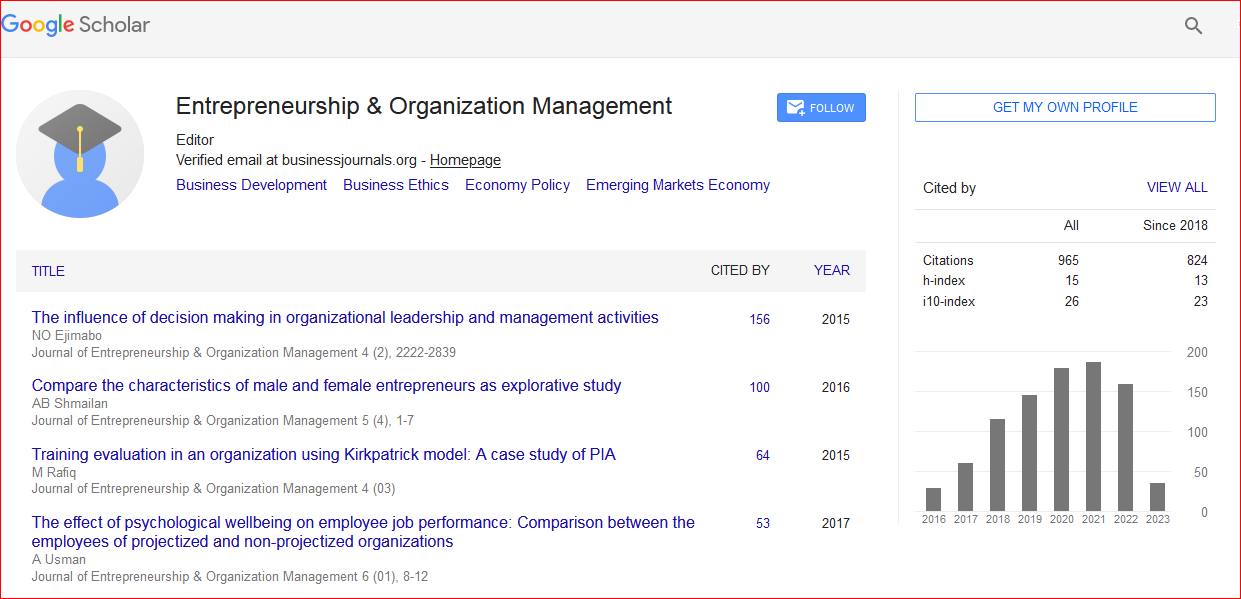
Entrepreneurship & Organization Management received 1115 citations as per Google Scholar report