Brief Report - (2025) Volume 16, Issue 4
Received: 01-Jul-2025, Manuscript No. jpm-26-179423;
Editor assigned: 03-Jul-2025, Pre QC No. P-179423;
Reviewed: 17-Jul-2025, QC No. Q-179423;
Revised: 22-Jul-2025, Manuscript No. R-179423;
Published:
29-Jul-2025
, DOI: 10.37421/2090-0902.2025.16.541
Citation: Natarajan, Priya. ”Functional Analysis for Quantum Mechanics.” J Phys Math 16 (2025):541.
Copyright: © 2025 Natarajan P. This is an open-access article distributed under the terms of the Creative Commons Attribution License, which permits unrestricted use, distribution and reproduction in any medium, provided the original author and source are credited.
The rigorous formulation of quantum mechanics is fundamentally underpinned by methods from functional analysis, particularly the theories of Hilbert spaces and operators. These mathematical constructs provide the essential framework for representing quantum states as vectors within Hilbert spaces and observable quantities as self-adjoint operators. The Schrödinger equation, which governs the time evolution of quantum systems, finds a natural and elegant expression within this framework, enabling the analysis of dynamics through unitary operators [1].
Spectral theory, a key component of functional analysis, plays a crucial role in quantum mechanics by allowing for the detailed study of self-adjoint operators. The eigenvalues and eigenvectors of these operators correspond to the possible outcomes of measurements and the states into which the system collapses, respectively. This spectral decomposition offers a profound insight into the probabilistic nature of quantum phenomena and the relationship between mathematical formalism and experimental observation [2].
Beyond Hilbert spaces, C*-algebras offer an abstract and powerful approach to the algebraic formulation of quantum mechanics. This framework provides a unified perspective for describing physical systems, encompassing quantum statistical mechanics and quantum field theory. The algebraic structure elegantly encodes concepts such as states, observables, and time evolution, proving particularly advantageous for systems with infinite degrees of freedom [3].
The dynamics of quantum systems are extensively investigated through time-dependent perturbation theory, a direct application derived from functional analysis. This methodology details how quantum states evolve under the influence of time-varying Hamiltonians, providing formulas for transition probabilities and elucidating phenomena like atomic transitions induced by electromagnetic fields, all rooted in the properties of unitary evolution operators [4].
Furthermore, the application of Fredholm operators and index theory within functional analysis has opened avenues for exploring topological phases of matter in quantum mechanics. The Fredholm index serves as a topological invariant, robust against perturbations, which is critical for understanding effects such as the quantum Hall effect and relies on the rigorous mathematical tools provided by functional analysis for its computation [5].
The spectral theorem for self-adjoint operators is a cornerstone for understanding quantum measurement. It facilitates a probabilistic interpretation of measurement outcomes by associating a spectral family with an observable operator, detailing how a quantum state collapses into an eigenstate upon measurement, a concept deeply embedded in the mathematical structure of Hilbert spaces [6].
Distribution theory, a sophisticated branch of functional analysis, provides a rigorous foundation for defining quantum mechanical operators and wave functions. This theory addresses the challenges posed by generalized functions, such as the Dirac delta function, which frequently appear in quantum mechanics, ensuring a consistent and robust mathematical framework for analysis [7].
The properties of bounded linear operators on Hilbert spaces are fundamental to representing physical observables with finite expectation values in quantum mechanics. Understanding these properties is crucial for analyzing the stability and predictability of quantum systems, with numerous examples drawn from standard quantum mechanical models illustrating their significance [8].
In contrast, unbounded operators, such as those representing position and momentum, present unique technical challenges in quantum mechanics. Their rigorous treatment within the Hilbert space framework, including their dense domains and spectral properties of their closures, is essential for a comprehensive understanding of quantum dynamics [9].
Finally, Hilbert space projections play a critical role in quantum mechanics, particularly in state preparation and measurement. Orthogonal projections enable the description of selecting specific quantum states and are foundational in quantum information and computation for understanding qubits and quantum gates, highlighting the pervasive utility of functional analysis in modern quantum physics [10].
Functional analysis provides the bedrock for the precise mathematical formulation of quantum mechanics, with Hilbert spaces and operator theory standing as its principal pillars. Quantum states are abstractly represented as vectors within Hilbert spaces, while observable physical quantities are mapped to self-adjoint operators. The central equation governing quantum dynamics, the Schrödinger equation, is elegantly expressed and analyzed within this structure, facilitating the understanding of time evolution through unitary operators [1].
Spectral theory, a key branch of functional analysis, is indispensable for comprehending quantum systems. It allows for the spectral decomposition of self-adjoint operators, which fundamentally clarifies the nature of observable quantities and their potential measurement results in quantum mechanics. This theoretical framework, exemplified by analyses of simple quantum systems, underscores the mathematical rigor functional analysis imparts to quantum theory, meticulously examining the interplay between eigenvalues, eigenvectors, and the probabilistic interpretation of quantum states [2].
The algebraic formulation of quantum mechanics is significantly advanced by the use of C*-algebras. These algebras establish an abstract and powerful framework for characterizing physical systems, particularly relevant in quantum statistical mechanics and quantum field theory. Within this algebraic structure, states, observables, and temporal evolution are concisely encoded, offering distinct advantages when dealing with systems possessing infinite degrees of freedom and unifying classical and quantum mechanical perspectives [3].
Time-dependent perturbation theory, a direct outgrowth of functional analysis, is a vital tool for investigating the dynamics of quantum systems. This methodology details how the states of quantum systems evolve when subjected to time-varying Hamiltonians, providing crucial formulas for transition probabilities. It elucidates phenomena such as atomic transitions driven by electromagnetic fields, built upon the foundational properties of unitary evolution operators [4].
Fredholm operators and index theory from functional analysis are instrumental in understanding topological phases of matter within quantum mechanics. The Fredholm index acts as a topological invariant, resilient to minor perturbations, which is fundamental for characterizing phenomena like the quantum Hall effect. The rigorous computation of these indices is made possible by the sophisticated mathematical apparatus of functional analysis [5].
The spectral theorem, applied to self-adjoint operators, is paramount in the study of quantum measurement. The spectral family associated with an observable operator provides the mathematical basis for the probabilistic interpretation of measurement outcomes, explaining how quantum states collapse into eigenstates upon measurement, a process deeply rooted in the structure of Hilbert spaces [6].
Distribution theory, a specialized area of functional analysis, is crucial for the rigorous definition of quantum mechanical operators and wave functions. It offers a consistent mathematical approach to handling generalized functions, such as the Dirac delta function, which commonly arise in quantum mechanics, thereby enabling more robust analyses of quantum phenomena [7].
Bounded linear operators and their associated properties are essential in quantum mechanics for representing physical observables that yield finite expectation values. The examination of these properties sheds light on the stability and predictability of quantum systems, with numerous examples drawn from standard quantum mechanical models illustrating their practical importance [8].
Conversely, unbounded operators, particularly those describing position and momentum, introduce specific technical complexities in quantum mechanics. Their rigorous treatment, including considerations of their dense domains and the spectral properties of their closures within the Hilbert space framework, is vital for a complete theoretical understanding of quantum dynamics [9].
Orthogonal projections within Hilbert spaces play a significant role in quantum mechanics, especially concerning the preparation and measurement of quantum states. These projections are instrumental in defining processes for selecting specific quantum states and form the basis for understanding qubits and quantum gates in quantum information and computation [10].
This collection of research explores the profound integration of functional analysis with quantum mechanics. It highlights how Hilbert spaces and operator theory provide the mathematical foundation for representing quantum states and observables, with the Schrödinger equation naturally arising within this framework. Spectral theory, C*-algebras, perturbation theory, and Fredholm operators are presented as crucial tools for understanding quantum dynamics, measurement, and phenomena like topological phases. The use of distribution theory, bounded and unbounded operators, and Hilbert space projections further demonstrates the power of functional analysis in providing rigorous mathematical descriptions for various aspects of quantum theory, from fundamental principles to advanced applications in quantum information and condensed matter physics.
None
None
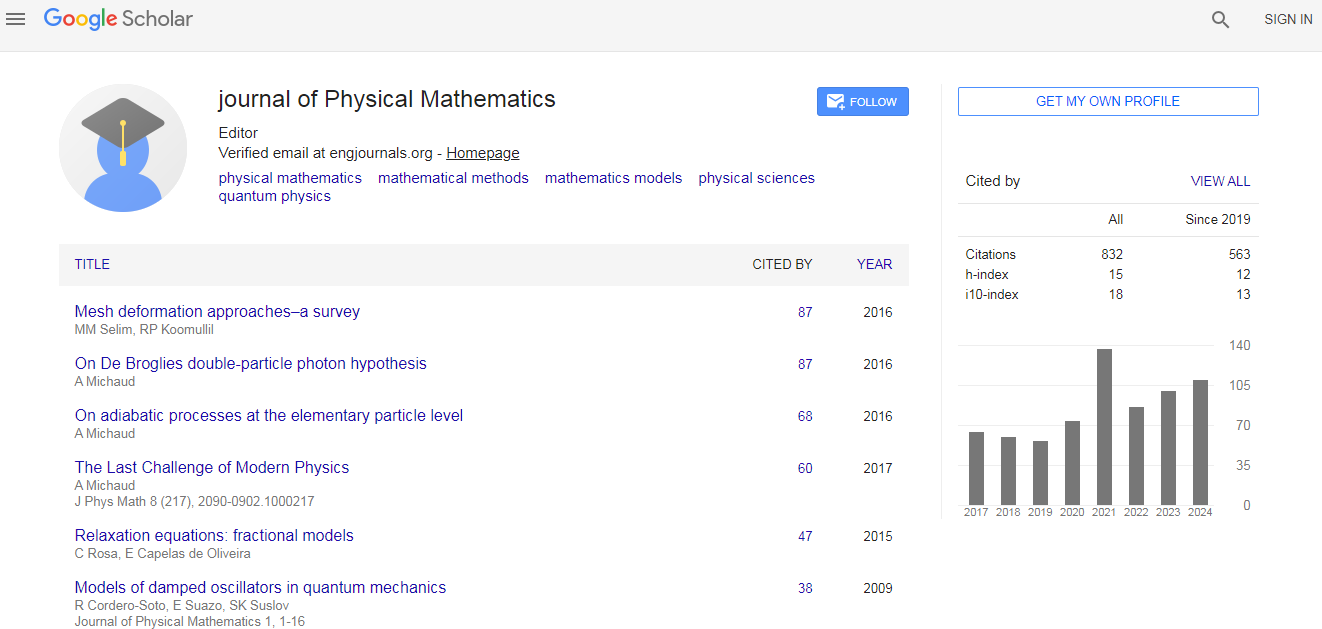
Physical Mathematics received 686 citations as per Google Scholar report