Opinion - (2025) Volume 10, Issue 1
Received: 01-Feb-2025, Manuscript No. arwm-25-165528;
Editor assigned: 03-Feb-2025, Pre QC No. P-165528;
Reviewed: 14-Feb-2025, QC No. Q-165528;
Revised: 19-Feb-2025, Manuscript No. R-165528;
Published:
26-Feb-2025
, DOI: 10.37421/2475-7675.2025.10.381
Citation: Thanh, Qdais. “From Prevention to Disposal: Navigating the Waste Hierarchy.’’ Adv Recycling Waste Manag 10 (2025): 381.
Copyright: © 2025 Thanh Q. This is an open-access article distributed under the terms of the Creative Commons Attribution License, which permits unrestricted use, distribution and reproduction in any medium, provided the original author and source are credited.
The issue of waste management is one that touches all aspects of modern life. As society continues to advance, so too does the volume of waste produced, and with it, the pressing need to address how this waste is handled. The waste hierarchy is a framework that prioritizes waste management strategies, starting with prevention at the top and moving through to disposal at the bottom. Understanding this hierarchy is crucial for both individuals and industries as it provides a clear and organized method to manage waste in an environmentally responsible manner. In essence, the hierarchy reflects the most desirable options for waste management, where minimizing harm to the environment and human health is the ultimate goal.
At the top of the waste hierarchy is prevention. This is the ideal solution to the waste problem: avoiding waste before it is created. Prevention requires a fundamental shift in how goods are produced and consumed. It involves designing products with longer lifespans, reducing packaging, and adopting practices that minimize resource use. Prevention can also take the form of changing consumer behavior, encouraging people to buy only what they need, to choose reusable products over single-use ones, and to think critically about the lifecycle of the items they purchase. Governments and corporations have a significant role to play here by incentivizing practices that reduce waste generation, such as offering tax breaks for companies that implement sustainable production methods or creating regulations that limit the use of hazardous materials [1].
Following prevention, the next level in the hierarchy is reuse. This strategy focuses on extending the life of products and materials through their reuse. Reusing products or components can drastically reduce the need for new resources and, as a result, lessen the overall environmental impact of waste. The reuse process can take many forms, from donating second-hand goods to repurposing materials for new uses. For instance, glass bottles can be cleaned and refilled, textiles can be turned into new clothing items, and old electronics can be refurbished for resale [2]. Reuse is not only beneficial from an environmental standpoint, but it also offers economic advantages, as it reduces the need for costly raw materials and energy required to create new products. Moreover, fostering a culture of reuse can help build a circular economy, where materials are kept in use for as long as possible, thus reducing the overall demand for virgin resources [3].
Next in the hierarchy is recycling, which involves the processing of used materials to create new products. Recycling is an essential part of waste management as it reduces the amount of waste sent to landfills and conserves natural resources. Materials such as paper, plastic, metal, and glass can be recycled into new items, thus avoiding the need to extract and process raw materials. However, the effectiveness of recycling depends largely on the material and the infrastructure in place for collecting and processing it. For example, recycling plastic can be complex due to the various types of plastic and the difficulty in separating them, while recycling metals and glass is often more straightforward [4]. Another consideration in recycling is the quality of the recycled material, as some items can only be recycled a limited number of times before the material degrades. Despite these challenges, recycling remains a key pillar of modern waste management strategies, and significant progress is being made to improve recycling technologies and systems worldwide.
Once prevention, reuse, and recycling have been exhausted, the next step in the waste hierarchy is recovery. Recovery refers to the process of converting waste into energy or other forms of useful output, such as compost. This can take many forms, including incineration with energy recovery, anaerobic digestion, or the conversion of waste to biofuels. Recovery technologies have advanced in recent years, allowing waste to be processed in ways that generate energy, thus reducing the reliance on fossil fuels. Waste-to-energy facilities, for example, can burn non-recyclable waste to produce electricity or heat [5]. While recovery can offer environmental benefits by reducing landfill use and generating useful energy, it is generally considered less desirable than the previous stages in the waste hierarchy, as it still involves the incineration or processing of waste that could otherwise be prevented, reused, or recycled.
Finally, at the bottom of the hierarchy is disposal. This is the least preferred option and should only be used when no other alternatives are available. Disposal generally involves sending waste to a landfill or incinerating it without energy recovery. Landfills, in particular, have significant environmental impacts, including the potential for leachate to contaminate groundwater, the emission of methane (a potent greenhouse gas), and the occupation of valuable land space. While disposal is inevitable in some cases, its role should be minimized as much as possible through the application of the previous waste management strategies. Governments and industries can reduce the reliance on disposal by developing more efficient systems for waste collection, increasing public awareness about waste reduction, and improving recycling and recovery technologies.
The waste hierarchy is not a rigid rulebook but rather a flexible framework that encourages continual improvement. The goal is to move toward more sustainable and efficient waste management systems, with a focus on reducing the overall volume of waste generated and maximizing the value extracted from the materials that do exist. The hierarchy is an evolving concept, with new technologies and methods emerging regularly that may change the way we approach waste. For example, advancements in waste sorting technologies, such as artificial intelligence and machine learning, are helping to increase the efficiency of recycling programs and reduce contamination rates. Similarly, the rise of biodegradable materials offers new possibilities for reducing the environmental impact of waste.
Google Scholar Cross Ref Indexed at
Google Scholar Cross Ref Indexed at
Google Scholar Cross Ref Indexed at
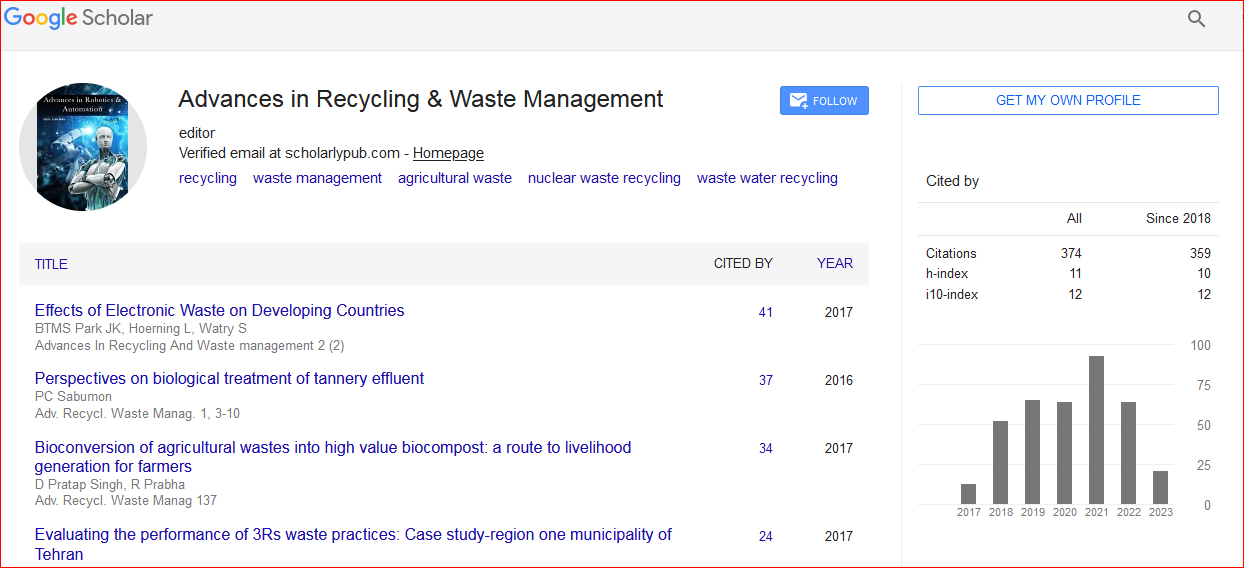
Advances in Recycling & Waste Management received 438 citations as per Google Scholar report