Perspective - (2025) Volume 9, Issue 5
Received: 02-Sep-2025, Manuscript No. fsb-26-189966;
Editor assigned: 04-Sep-2025, Pre QC No. P-189966;
, QC No. Q-189966;
, Manuscript No. R-189966;
, DOI: 10.37421/2577-0543.2025.9.252
Citation: Tanaka, Hiroshi. ”Formulating Biologics and Biosimilars: Efficacy, Stability, and Delivery.” J. Formul. Sci. Bioavailability 09 (2025):252.
Copyright: © 2025 Tanaka H. This is an open-access article distributed under the terms of the Creative Commons Attribution License, which permits unrestricted use, distribution and reproduction in any medium, provided the original author and source are credited.
Developing robust formulations for biologics and biosimilars is a critical endeavor, ensuring that these complex therapeutic proteins maintain their efficacy and stability throughout their intended shelf life. This requires a deep understanding of the unique physicochemical properties inherent to protein-based drugs and the meticulous design of sophisticated delivery systems. The primary objective is to preserve the structural integrity and bioavailability of these valuable therapeutic agents, thereby maximizing their therapeutic potential for patients. Key considerations in this intricate process include the judicious selection of excipients, the optimization of manufacturing processes to avoid degradation or aggregation, and the rigorous analytical characterization necessary to demonstrate comparability with originator products, a cornerstone of biosimilar development [1].
The analytical comparability of biosimilar products to their reference biologics stands as a pivotal aspect of the overall formulation development strategy. The application of advanced analytical techniques is indispensable for comprehensively characterizing the critical quality attributes (CQAs) of these complex molecules. Methods such as mass spectrometry, various forms of chromatography, and sophisticated spectroscopic techniques are essential tools in demonstrating the structural and functional similarity between a biosimilar and its reference product. Ensuring that these CQAs are consistently maintained throughout the entire formulation and manufacturing lifecycle is a fundamental prerequisite for achieving regulatory approval, underscoring the importance of robust analytical strategies [2].
Excipients are indispensable components in the formulation of biologics, playing a crucial role in their stabilization and in preventing undesirable events such as aggregation, degradation, and the induction of immunogenicity. The careful selection of appropriate excipients, which may include buffers to control pH, stabilizers to protect against denaturation, surfactants to prevent interfacial stress, and tonicity modifiers to ensure isotonicity, necessitates a profound understanding of the specific vulnerabilities of the biologic in question. Formulation scientists must diligently evaluate potential detrimental interactions that might occur between the biologic itself and the chosen excipients to ensure a stable and effective final product [3].
The development and implementation of novel drug delivery systems represent a significant advancement in the administration of biologics, transforming patient care and therapeutic outcomes. Such innovations include the creation of long-acting injectable formulations and sophisticated subcutaneous delivery systems. These advanced formulations are designed with the explicit goals of improving patient compliance, reducing the frequency of drug administration, and ultimately enhancing overall therapeutic effectiveness. Formulation science serves as the foundational discipline for overcoming the inherent challenges associated with the efficient and safe delivery of these large, complex biomolecules [4].
Manufacturing processes for biologics and biosimilars are intricately linked to the quality and stability of the final therapeutic product, and their impact cannot be overstated. This encompasses a range of critical steps, including downstream processing for purification and sterile filtration, which can significantly influence product characteristics. Formulation development must intrinsically consider these manufacturing constraints to ensure that the intended formulation can be reproducibly manufactured at a commercial scale while rigorously maintaining all critical quality attributes. This integrated approach is vital for consistent product quality and patient safety [5].
The immunogenicity of biologics and biosimilars represents a significant concern within the pharmaceutical industry, as it can profoundly impact both patient safety and therapeutic efficacy. Formulation design emerges as a key strategy in the effort to minimize the potential for eliciting adverse immune responses. Employing strategies such as optimizing the protein's native conformation, actively reducing the propensity for aggregation, and judiciously selecting appropriate excipients can collectively contribute to mitigating the risks associated with immunogenicity, thereby enhancing the overall therapeutic profile of the drug [6].
For biosimilar development, the demonstration of both analytical and clinical similarity to the approved reference product is an absolute requirement for regulatory approval. Formulation development plays a substantial and integral role in achieving this objective. By ensuring that the biosimilar product exhibits comparable physicochemical properties, exhibits similar stability profiles under various conditions, and demonstrates equivalent pharmacokinetic and pharmacodynamic (PK/PD) characteristics, formulation scientists contribute directly to establishing the necessary evidence for biosimilarity, paving the way for its market entry [7].
Stability studies constitute a fundamental pillar in the comprehensive formulation development process for both biologics and biosimilars. These studies are meticulously designed to assess the performance and integrity of the formulation under a variety of simulated storage conditions, including variations in temperature, humidity, and exposure to light, over extended periods. Identifying the specific degradation pathways that may affect the drug product and subsequently implementing effective strategies to mitigate these degradation mechanisms are crucial steps in establishing a reliable shelf-life and guaranteeing the consistent quality of the product [8].
The strategic transition from liquid formulations to lyophilized (freeze-dried) formulations is a widely adopted approach to significantly enhance the long-term stability of sensitive biologics. The process of lyophilization involves the careful removal of water through sublimation, a method that provides a protective environment for proteins, thereby shielding them from various degradation pathways. Developing an optimized and effective lyophilization cycle requires meticulous attention to the formulation components and precise control over the processing parameters to achieve the desired stability [9].
Regulatory expectations for the development and approval of biologics and biosimilars are continually becoming more stringent, demanding a high level of scientific rigor and comprehensive documentation. Formulation development must therefore operate in strict alignment with these evolving regulatory guidelines. This necessitates a strong focus on robust product characterization, meticulous comparability studies to demonstrate similarity to reference products, and the proven consistency of manufacturing processes. A thorough understanding of the complex regulatory landscape is therefore as vital to the success of formulation development as a deep understanding of the underlying scientific principles [10].
The development of robust formulations for biologics and biosimilars is paramount for ensuring therapeutic efficacy and stability. This involves understanding the unique physicochemical properties of protein-based drugs and designing delivery systems that maintain their structural integrity and bioavailability. Key considerations include excipient selection, manufacturing processes, and analytical characterization to demonstrate comparability with originator products [1].
The analytical comparability of biosimilars to their reference biologics is a critical aspect of formulation development. Advanced analytical techniques, including mass spectrometry, chromatography, and spectroscopic methods, are essential for characterizing critical quality attributes (CQAs) and demonstrating similarity. Ensuring these CQAs are maintained throughout the formulation and manufacturing process is key to regulatory approval [2].
Excipients play a crucial role in stabilizing biologics and preventing aggregation, degradation, and immunogenicity. The selection of appropriate excipients, such as buffers, stabilizers, surfactants, and tonicity modifiers, requires a deep understanding of the biologic's specific vulnerabilities. Formulation scientists must carefully evaluate potential interactions between the biologic and excipients [3].
The development of novel drug delivery systems, such as long-acting injectables and subcutaneous formulations, is transforming the administration of biologics. These advanced formulations aim to improve patient compliance, reduce dosing frequency, and enhance therapeutic outcomes. Formulation science is central to overcoming the challenges associated with delivering these large molecules effectively [4].
Manufacturing processes for biologics and biosimilars, including downstream processing and sterile filtration, can significantly impact the final product's quality and stability. Formulation development must consider these manufacturing constraints to ensure that the intended formulation can be produced reproducibly and at scale while maintaining critical quality attributes [5].
The immunogenicity of biologics and biosimilars is a major concern that can impact safety and efficacy. Formulation design plays a critical role in minimizing the potential for immune responses. Strategies such as optimizing protein conformation, reducing aggregation, and selecting appropriate excipients can help mitigate immunogenicity risks [6].
For biosimilar development, demonstrating analytical and clinical similarity to the reference product is essential. Formulation development contributes significantly to this by ensuring that the biosimilar product possesses comparable physicochemical properties, stability profiles, and pharmacokinetic/pharmacodynamic (PK/PD) characteristics [7].
Stability studies are a cornerstone of formulation development for biologics and biosimilars. These studies assess how the formulation performs under various storage conditions (temperature, humidity, light) over time. Identifying degradation pathways and implementing strategies to mitigate them are crucial for establishing shelf-life and ensuring product quality [8].
The transition from liquid to lyophilized (freeze-dried) formulations is often employed to enhance the long-term stability of biologics. Lyophilization involves removing water through sublimation, which can protect sensitive proteins from degradation. Developing an effective lyophilization cycle requires careful optimization of formulation components and processing parameters [9].
Regulatory expectations for biologics and biosimilars are increasingly stringent. Formulation development must align with these guidelines, focusing on robust characterization, comparability studies, and proven manufacturing consistency. Understanding the regulatory landscape is as vital as understanding the science of formulation [10].
Formulation development for biologics and biosimilars is crucial for therapeutic efficacy and stability, requiring an understanding of protein properties and delivery systems. Key aspects include excipient selection, manufacturing considerations, and analytical characterization for comparability. Advanced analytical techniques are essential for demonstrating biosimilarity by characterizing critical quality attributes. Excipients play a vital role in stabilizing proteins and preventing immunogenicity, necessitating careful selection and evaluation of interactions. Novel drug delivery systems are transforming biologic administration by improving patient compliance and therapeutic outcomes. Manufacturing processes significantly impact product quality and stability, requiring formulation development to consider these constraints. Minimizing immunogenicity is a major concern addressed through formulation design strategies. Demonstrating analytical and clinical similarity is essential for biosimilar approval, with formulation contributing to comparable characteristics. Stability studies are fundamental for assessing performance under various conditions and establishing shelf-life. Lyophilization is a key strategy for enhancing long-term stability by protecting sensitive proteins. Stringent regulatory expectations necessitate alignment of formulation development with guidelines, emphasizing characterization, comparability, and manufacturing consistency.
None
None
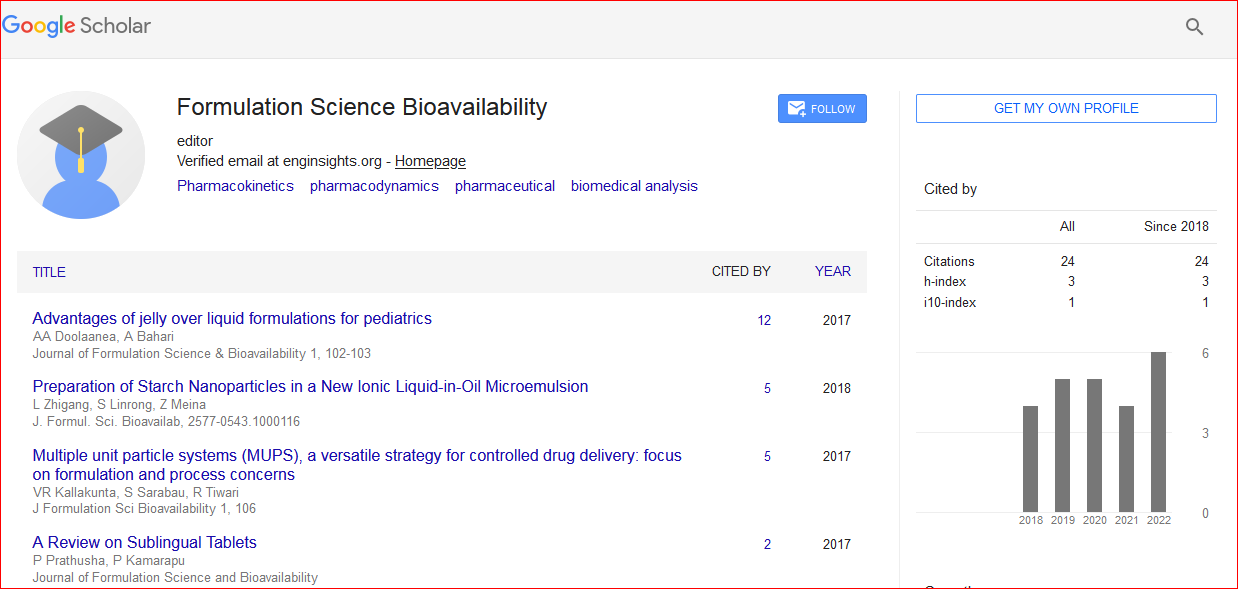
Journal of Formulation Science & Bioavailability received 23 citations as per Google Scholar report