Short Communication - (2025) Volume 16, Issue 2
Received: 01-Apr-2025, Manuscript No. jfr-26-184097;
Editor assigned: 03-Apr-2025, Pre QC No. P-184097;
Reviewed: 17-Apr-2025, QC No. Q-184097;
Revised: 22-Apr-2025, Manuscript No. R-184097;
Published:
29-Apr-2025
, DOI: 10.37421/2157-7145.2025.16.658
Citation: Carter, Emily. ”Forensic Odontology: Identifying Disaster Victims Through Dental Records.” J Forensic Res 16 (2025):658.
Copyright: © 2025 Carter E. This is an open-access article distributed under the terms of the Creative Commons Attribution License, which permits unrestricted use, distribution
and reproduction in any medium, provided the original author and source are credited.
Forensic odontology is a critical discipline within the broader field of forensic science, playing a vital role in the identification of deceased individuals, particularly in situations involving mass disasters or challenging postmortem conditions. This specialized branch of dentistry applies dental knowledge to criminal and civil investigations, with a significant emphasis on establishing identity through the unique characteristics of a person's dentition and dental work. The inherent variability found in tooth morphology, alignment, and the presence of restorative or prosthetic treatments makes dental records an exceptionally reliable source for positive identification, often proving indispensable when other methods are compromised by decomposition, dismemberment, or severe thermal damage [1].
The reliance on forensic odontology in mass disaster victim identification underscores its importance as a cornerstone of a multidisciplinary approach. Effective identification strategies in such catastrophic events demand robust protocols for the systematic collection and meticulous processing of dental evidence. This process necessitates strong inter-agency cooperation and the adoption of standardized methodologies to ensure both efficiency and accuracy in identifying victims, thereby facilitating closure for grieving families and aiding in legal and humanitarian efforts [2].
The intrinsic nature of dental anatomy, characterized by its uniqueness and the enduring nature of dental restorations, renders it an ideal subject for identification purposes. Ongoing advancements in forensic odontology continue to refine techniques and address emerging challenges in disaster victim identification. This includes the integration of sophisticated imaging technologies and digital comparison methods, which are instrumental in overcoming the difficulties presented by degraded or fragmented remains, further enhancing the precision of identification [3].
The interpersonal variability inherent in dental characteristics, when coupled with the detailed and comprehensive nature of dental records, provides a robust foundation for achieving positive identification in mass fatality incidents. Studies consistently examine the reliability and accuracy of these dental identification methods, critically emphasizing the paramount importance of thorough documentation and the strict adherence to standardized comparison protocols to prevent misidentifications [4].
Furthermore, the application of DNA analysis in conjunction with forensic odontology significantly bolsters the accuracy and reliability of disaster victim identification. While dental evidence offers a unique biometric fingerprint, DNA analysis can serve as a powerful tool for confirming identity, especially in those challenging cases where dental records may be limited, incomplete, or severely compromised. This highlights the synergistic potential of these complementary disciplines [5].
Effective disaster victim identification intrinsically requires a systematic, organized, and well-coordinated approach, with forensic odontology serving as a critical and indispensable component. Research outlines the systematic process involved in dental evidence collection, analysis, and comparison during mass casualty events, underscoring the necessity of experienced personnel and standardized procedures for achieving successful and definitive identifications [6].
The role of forensic dentists extends beyond mere identification to encompass the crucial tasks of collecting and meticulously preserving dental evidence at disaster scenes. This involves detailing the practical aspects of effective scene management specifically for dental evidence, emphasizing the absolute importance of meticulous documentation, maintaining an unbroken chain of custody, and employing proper handling techniques to safeguard the integrity of this vital identification data [10].
In instances of mass disasters, cadaver identification frequently involves dealing with significant postmortem changes that can substantially complicate dental analysis. This area of study focuses on the specific challenges posed by severe thermal injuries and advanced decomposition on dental evidence. It also explores the adaptation and development of specialized techniques designed to overcome these formidable hurdles encountered in forensic odontology [8].
The development and widespread implementation of standardized protocols for disaster victim identification are absolutely paramount for ensuring both efficiency and accuracy in the process. Comprehensive reviews discuss the critical elements that constitute a thorough disaster victim identification plan, with a particular and significant emphasis placed on the seamless integration of forensic odontology within the broader, overarching identification framework [9].
Finally, the role of the forensic odontologist also extends into providing expert opinion and critical testimony within legal proceedings that follow disaster victim identification. This aspect involves discussing the numerous challenges and complex ethical considerations that forensic odontologists face when presenting their findings, thereby ensuring the integrity of the entire identification process and its subsequent acceptance within judicial contexts [7].
Forensic odontology serves as a pivotal discipline in the identification of disaster victims, especially when conventional methods are rendered ineffective due to severe decomposition, dismemberment, or extensive thermal damage. Dental records, encompassing radiographs, charts, and antemortem dental photographs, function as unique identifiers due to the inherent variability in dentition and restorative treatments. The identification process involves a meticulous comparison between postmortem dental findings and antemortem records, establishing a positive identification based on concordant details [1].
Mass disaster victim identification is heavily contingent on a multidisciplinary approach, with forensic odontology playing a foundational role. This involves emphasizing the importance of establishing robust protocols for the collection and processing of dental evidence from disaster sites. The process also highlights the critical need for inter-agency cooperation and the adoption of standardized methodologies to guarantee efficient and accurate victim identifications [2].
The distinctive characteristics of dental anatomy and the enduring nature of dental restorations make them exceptionally suitable for identification purposes. This field continuously reviews the latest techniques and addresses the challenges encountered in forensic odontology for disaster victim identification. It includes the utilization of advanced imaging and digital comparison methods to overcome difficulties presented by degraded remains, thereby improving identification accuracy [3].
Interpersonal variability in dental characteristics, combined with the detailed nature of dental records, provides a strong basis for positive identification in mass fatality incidents. The reliability and accuracy of dental identification methods are consistently examined, with a particular emphasis placed on the critical importance of thorough documentation and standardized comparison protocols to ensure definitive identification [4].
The integration of DNA analysis alongside forensic odontology significantly enhances the accuracy and reliability of disaster victim identification. While dental evidence provides a unique identifier, DNA analysis can definitively confirm identity, particularly in cases where dental records are limited or compromised. This synergistic approach leverages the strengths of both disciplines [5].
Effective disaster victim identification necessitates a systematic and organized approach, wherein forensic odontology is a critical component. The systematic process of dental evidence collection, analysis, and comparison in mass casualty events is outlined, emphasizing the importance of experienced personnel and standardized procedures for successful identifications [6].
The role of the forensic odontologist extends beyond identification to include the crucial tasks of collecting and preserving dental evidence at disaster scenes. This involves detailing the practical aspects of scene management for dental evidence, stressing the importance of meticulous documentation, maintaining the chain of custody, and proper handling to preserve the integrity of critical identification data [10].
Cadaver identification following mass disasters often involves significant postmortem changes that can complicate dental analysis. This area focuses on the specific challenges posed by thermal injuries and decomposition on dental evidence. It also explores adapted techniques designed to overcome these obstacles encountered in forensic odontology [8].
The development and implementation of standardized protocols for disaster victim identification are vital for ensuring efficiency and accuracy. This review article discusses the essential elements of a comprehensive disaster victim identification plan, with a particular focus on the integration of forensic odontology within the broader identification framework [9].
Moreover, the role of the forensic odontologist encompasses providing expert opinion and testimony in legal proceedings following disaster victim identification. This involves discussing the challenges and ethical considerations faced by forensic odontologists in presenting their findings, ensuring the integrity of the identification process and its acceptance in judicial contexts [7].
Forensic odontology is crucial for identifying disaster victims, especially when conventional methods fail due to decomposition or damage. Dental records are unique identifiers, and their comparison with postmortem findings establishes identity. A multidisciplinary approach, robust protocols, and standardized methodologies are essential for mass disaster victim identification. Advances in imaging and digital comparison aid in identifying victims with degraded remains. DNA analysis complements dental evidence, enhancing accuracy. The process requires systematic collection, analysis, and preservation of dental evidence, emphasizing meticulous documentation and chain of custody. Challenges like thermal injuries and decomposition necessitate adapted techniques. Standardization and expert testimony are also key aspects of this field.
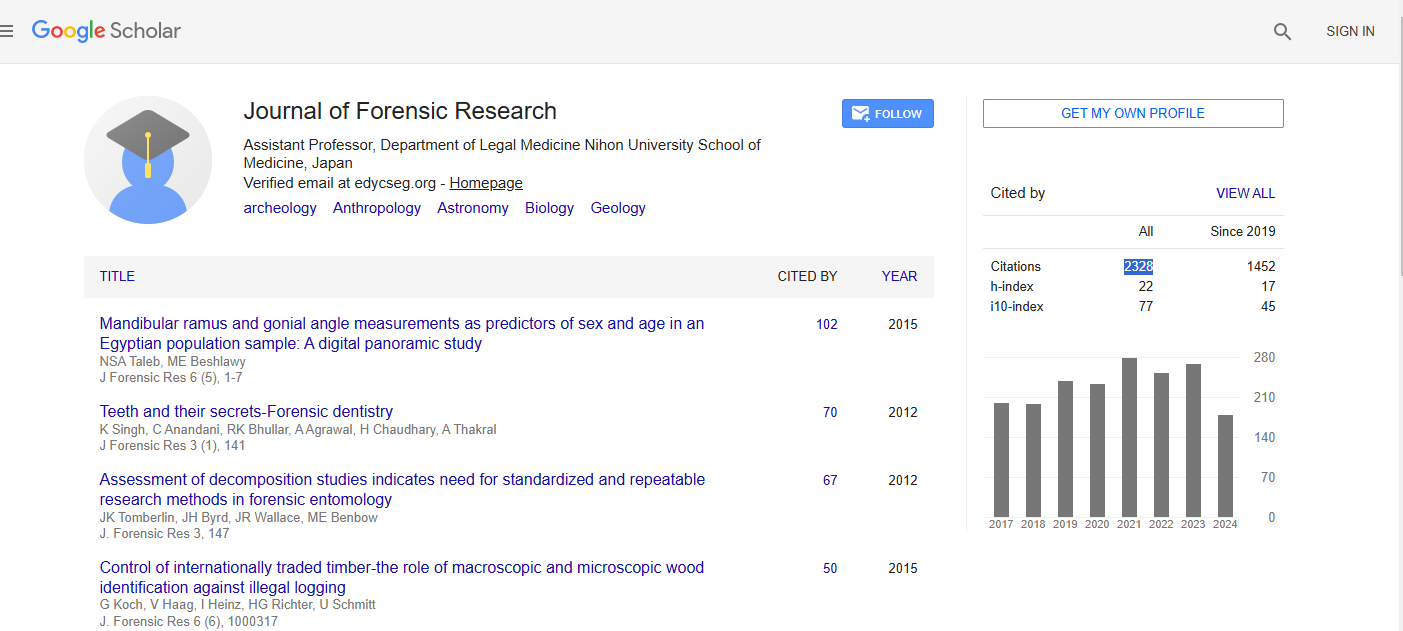
Journal of Forensic Research received 2328 citations as per Google Scholar report